
 Worksheets
Computer networks
Total questions: 237
Worksheet time: 2hrs 59mins
The main high-bandwidth connectivity methods used by medium and large enterprises:
T1
PointToPoint
bus
DSL
cable modem
The main high-bandwidth connectivity methods used by medium and large enterprises
T3
PointToPoint
bus
DSL
cable modem
Using the ping command, you can determine:
number of routers between source and destination devices
default gateway address
the average time it takes for a packet to reach its destination and for the response to return to its origin
IP address of the router closest to the end device
the average time each router takes to respond between source and destination devices
Command Line Utilities for Diagnosing Problems at Layer 3
CLI
ping
DNS
packet sniffer
Telnet
Command Line Utilities for Diagnosing Problems at Layer 3
packet sniffer
DHCP
DNS
ipconfig
Telnet
Command Line Utilities for Diagnosing Problems at Layer 3
Telnet
packet sniffer
GUI
TeraTerm
ping
Physical layer functions of the OSI model
signal generation
data sharing
adding a hardware address
data encapsulation in frames
packet routing
Physical layer functions of the OSI model
data encapsulation in frames
signal generation
data sharing
adding a hardware address
packet routing
What is included in a logical topology map?
location of the wiring closet and access point
wireless signal coverage area
network data path
physical location of intermediate devices
location of cable lines
What is included in a logical topology map?
location of the wiring closet and access point
wireless signal coverage area
location of cable lines
device names and Layer 3 addressing information
physical location of intermediate devices
A type of network topology that allows you to see which end devices are connected to which intermediate devices and which media is being used:
star
ring
bus
physical
logical
By placing network equipment in the telecommunications bay, rather than at the user's workplace, the following advantages can be achieved:
enhanced physical security
centralized node management
higher transmission speed
greater resistance against hacking attempts
less electricity consumption.
A common name for all computers connected to a network that are directly involved in network communication:
server
host
intermediate device
router
client
Carriers that are used in the transmission of data by light pulses
twisted pair
coaxial cable
copper cable
wireless connection
Classful IP addresses describe the following statements:
3 out of 5 address classes are reserved for multicast and experimental use.
Reading the first bit allows you to determine the class to which the address belongs.
Only class A addresses have high bits of 100.
The number of bits used to identify nodes depends on the class of the network.
The host portion of a class C address can be up to 24 bits.
Classful IP addresses describe the following statements:
3 out of 5 address classes are reserved for multicast and experimental use.
The host portion of a class C address can be up to 24 bits.
Only class A addresses have high bits of 100.
Reading the first bit allows you to determine the class to which the address belongs.
All subnets on a network have the same size..
Cisco Non-Volatile Memory (NVRAM):
used to store data in the absence of power
used to store the password encryption key.
used to store the routing table
contains the current configuration file
used to store the ARP table
User EXEC mode:
All aspects of the router configuration are available in this mode.
It is the default mode when you first start an unconfigured router..
All router commands are available.
The global configuration mode can be accessed using the enable command.
In this mode, you can configure the interfaces and protocols of the router.
A network attack that slows down or crashes hardware and software:
Zero Day or Zero Hour
Virus, worm or trojan virus
Denial of service attack.
Firewall
Spyware
A way to create a secure connection for remote workers
Zero Day or Zero Hour
Virus, worm or trojan virus
Denial of service attack.
Virtual Private Network (VPN)
Firewall
What is used to block unauthorized access to the network..
Zero Day or Zero Hour
Virus, worm or trojan virus
Denial of service attack
Virtual Private Network (VPN)
Firewall
A network attack that occurs on the first day a vulnerability is known
Virus, worm or trojan virus
Denial of service attack
Virtual Private Network (VPN)
Firewall
Zero Day or Zero Hour
Malicious code running on user devices
Virus, worm or trojan virus
Zero Day or Zero Hour
Firewall
Virtual Private Network (VPN)
Denial of service attack
A type of software installed on a computer that secretly collects information about websites visited by computer users.
Firewall
Zero Day or Zero Hour
Spyware
Virtual Private Network (VPN)
Denial of service attack.
A type of network that provides secure access to corporate systems for vendors, customers, and employees.
Extended network
Virtual Private Network (VPN)
Internet
Extranet
intranet
A network trend that allows users to access company network resources from their personal laptops and smartphones.
intranet
VPN
Extranet
Cloud computing
BYOD
A network trend that allows users to access company network resources from their personal laptops and smartphones.
BYOD
Cloud computing
Extranet
VPN
intranet
ISP
a protocol that defines the method of interaction between computers on a local network.
An organization that provides an opportunity for individuals and businesses to connect to the Internet.
an organization that develops standards for cables and wires in networking.
a network device that combines the functionality of several different network devices into one.
A protocol that defines network security requirements.
A network characteristic that allows a network to rapidly expand to support new users and applications without compromising the efficiency of serving existing ones.
availability
quality of service
scalability
reliability
consistency
A device that performs the function of determining the path that messages should take through internetworks.
firewall
web serverv
router
DSL - modem
IPS
Command log functions
Save command lines in a log for future reference.
Save router settings.
Calling up to 15 command lines by default.
View a list of commands entered during the previous session.
Calling previously entered commands.
Modes and interfaces that can be password protected to restrict access to the Cisco IOS or its segments.
Virtual Terminals (VTY)
ip address configuration mode
user EXEC configuration save mode
Ethernet interface
user EXEC mode
Static routes describe
They are automatically updated when the interface is reconfigured or disabled.
They require manual reconfiguration to implement network changes.
They are defined in the routing table with the prefix C
They are created in interface customization mode.
They automatically become the default gateway on the router.
The local DNS server is responsible for the following tasks
dynamic IP address assignment
support for a large number of cached DNS records
converting names to IP addresses for internal hosts.
Internet service provider server support
forwarding all name conversion requests to root servers on the internet
OSI and TCP/IP models:
The TCP/IP model is a theoretical model, and the OSI model is based on real protocols.
The two lower layers of the TCP/IP model form the lower layer of the OSI model.
The TCP/IP model is based on eight layers, and the OSI model is based on four layers.
The OSI network layer is comparable to the Internet layer of the TCP/IP model.
The TCP/IP model defines protocols for connecting physical networks.
OSI and TCP/IP models:
The TCP/IP model is a theoretical model, and the OSI model is based on real protocols.
The two lower layers of the TCP/IP model form the lower layer of the OSI model.
The TCP/IP model is based on eight layers, and the OSI model is based on four layers.
The OSI network layer is comparable to the Internet layer of the TCP/IP model.
The TCP/IP model defines protocols for connecting physical networks.
OSI and TCP/IP models:
The TCP/IP model defines protocols for connecting physical networks.
The TCP/IP model is a theoretical model, and the OSI model is based on real protocols.
The two lower layers of the TCP/IP model form the lower layer of the OSI model.
The OSI session layer is comparable to the Internet layer of the TCP/IP model.
The TCP/IP model is based on four layers, and the OSI model is based on seven layers.
The package parameters will be the same for each session when a node interacts with multiple applications on the same server
IP address and MAC address
MAC address and session number
IP address and session number
IP address and port number
MAC address and port number
Network Reliability Characteristics
The higher the MTTR (Mean Time to Repair), the higher the reliability.
Redundant hardware provides increased reliability.
Reliability is measured by the number of applications used on the network.
Fault tolerance is a measure of reliability.
The ISP guarantees the same level of reliability to all subscribers.
Description of the FTP protocol
It uses the well-known port 23.
The FTP client starts the data transfer using the active connection.
The protocol interpreter performs the data transfer function.
The protocol requires two connections between the client and the server.
FTP servers open a well-known port on the client computer.
Default subnet mask for address 172.32.18.222
255.255.255.254
255.255.255.0
255.0.0.0
255.255.0.0
255.255.255.255
Default subnet mask for address 192.152.18.222
255.255.255.255
255.255.255.254
255.255.0.0
255.0.0.0
255.255.255.0
A class C network address can start with a high order binary number:
110
000
001
010
011
Subnet mask for network address 172.16.4.8/18
255.255.0.0
255.255.192.0
255.255.240.0
255.255.248.0
255.255.255.0
The number of IP addresses that can be assigned to end devices on a network with a subnet mask of 255.255.255.248.
30
126
6
254
510
For a subnet with at least 20 host addresses, use the subnet mask.
255.255.255.240
255.255.255.192
55.255.255.0
255.255.255.224
255.255.255.248
Feature that provides scalability of network devices
low cost
low maintenance requirements
simplicity of repair
fixed number of interfaces
modularity
Internet bandwidth speed units.
bits per second
bytes per second
Hertz
megabyte per second
packets per second
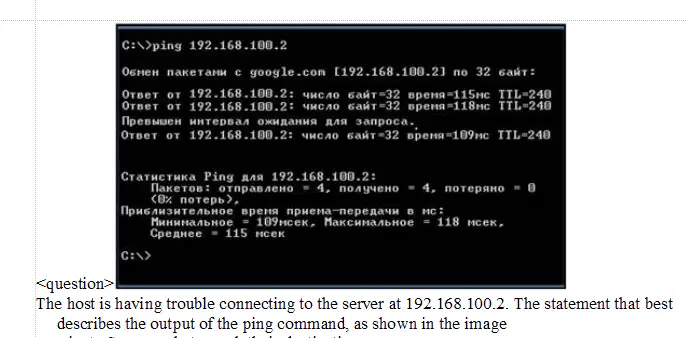
The server has no return path to the node.
Server is disabled.
Some packets reach their destination.
Two routers on the path are not responding to pings.
Echo request services are not supported on the destination.
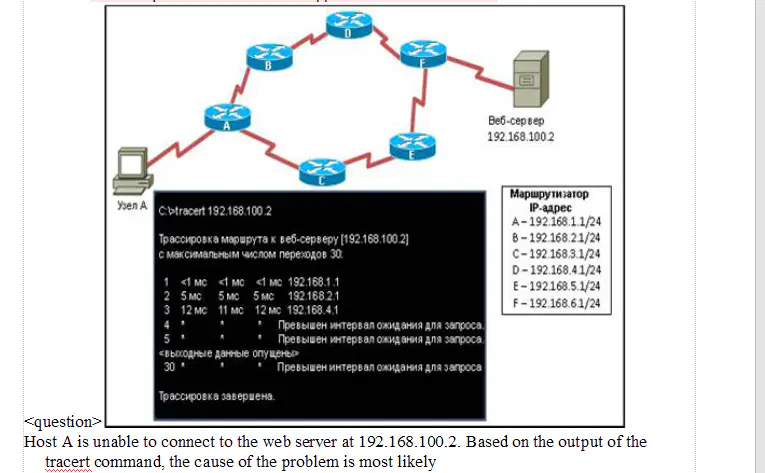
Router В
Router F
Router А
Router С
Router D
A network utility that helps determine the location of network problems and the routers through which the packet passes
netstat
ipconfing
ping
tracert
nslookup
Function of the transport layer of the OSI model
transferring data to the next device with a direct connection
formatting and encoding data for transmission
converting data into bits for transmission
routing data between networks
Ensuring reliable data transmission over the network using TCP
Level 1 issue causing loss of Internet connection
interruption of the network cable connection
invalid subnet mask
wrong default gateway
invalid MAC address
faulty printer cable
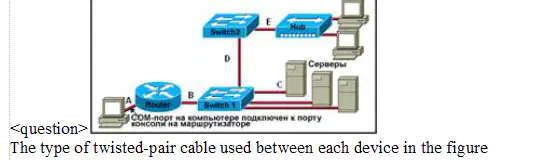
A= straight through, B= straight through, C= straight through, D= crossover, E= console
A= console, B= straight through, C= crossover, D= crossover, E= straight through
A= console, B=straight through, C= straight through, D=crossover, E= crossover
A= crossover, B= straight through, C= straight through, D= crossover, E= crossover
A= console, B= crossover, C= crossover, D= straight through, E= straight through
A= straight through, B= straight through, C= straight through, D= crossover, E= console
A= console, B= straight through, C= crossover, D= crossover, E= straight through
A= console, B=straight through, C= straight through, D=crossover, E= crossover
A= crossover, B= straight through, C= straight through, D= crossover, E= crossover
A= console, B= crossover, C= crossover, D= straight through, E= straight through
Meaning of the statement: “The goal of communication system availability is five-9k.”
The optimal time for network maintenance is from 17:00 to 09:00 five days a week.
The most critical time in terms of network availability is from 9:00 am to 5:00 pm five days a week.
Five percent of all network costs cover 99% of user requirements.
The network must be available 99.999% of the time.
An idle time of .00001% is invalid.
The total number of combinations of eight bits in an 8-bit binary number
1024
255
254
128
256
Convert decimal number 231 to its binary equivalent.
11100111
11110010
11011011
11110110
11100101
Given a class C IP address and a default subnet mask, select the number of usable ports?
255
254
256
510
512
Broadcast network address for class C address 192.168.32.0 with default subnet mask
192.168.0.255
192.168.0.0
192.168.32.255
192.168.32.0
192.168.32.254
Company XYZ uses the network address 192.168.4.0 and the mask 255.255.255.224 to create subnets. The maximum number of usable hosts per subnet is:
24
14
6
30
8
The maximum number of host addresses per network provided by the IPv4 class:
Class E
Class D
Class C
Class B
Class A
Which IPv4 class provides the largest number of networks?
Class C
Class A
Class B
Class D
Class E
The statement that provides a shared IP address
Shared addresses cannot be used on a private network.
Shared IP addresses must be unique throughout the Internet.
Shared addresses can only be duplicated on the local network.
Shared IP addresses should only be unique within the local network.
Network administrators are free to choose any public address to use on network devices that have access to the Internet.
The statement that provides a shared IP address
Shared addresses cannot be used on a private network.
Shared IP addresses must be unique throughout the Internet.
Shared addresses can only be duplicated on the local network.
Shared IP addresses should only be unique within the local network.
Network administrators are free to choose any public address to use on network devices that have access to the Internet.
Number of bits in an IPv6 address
94
64
128
192
256
Number of bits in an IPv6 address
94
64
128
192
256
Range of first octet in class B address
128 to 192
127 to 192
127 to 191
128 to 191
128 to 255
The range of IP addresses that can be assigned to hosts connected to the Fa0/0 interface of Router1 with IP address 192.168.1.65/27 to access external networks.
from 192.168.1.66 to 192.168.1.128
from 192.168.1.0 to 192.168.1.127
from 192.168.1.66 to 192.168.1.96
from 192.168.1.0 to 192.168.1.95
from 192.168.1.66 to 192.168.1.94
The network administrator uses a laptop to configure Switch X with a default gateway through the switch's console port. The VLAN 1 interface of the switch is assigned the IP address 192.168.5.68/26. To assign a default gateway to the switch, the administrator must run the command:
X(config)#ip default-gateway 192.168.5.126
X(config)#ip default-gateway 192.168.5.1
X(config)#ip default-gateway 192.168.5.190
X(config)#ip route 0.0.0. 0 0.0.0.0 192.168.5.192
X(config)#ip route 192.168.5.0 255.255.255.192 192.168.5.1
The SYST LED on the Catalyst 2960 switch reports a POST fault.
flashes yellow rapidly.
lights up permanently in yellow
flashes green rapidly
lights up in solid green
lights constantly in red
To save time, IOS commands can be entered partially and then terminated with a key or key combination
Ctrl-N
Ctrl-P
Tab
Up Arrow
Right arrow
Purpose of the routing protocol.
Allows the administrator to create a network addressing scheme.
Provides a segmentation method and reassembles data packets.
Used to create and maintain ARP tables.
Allows the router to share information about known networks with other routers.
Provides a procedure for encrypting and decrypting data into bits for packet forwarding.
Correct matching of protocol and port number
SMTP - 80
POP3 - 25
FTP - 110
DNS - 25
HTTP - 80
Correct matching of protocol and port number
SMTP - 25
DNS - 25
FTP - 110
HTTP - 25
POP3 - 25
Node sends ICMP echo request
to respond to a DNS name query
to run the "ping" utility, which determines if the destination address is reachable
to broadcast its identifier to neighboring devices with a local connection
to request the MAC address corresponding to the destination IP address
to determine the route from the source computer to the destination
Maximum transmission speed of T1
128 kbps
56 kbps
1,544 Mbps
2,4 Mbps
44,736
Individuals and small businesses connect directly to the Internet Service Provider's network to access the Internet
at IXP
over the Metro Ethernet link
via the Internet Service Provider's extranet
on POP
on the T1 communication channel
The network support group responsible for testing new subscriber connections and monitoring the current operation of the channel
planning and scaling
field installation
customer support
customer service
network management
The original purpose of creating the Internet:
research
voice communication
marketing
commerce
The ping command can be used to determine:
the number of routers between the source and destination devices
the average time it takes for the packet to reach the destination point and for the response to return to the starting point
IP address of the router closest to the destination device
the route from the source computer to the destination
the average time in which each router responds on the path between the source and destination devices
The ping command can be used to determine:
the minimum time needed for the packet to reach the destination point and for the response to return to the starting point
IP address of the router closest to the destination device
the number of routers between the source and destination devices
whether the destination device is reachable via the network or not
the average time in which each router responds on the path between the source and destination devices
The ping command can be used to determine:
the minimum time needed for the packet to reach the destination point and for the response to return to the starting point
IP address of the router closest to the destination device
the number of routers between the source and destination devices
whether the destination device is reachable via the network or not
the average time in which each router responds on the path between the source and destination devices
The ping command can be used to determine:
the minimum time needed for the packet to reach the destination point and for the response to return to the starting point
IP address of the router closest to the destination device
the number of routers between the source and destination devices
whether the destination device is reachable via the network or not
the average time in which each router responds on the path between the source and destination devices
Description of classful IP addresses:
3 out of 5 address classes are reserved for multicast and experimental use.
The host portion of a class C address can be up to 24 bits.
Only class A addresses have high bits of 100.
Reading the first bit allows you to determine the class to which the address belongs.
The number of bits used to identify nodes depends on the class of the network.
Command to test connectivity between host 2 and host 6 on the network.
ipconfig
ping
netstat
nslookup
ipconfig /all
Statement regarding ping and tracert commands
the tracert command uses IP addresses; the ping command does not use them
the tracert command displays each hop, while the ping command displays only the response of the destination device
both the ping and tracert commands can display the results graphically on the display
the ping command displays the result of the transmission; the tracert command does not display
the ping command displays each hop, while the tracert command displays only the response of the destination device
If part of the message using TCP is not delivered to the end node:
The sender sends a request to clarify the failure.
The sender resends the entire message.
The missing part of the message is retransmitted.
Nothing happens. TCP does not check for errors or missing data.
The sender sends a request to the recipient to return his message
TCP protocol functions:
Contains the source IP address in the TCP header.
This is a connectionless protocol.
It breaks the data into datagrams.
It uses a three-way handshake between the sending and receiving systems for each connection.
The amount of service information is only 8 bytes.
Data is transferred from the source PC to the destination server. The following statements correctly describe the TCP or UDP function in this situation:
The source port field identifies the running application or service that will process the data returned to the PC.
The UDP destination port number identifies the transmitting node on the network.
UDP is the preferred protocol if the function requires a minimum amount of service information.
TCP is the preferred protocol if the function requires a minimum amount of service information.
The TCP source port number identifies the transmitting node on the network.
Functions of the TCP protocol:
It ensures the retransmission of data lost during transmission.
This is a connectionless protocol.
Contains the source IP address in the TCP header.
The amount of service information is only 16 bytes.
The amount of service information is only 8 bytes.
Parts of the cable system:
Network adapters.
Connectors.
Bridges.
Concentrators
Repeaters.
Wireless LAN standards include:
802.11x, 802.11zx, 802.11zy
802.11с, 802.11g, 802.11n
802.11b, 802.11g, 802.11n
802.11с, 802.11e, 802.11g
802.11n, 802.11zx, 802.11zy
Wireless LAN standards include:
802.11x, 802.11zx, 802.11zy
802.11с, 802.11g, 802.11n
802.11b, 802.11g, 802.11n
802.11с, 802.11e, 802.11g
802.11n, 802.11zx, 802.11zy
Valid public addresses include:
10.15.250.5, 192.15.301.240, 192.168.1.245
64.104.78.227, 128.107.12.117, 172.16.0.4
10.0.0.1, 64.104.78.227, 128.107.12.117
64.104.78.227, 128.107.12.117, 198.133.219.17
10.15.250.5, 192.15.301.240, 198.133.219.17
Valid public addresses include:
10.15.250.5, 192.15.301.240, 192.168.1.245
64.104.78.227, 128.107.12.117, 172.16.0.4
10.0.0.1, 64.104.78.227, 128.107.12.117
64.104.78.227, 128.107.12.117, 198.133.219.17
10.15.250.5, 192.15.301.240, 198.133.219.17
Of the addresses listed below, the private IP addresses are:
10.1.1.1, 172.32.5.2, 192.164.8.15
192.167.10.10, 172.16.4.4, 10.1.1.1
172.32.5.2, 192.167.10.10, 224.6.6.6
192.164.8.15, 172.32.8.1, 224.6.6.6
192.168.5.5, 172.16.4.4, 10.1.1.1
The following addresses belong to the category of public IP addresses:
198.133.2.9, 128.106.12.32, 64.102.64.224
10.0.0.1, 192.168.31.19, 172.16.0.1
128.106.12.32, 172.16.0.1, 10.0.0.16
172.16.0.1, 172.27.0.4, 64.102.64.224
172.27.0.4, 10.0.0.16, 192.168.31.19
Router functions and characteristics:
Used to connect networks and access the Internet.
Uses IP addresses. Implements network layer functions. Connects networks.
Uses MAC addresses. Unable to make decisions about the best route for data movement on the network.
Implements link layer functions.
Use MAC addresses. Implements network layer functions.
Acting as a DHCP server, the built-in router can provide the client with the following types of information:
Physical address. Dynamic IP address. Default gateway.
ACL data. FTP server address. FTP server address.
Default gateway. Dynamic IP address. DNS server address.
MAC address. FTP server address. Default gateway.
tatic IP address. DNS server address. FTP server address.
Transport layer services
connection setup
pathfinding
data encryption
flow control
troubleshooting
The layer of the OSI model responsible for detecting and rejecting corrupted frames:
network
Transport
session
presentation
data link
Valid public IP addresses:
198.133.219.17
172.16.12.117
10.10.78.227
192.168.1.245
10.15.250.5
Valid public IP addresses:
198.133.219.17
172.16.12.117
10.10.78.227
192.168.1.245
10.15.250.5
Valid public IP addresses:
198.133.219.17
172.16.12.117
10.10.78.227
192.168.1.245
10.15.250.5
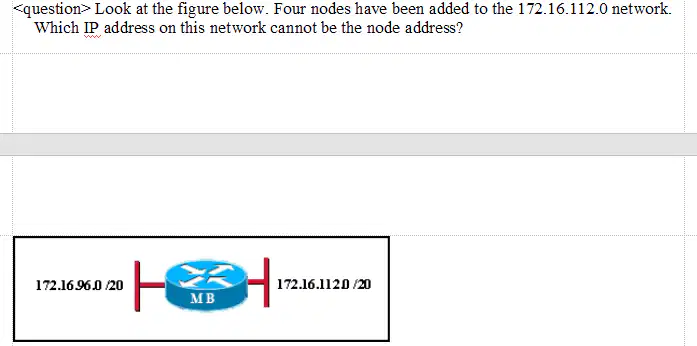
172.16.113.55
172.16.112.255
172.16.127.255
172.16.112.89
172.16.120.96
Based on IP address 192.168.65.54 and subnet mask 255.255.255.240, determine which network the node belongs to.
192.168.65.64
192.168.65.32
192.168.65.16
192.168.65.48
192.168.65.0
Based on IP address 192.168.65.54 and subnet mask 255.255.255.240, determine which network the node belongs to.
192.168.65.64
192.168.65.32
192.168.65.16
192.168.65.48
192.168.65.0
Addresses that are valid node addresses if the subnet mask is 255.255.254.0
128.107.62.0
10.165.55.255
172.55.33.255
64.104.128.0
64.100.2.255
Addresses that are valid node addresses if the subnet mask is 255.255.254.0
128.107.62.0
10.165.55.255
172.55.33.255
64.104.128.0
64.100.2.255
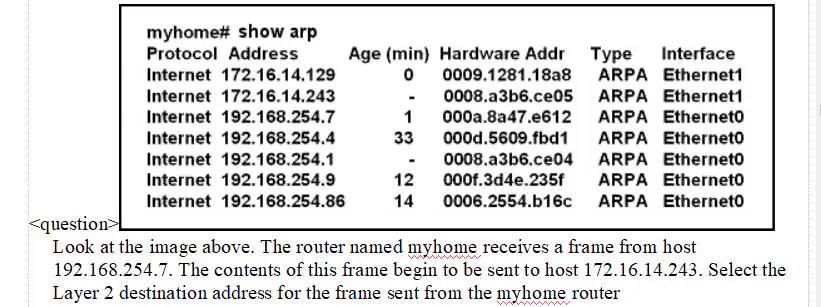
0008.a3b6.ce05
0009.1281.18a8
000a.8a47.e612
172.16.14.129
172.16.14.243
There are requirements for setting up a console session between the computer and the router:
It is enough to have the CLI on the computer to access the terminal configuration mode.
ou need to connect the console port of the router and the serial port of the computer with an inverted cable.
You need to connect the console port of the router and the network adapter of the computer with a console cable.
The computer must be configured with a default gateway.
The IP addresses assigned to the router and the computer must be on the same subnet.
Technology used in WAN
ARP
CDP
PPP
WEP
CSMA/CD
Layer of the OSI model that defines logical addressing
Transport
Session
Presentation
network
application
With a subnet mask of 255.255.255.248, the following IP addresses are valid:
200.152.2.160
194.10.10.104
192.168.200.87
220.100.100.113
223.168.210.100
The router receives a packet with the destination address 172.16.30.79/22. Select the subnet to which this packet belongs.
172.16.28.0/22
172.16.30.0/22
172.16.30.64/22
172.16.30.76/22
172.16.28.56/22
The broadcast address of the subnet where host A with the address 10.149.177.147/12 is located:
10.255.255.255
10.159.255.255
10.144.255.255
10.149.255.255
10.149.191.255
To initially configure Cisco routers using the IOS CLI, you need:
straight through cable
crossover cable
inverted cable
RJ-15 to DB-9 adapter
VTY port of the router
The command to create an encrypted password that restricts access to privileged EXEC mode on a Cisco router:
RouterA(config)# encrypted password cisco
RouterA(config)# password encrypted cisco
RouterA(config)# enable password cisco
RouterA(config)# enable secret cisco
RouterA(config)# service-password encryption cisco
Application layer protocols of the OSI model:
ARP, SMTP.
RARP, TCP
DSL, POP3.
NOC, UDP.
SMTP, POP3.
Wireless technology used on smartphones to transfer data to another device in close proximity:
NFC
Wi-Fi
3G/4G
Bluetooth
POP3
Characteristics of peer-to-peer networks:
Difficult to organize and maintain.
The network operating system provides all computers on the network with potentially equal opportunities.
These networks use two network operating systems that have fundamental functional differences.
They are called centrally managed networks.
These are large networks with numerous subnets.
Characteristics of peer-to-peer networks:
Difficult to organize and maintain.
They are called decentralized networks.
These networks use two network operating systems that have fundamental functional differences.
They are called centrally managed networks.
The network operating system includes components for centralized network administration.
Functions of the TCP protocol:
This is a connectionless protocol.
Contains the source IP address in the TCP header.
ensures the retransmission of data lost during transmission.
The amount of service information is only 16 bytes.
The amount of service information is only 8 bytes.
Functions of the TCP protocol:
Contains the source IP address in the TCP header.
This is a connectionless protocol.
It breaks down the data into datagrams.
It uses a three-step negotiation between the transmitting and receiving systems to establish each connection.
The amount of service information is only 8 bytes.
Functions of the TCP protocol:
This is a connectionless protocol.
The amount of service information is only 8 bytes.
It breaks down the data into datagrams.
The amount of service information is only 16 bytes.
It defines the way messages are assembled at the destination node.
The configuration components needed to enable a host to exchange data with other hosts on remote networks:
IP address, subnet mask, default gateway
subnet mask, DNS server, domain name
default gateway, DNS-server, domain name
DNS server, domain name
domain name, DHCP server address, default gateway
The following interference can affect the data rate of UTP cables:
number of nodes in the network
electromagnetic interference.
noise
humidity
temperature.
Description of the router's ARP table and routing table.
The ARP table contains information about networks and about individual devices.
The ARP table contains information about networks, not about individual devices.
The ARP table contains information about individual devices, not about networks
Routing tables contain information about individual devices, not networks.
Routing tables contain information about networks and about individual devices.
Decimal value corresponding to the binary number 11001010:
240
212
196
202
203
Private IP addresses include:
198.168.6.18
172.68.83.35
128.37.255.6
209.168.5.29
10.234.2.1
A protocol that allows you to enter https://mail.ru instead of an IP address to open a web page:
DNS
FTP
HTML
HTTP
IM
The default subnet mask for the IP address is 198.133.219.4:
255.255.0.0
255.0.0.0
255.255.255.0
255.255.255.254
255.255.255.255
The characteristics of a group mailing list:
routers will route group addresses between 224.0.0.0 and 224.0.0.255.
one packet can be sent to a group of nodes.
the group mailing source address ranges from 224.0.0.0 to 224.0.0.255.
computers use multicast to request IPv4 addresses.
group mailing messages convert low-level addresses to high-level addresses.
CSMA/CA is an access method, ...
used in any technology with an excessive number of collisions.
used in wireless technology to avoid duplicate SSIDs.
used in wireless technology to prevent collisions.
used in wired Ethernet technology to prevent collisions.
used at the central level.
The transport layer ports in the range from 1 to 1023 are called:
source
reserved
private
public
recipient
Benefits of using fiber optic cable to connect devices:
Fiber optic cable is typically used in small corporate and home networks.
Fiber optic cable is easy to install.
Fiber optic cable uses additional shielding to protect the copper wires.
The fiber optic cable uses an RJ-45 connector.
Fiber optic cable is resistant to electromagnetic and high frequency interference.
The user wants to test the connection between node 3 and node 8 on the network. To check the connection, you can use the command:
ping
ipconfig
netstat
nslookup
ipconfig /all
Functions of the upper layers of the OSI model
placement of electrical signals on a carrier for transmission
initiating the process of transferring data over the network
encapsulating a data packet into a frame
segmentation and identification of data for reassembly at destination
selection of the appropriate route for data transmission over the network
Functions of the upper layers of the OSI model
encapsulating a data packet into a frame
placement of electrical signals on a carrier for transmission
encryption and compression of data for transmission
segmentation and identification of data for reassembly at destination
selection of the appropriate route for data transmission over the network
The main switchboard usually contains elements
fax machines
equipment for teleconferencing
copier
user workstations
racks with network equipment
The main switchboard usually contains the following items:
point of presence
user workstations
equipment for teleconferencing
fax machines
copier
Reasons for doing NAT
so that public Internet users have access to local networks
to store registered public IP addresses
to reduce load and CPU usage in gateway routers
to improve the efficiency of routing protocols
to route private addresses on the public Internet
Reasons for doing NAT
to improve the efficiency of routing protocols
so that public Internet users have access to local networks
to allow LANs with private addresses to participate in the Internet
to route private addresses on the public Internet
to reduce load and CPU usage in gateway routers
Using the show cdp neighbors command, you can get the following information about a neighbor device
password to access configuration mode
password to access privileged mode
routing protocol.
platform
IP addresses of all interfaces
Using the show cdp neighbors command, you can get the following information about a neighbor device
password to access privileged mode
IP addresses of all interfaces
password to access configuration mode
routing protocol.
connected neighbor interface
Using the show cdp neighbors command, you can get the following information about a neighbor device
device ID
password to access configuration mode
routing protocol.
IP addresses of all interfaces
password to access privileged mode
HTTPS Specifications
Defines additional rules for passing data between the application layer and the data link layer.
Supports authentication.
Allows more concurrent connections than HTTP .
Open data transfer protocol.
Uses a different client request-server response process than the process used by HTTP .
HTTPS Specifications
Defines additional rules for passing data between the application layer and the data link layer.
Allows more concurrent connections than HTTP .
Encrypts SSL packets .
Open communication protocol
Uses a different client request-server response process than the process used by HTTP .
HTTPS Specifications
Open communication protocol
Allows more concurrent connections than HTTP .
Defines additional rules for passing data between the application layer and the data link layer.
Requires additional processing time on the server.
Uses a different client request-server response process than the process used by HTTP .
Coincident TCP and UDP header fields
priority indicator
confirmation number
sequence number
dialog box
source port
Coincident TCP and UDP header fields
checksum
priority indicator
dialog box
sequence number
confirmation number
Coincident TCP and UDP header fields
priority pointer
destination port
dialog box
sequence number
confirmation number
An update type that allows client computers to register and update resource records with the DNS server in case of any changes
zonal transmission
local recursive query
dynamic
query root domain
TLD query
Description of classful IP addresses
Reading the first bit allows you to determine the class to which the address belongs.
3 of the 5 address classes is reserved for multicast and experimental use.
Only Class A addresses have high bits of 100.
All subnets in a network are the same size.
The host portion of a class C address can be up to 24 bits.
Only MAC address filtering is enabled on the access point. The "authenticity" of the client is considered established when
The client receives the MAC address from the access point, checks its correspondence in the routing-table, and sends an acknowledgment message to the access point
The access point sends the MAC address to the server and receives confirmation of the validity of this MAC address
client sends MAC address to access point
Client provides the correct private key to the access point
The access point checks if the given MAC address is in the MAC address table and sends an acknowledgment message to the client
The reason why IEEE 802.11 wireless technology allows data transmission over a longer distance than Bluetooth technology
has a higher power output
transmission is carried out at much lower frequencies
transmission is carried out at much higher frequencies
more advanced encryption methods are used
has a lower output power
A protocol that allows you to type “https :// mail. ru” into the address bar instead of an IP address to open a web page
FTP
DNS
HTML
HTTP
IM
Abbreviation related to the use of telephone communication over the Internet
IM
HTML
VoIP
HTTP
SNMP
An area of the network where traffic from other hosts can cause the sending host to stop sending data, after which the sending host waits an arbitrary amount of time before resending the message
distribution level
broadcast domain
access level
collision area
peer-to-peer network
The following types of encapsulations can be set by the administrator on the integrated router's serial interface:
HDLC, DHCP, PAP
CHAP, ATM, PPP
ATM, ICMP, DHCP
Frame Relay, PPP, HDLC
PAP , PPP , ICMP
Data is being transferred from the source PC to the destination server. The following statements correctly describe the function of TCP or UDP in this situation:
TCP is the preferred protocol if the function requires minimal overhead.
UDP is the protocol of choice if the function requires minimal overhead.
The UDP destination port number identifies the transmitting node on the network.
The TCP process running on the PC randomly chooses a destination port when establishing a session with the server.
The UDP destination port number identifies the application or service on the server that will process the data.
Composite link properties in circuit-switched networks:
The composite channel is created temporarily for the period of a communication session of two subscribers.
Throughout its length it consists of a different number of elementary channels.
The number of elementary channels changes throughout its length.
Has a different non-fixed throughput throughout its entire length.
Data is delivered to the subscriber with delays, but at a constant rate.
Composite link properties in circuit-switched networks:
Throughout its length it consists of a different number of elementary channels.
Data is guaranteed to be delivered to the subscriber without delays, losses and at the same speed.
The number of elementary channels changes throughout its length.
Has a different non-fixed throughput throughout its entire length.
Data is delivered to the subscriber with delays, but at a constant rate.
Application layer protocol of the OSI model :
ARP.
RARP
HTTP.
TCP.
DSL.
Protocols applied level OSI Models :
RARP, TCP
DSL, POP3.
ARP, SMTP.
SMTP, POP3.
NOC , UDP .
The following three methods are used in social engineering:
Fishing, Vishing, Teleporting
Vishing, Teleporting, Refreshing
Spaming, Televoting, Freshing
Pretexting, Televoting, Phishing
Phishing, Vishing, Pretexting
The following command line utilities are most commonly used to diagnose problems at Layer 3 (central level):
ping, ipconfig, traceroute
tftp, ipconfig, ping
route, Telnet, Packet sniffer
arp - a, Telnet, ping
Packet sniffer, traceroute
Protocols describing methods that are used to protect user data in transit over the Internet:
ICMP, HTTPS, DNS
IPSEC, SSL, HTTPS
SMTP, DNS, FTP
SSL, HTTPS, ICMP
TFTP , FTP , IPSEC
The following applications can be used for in-band management:
FTP, SNMP, NAT
DNS, DHCP, TFTP
Telnet, HTTP, SNMP
HTTP, NAT, Telnet
SNMP , DHCP , TFTP
Packet switched computer-wide area networks are:
SLIP, Frame Relay
ATM, DTE, HDLC
SDH, Frame Relay, HDLC
X.25, ATM, Frame Relay
Frame Relay , DTE , ISDN
Characteristics of the quality of service of an Internet provider:
Install special applications, additional web space.
Free Windows upgrade , free hardware replacement.
Free hardware replacement, free antivirus updates.
Install special applications.
Connection speed, additional web space, and email profiles.
A manufacturing company subscribes to some ISP hosting services. Hosting services include web hosting, data transfer and email. The following protocols represent these three key applications:
HTTP, FTP, SMTP
UDP, DHCP, SNMP
FTP, SMTP, SNMP
TCP, SMTP, HTTP
DNS, HTTP, UDP
In global networks with dedicated channels, the following protocols are used:
X.25, SLIP, ISDN
PPP, SLIP, HDLC
ATM, HDLC, DCE
SLIP, ISDN, DCE
Frame Relay, HDLC
Protocols used to process email:
HTTP, IMAP4, DNS
FTP, IMAP4, POP3
POP3, SMTP, IMAP4
DHCP SMTP, DNS
HTML SMTP, FTP
Application layer protocol using UDP as transport protocol:
HTTP, SMTP, SNMP
ICMP, IP, TFTP
DNS, SMTP, IP
SNMP, DNS, TFTP
ARP, IP, TFTP
Modification Ethernet technologies:
FDDI technology.
PPP technology.
CSMA/CD technology.
Token Ring technology.
A 10 Mbit variant of the IEEE 802.3 standard.
Unique characteristics of the UDP protocol
low overhead
connection protocol
full duplex operation
flow control
reliable data transmission
Unique characteristics of the UDP protocol
connection protocol
no flow control
full duplex operation
reliable data transmission
high overhead
Unique characteristics of the UDP protocol
full duplex operation
connection protocol
lack of error recovery procedure
reliable data transmission
recovering errors after a crash
Transport Layer Services
transfer bits
path definition
data encryption
flow control
packet encapsulation in a data frame
In order to connect a router to an ISP network, to provide Internet access using a T1 link, a consumer company needs a device...
ISDN modem
NT1 device
DSL router
modem
CSU/DSU device
A network administrator wants to configure a Cisco 2960 switch to restrict access to each port to a single MAC address. This function will help solve this problem:
port security
CDP protocolc
ICMP protocol
access lists
flow control
Assignment of the crypto key generate rsa command when configuring the switch to use SSH on virtual terminal connections
display hosts connected via SSH
Generate a public/private key pair
disable hosts connected via SSH
display active SSH ports on the switch
access to SSH database configuration
True statements about Ethernet full duplex operation
Hub ports are preconfigured for full duplex operation.
The device listens on the medium and transmits data only when it is free
There are no collisions in full duplex mode.
The host's network adapter must determine the availability of the medium before handover.
Both the host network adapter and the switch port must operate in half-duplex mode.
True statements about Ethernet full duplex operation
The device listens on the medium and only transmits data when it is free.
Hub ports are preconfigured for full duplex operation.
The host's network adapter must determine the availability of the medium before handover.
A dedicated switch port is required for each host.
Both the host network adapter and the switch port must operate in half-duplex mode.
True statements about Ethernet full duplex operation
The host's network adapter must determine the availability of the medium before handover.
Hub ports are preconfigured for full duplex operation.
All devices on the segment receive data that is transmitted over the network.
The device listens on the medium and only transmits data when it is free.
Both the host network adapter and the switch port must be in full duplex mode.
CSMA/CD specifications
The device listens on the medium and only transmits data when it is free.
Devices can be configured with a higher transmission priority
The signal "Jam" indicates that the collision is allowed and the transmission medium is free
After a collision, only a device with an electronic token can transmit data.
Both the host network adapter and the switch port must be in full-duplex mode
CSMA/CD specifications
Devices can be configured with a higher transmission priority.
All devices on the segment receive data that is transmitted over the network.
The signal "Jam" indicates that the collision is allowed and the transmission medium is free
Both the host network adapter and the switch port must be in full duplex mode.
After a collision, only a device with an electronic token can transmit data.
CSMA/CD specifications
After a collision, only a device with an electronic token can transmit data.
The signal "Jam" indicates that the collision is allowed and the transmission medium is free
Devices can be configured with a higher transmission priority.
After a collision is detected, nodes may attempt to resume transmission after a random delay period.
Both the host network adapter and the switch port must be in full duplex mode
The ip route 192.168.7.24 255.255.255.248 192.168.7.9 command describes the statements:
Address 192.168.7.9 represents the destination network for this route
This command was issued in interface configuration mode
The address 192.168.7.24 in this command is the next hop router
The address 192.168.7.24 in this command is the default route
A packet destined for host 192.168.7.30 will be forwarded to 192.168.7.9
The ip host command , when creating host tables on Cisco routers, is used to
creating static routes to specific hosts
Enable communication with other IP devices using names
assigning a meaningful name to the local router
Detect only directly connected networks and their hosts
setting the device nodes to which the router should connect
A system administrator can change the following items to set the Cisco IOS boot source
boot configuration file
system ROM
system image file
password to access the console
file with loader image
TCP uses sequence numbers in a segment
to specify the order in which segments are transmitted from source to destination
defines the number of bytes of data (payload) after which the sender waits for confirmation from the recipient
to detect missing segments at destination
to limit the number of segments that can be sent from the interface at the same time
to determine if the packet was modified during transmission
TCP uses sequence numbers in segment
to limit the number of segments that can be sent from the interface at the same time
to specify the order in which segments are transmitted from source to destination
defines the number of bytes of data (payload) after which the sender waits for confirmation from the recipient
to collect segments at a remote site
to determine if the packet was modified during transmission
The UDP protocol is characterized by assertions
UDP provides fast Layer 3 data transfer with connection establishment
UDP provides sophisticated flow control mechanisms.
UDP uses the IP protocol to detect and resolve errors.
UDP defines the number of bytes of data (payload) after which the sender waits for confirmation from the recipient
UDP provides fast, connectionless Layer 4 data transfer.
The UDP protocol is characterized by assertions
UDP uses application layer protocols to detect errors.
UDP provides fast Layer 3 data transfer with connection establishment
UDP defines the number of bytes of data (payload) after which the sender waits for confirmation from the recipient
UDP uses the IP protocol to detect and resolve errors.
UDP provides sophisticated flow control mechanisms.
The UDP protocol is characterized by assertions
UDP provides fast Layer 3 data transfer with connection establishment
Using UDP is justified if the application does not need to guarantee data delivery.
UDP defines the number of bytes of data (payload) after which the sender waits for confirmation from the recipient
UDP uses the IP protocol to detect and resolve errors.
UDP provides sophisticated flow control mechanisms.
The router can boot the Cisco IOS at startup from:
module RAM
NVRAM
TFTP Server
procedure settings
terminal
The router can boot the Cisco IOS at startup from:
module RAM
NVRAM
flash memory
procedure settings
terminal
Hub functions:
The hub type does not depend on the architecture and characteristics of the local computer network.
Enable incorrect ports.
Complicates the control and operation of the network.
Combining physical network segments into a single shared environment.
The hub type is independent of the technology used in the network.
Hub functions:
Assign allowed IP addresses to ports on the concentrator.
The hub type is independent of the technology used in the network.
Complicates the control and operation of the network.
Enable incorrect ports.
Performs functions that make it easier to control and operate the network.
Data is being transferred from the source PC to the destination server. The following statements correctly describe the function of TCP or UDP in this situation:
The UDP destination port number identifies the application or service on the server that will process the data.
TCP is the preferred protocol if the function requires minimal overhead.
UDP is the protocol of choice if the function requires minimal overhead.
The UDP destination port number identifies the transmitting node on the network.
The TCP source port number identifies the transmitting node on the network.
Data is being transferred from the source PC to the destination server. The following statements correctly describe the function of TCP or UDP in this situation:
TCP is the preferred protocol if the function requires minimal overhead.
UDP segments are encapsulated in an IP packet for transmission over the network.
UDP is the protocol of choice if the function requires minimal overhead.
The UDP destination port number identifies the transmitting node on the network.
he TCP source port number identifies the transmitting node on the network.
TCP protocol functions:
It breaks the data into datagrams.
This is a connectionless protocol.
When establishing each connection, it uses a three-way negotiation between the transmitting and receiving systems.
Contains the source IP address in the TCP header.
The amount of service information is only 8 bytes.
TCP protocol functions:
This is a connectionless protocol.
Contains the source IP address in the TCP header.
It provides retransmission of data lost in transit.
The amount of service information is only 8 bytes.
It breaks the data into datagrams.
TCP protocol functions:
The amount of service information is only 16 bytes.
It breaks the data into datagrams.
The amount of service information is only 8 bytes.
This is a connectionless protocol.
It defines how messages are assembled on the destination node.
Application layer protocols governing the exchange of messages between a client with a web browser and a remote web server:
DNS
HTTP
HTML
DHCP
TCP
A protocol that allows you to enter 94.100.180.201 in the browser's address bar instead of a URL to open a web page
FTP
DNS
HTML
HTTP
SNMP
The URL points to the following information
Web server MAC address
Server IP address
protocol used
Gateway IP address
browser version
The URL points to the following information
Gateway IP address
Web server MAC address
name of the domain being accessed
browser version
Server IP address
The URL points to the following information
Web server MAC address
Gateway IP address
browser version
resource location
Server IP address
Commands to connect to a switch on the same LAN via Telnet for configuration and management:
Switch1(config)# line vty 0 15
Switch1(config - line)# ip address 192.168.2.126 255.255.255.192
Switch1(config-line)# login
Switch1(config)#line con 0
Switch1(config - line)# enable password cisco
Switch1(config-line)# login
Switch1(config)# ip default-gateway 192.168.2.1
Switch1(config)# exit
Switch1(config)# interface fa0/1
Switch1(config- if)# ip address 192.168.2.64 255.255.255.192
Switch1(config)# interface vlan 1
Switch1(config - if)# ip address 192.168.2.126 255.255.255.192
Switch1(config-if)# no shutdown
Router ROM features or specifications
handles instructions for POST diagnostic procedures
used to store routing tables
Enables software updates without changing chips on the motherboard
contains the ARP cache
contains a table of MAC addresses
Statements that correctly define the function of router memory components
RAM is used to permanently store the configuration file used during boot.
ROM contains diagnostic self-test routines for hardware modules.
Non-Volatile Memory (NVRAM) stores a backup copy of the IOS used at boot.
Flash memory content is lost when router is powered off
The ROM contains the most complete and latest version of IOS.
A network that provides secure access to corporate systems for vendors, customers, and employees
Intranet
Internet
Extranet
Personal network
Extended network
IPv structure 4 addresses
thirty-two dotted hexadecimal numbers
thirty-two hexadecimal numbers separated by colons
four binary numbers between 0 and 1 separated by colons
four decimal numbers between 0 and 255 separated by dots
four decimal numbers between 0 and 255 separated by colons
An interface type that does not have a physical port associated with it
GigabitEthernet
Sequential port
FastEthernet
console
switch virtual interface ( SVI )
Correct statement about user EXEC mode
Device command line in this mode ends with “>” character
in this mode, you can configure the interfaces and protocols of the router
all router commands are available in this mode
Global configuration mode can be accessed using the enable command
all aspects of the router's configuration are viewable in this mode.
Correct statement about user EXEC mode
Device command line in this mode ends with “#” character
only some aspects of the router's configuration are viewable in this mode.
in this mode, you can configure the interfaces and protocols of the router
all router commands are available in this mode
Global configuration mode can be accessed using the enable command
Enable command secret protects access to
virtual terminal
AUX port
privileged EXEC mode
lines consoles
Ethernet interface
Operating system shell
interacts with device hardware
Enables dedicated firewall services
Enables intrusion protection services
provides interaction between users and the kernel
provides communication between the kernel and the device hardware
Address of the network where the IP address is 10.1.100.50 with a subnet mask of 255.255.0.0
10.1.100.32
10.0.0.0
10.1.100.0
10.1.1.0
10.1.0.0
The type of data transfer in which the message will be sent to all devices on the local network
broadcast
group mailing
unicast
full duplex transmission
full duplex transmission
The OSI model layer defines data segmentation and reassembly services for individual data sessions between end devices
Views
Transport
Network
Applications
Physical
Number of binary bits in an IPv 6 address
48
32
128
64
256
The decimal-point representation of an IPv4 address represented as the binary string 00001010.01100100.00010101.00000001
100.21.10.1
10.100.20.1
100.10.11.1
10.100.21.1
10.10.21.1
The hexadecimal equivalent of the binary number 11001010
0 x 1210
0 x AC
312
202
0 xCA
Decimal equivalent of hexadecimal number 0 x 7 D
125
175
01111101
713
137
The command set will allow login using the cisco password
R1(config)# line console 0
R1( config- line)# password cisco
R1(config-line)# exit
R1(config)# line console 0
R1( config- line)# password cisco
R1(config-line)# login
R1(config)# line vty 0 4
R1( config- line)# password cisco
R1(config-line)# exit
R1(config)# line vty 0 4
R1( config- line)# password cisco
R1(config-line)# login
R1(config)# line console 0
R1( config- line)# password cisco
R1(config-line)# no shutdown
Command line mode that allows users to access all device commands, such as commands used for configuration, management, and troubleshooting
global configuration mode
custom EXEC mode
privileged EXEC mode
interface configuration mode
remote access mode
Map the 192.168.1.32/27 subnet with a host address that can be included in the subnet
192.168.1.0
192.168.1.63
192.168.1.64
192.168.1.48
192.168.1.128
How many bits must be borrowed from the host portion of an address to provide a router with five connected networks
5
1
4
2
3
How many host addresses are available on the network with the address 192.168.10.128/26
62
60
64
32
30
How many host addresses are available on network 172.16.128.0 with subnet mask 255.255.252.0
1024
1022
510
512
2048
Command ip route 192.168.7.24 255.255.255.248 192.168.7.9
192.168.7.9 represents the destination network for this route
introduced in interface configuration mode
defines a static route
192.168.7.24 in this command is the next hop router.
192.168.7.24 in this command is the default route
The main switchboard usually contains the elements :
copier
fax machines
user workstations
switches and routers
equipment for teleconferencing

