
 Worksheets
First Semester Science Quiz Review
Total questions: 32
Worksheet time: 48mins
Calculate the density of an object with a mass of 50 grams and a volume of 10 cubic centimeters.
5 g/cm³
0.2 g/cm³
500 g/cm³
50 g/cm³
What is the chemical symbol for water?
H
O
H2O
CO2
Which of the following is an example of a physical change?
Burning wood
Rusting iron
Melting ice
Baking a cake
The first letter of a chemical symbol is always a
Capital
Lowercase
Number
Symbol

Chemical Change (CC)
Physical Change (PC)
Chemical Property (CP)
Physical Property (PP)

Metal rusting is
a physical change
a chemical change

Mason and JaSiaha were playing in the park when they accidentally knocked over a glass bottle. The bottle broke into pieces. What kind of change does this represent?
physical change
chemical change
Which state of matter has a definite volume but no definite shape?
Solid
Liquid
Gas
Plasma
Which of the following is an example of a physical change?
Burning paper
Rusting iron
Melting ice
Cooking an egg

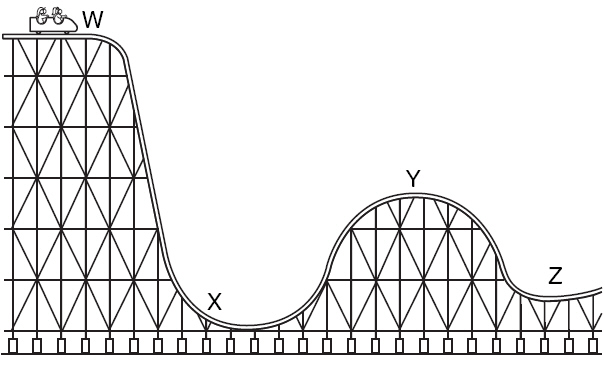

What is true of kinetic energy and potential energy at point X?
The kinetic energy and potential energy are the same.
The kinetic energy is at its greatest. Potential energy at its lowest.
Kinetic energy at its lowest. Potential energy at its greatest.
As height increases, so does...
Thermal energy
Mechanical energy
Kinetic energy
Potential energy
Give an example of energy conversion from potential energy to kinetic energy.
Ball dropped from a height
A wind turbine converting wind energy into electrical energy.
A person jumping off a diving board.
A car accelerating downhill.
Describe the process of energy transformation in a light bulb.
Mechanical energy to light energy and sound energy.
Electrical energy to light energy and heat energy
Chemical energy to light energy and heat energy.
Electrical energy to sound energy and kinetic energy.
What is the principle of energy conservation?
Energy cannot be created or destroyed, only transferred or transformed.
Energy can be created but not destroyed.
Energy can be destroyed but not created.
Energy can be both created and destroyed.
A substance with 2 or more objects mixed together in which each KEEP their own physical properties.
solutions
mixtures
solids
Items in a ________________ are difficult or impossible to pull apart.
mixture
physical change
solution
Silicon is a semiconductor and has properties of both metals and nonmetals. What type of element is Silicon?
Metal
Nonmetal
Metalloid
All of these properties describe metals except...
malleable
conductors
brittle
shiny

Metal
Nonmetal
Metalloid

Metal
Nonmetal
Metalloid

Metal
Nonmetal
Metalloid

What type of waves do not require a medium to travel?
electromagnetic
mechanical
sound
longitudinal

What is the direction of the disturbance in a transverse wave?
Circular or rings that flow from the center.
Parallel to the direction the wave travels.
Perpendicular to the direction the wave travels.

What type of wave is shown?
sound wave
longitudinal wave
compressional wave
transverse wave

What type of wave is shown?
longitudinal wave
transverse wave
ultraviolet ray
x-ray

Chemical symbol for Calcium
Cu
Co
Ca
C

