wayground logo

Free Printable Worksheets

Font size

S
M
L
XL
Worksheets

Fall 2025 Final Exam - World Geography

Total questions: 100

Worksheet time: 1hrs 5mins

Name
Class
Date
1.
What is the study of the earth and the people, plants, and animals that live on it?
a)
Cartography
b)
Economics
c)
Geography
d)
Astronomy
e)
Chemistry
2.
Which of the following is the theme of Geography that asks the question, "What is it like there?"
a)
Location
b)
Place
c)
Interaction
d)
Movement
e)
Region
3.
Which of the following is the theme of Geography that asks the question, "Where is it?"
a)
Location
b)
Place
c)
Interaction
d)
Movement
e)
Region
4.
Which term describes the sun and all of the objects that revolve around it?
a)
Atmosphere
b)
Hydrosphere
c)
Biosphere
d)
Solar System
e)
Water Cycle
5.
Which of the following is the part of Earth's surface that is covered in water?
a)
Atmosphere
b)
Hydrosphere
c)
Biosphere
d)
Solar System
e)
Water Cycle
6.
Which of the following refers to breaks in the earth's crust?
a)
Folds
b)
Faults
c)
Weathering
d)
Erosion
7.
Which of the following refers to a group of islands?
a)
Isthmus
b)
Peninsula
c)
Archipelago
d)
Strait
8.
Which of the following refers to a narrow piece of land that connects two large landmasses?
a)
Isthmus
b)
Peninsula
c)
Archipelago
d)
Strait
9.
What are substances from the Earth that are not living or made of living things?
a)
Fossil Fuels
b)
Minerals
c)
Artifacts
d)
Quipu
10.
Which of the following refers to an imaginary line that runs through the center of the earth between the poles?
a)
Axis
b)
Prime Meridian
c)
International Date Line
d)
Equinox
e)
Solstice
11.
Which of the following refers to when the sun's direct rays are over the Equator?
a)
Axis
b)
Prime Meridian
c)
International Date Line
d)
Equinox
e)
Solstice
12.
Which of the following refers to trees that lose their leaves in the autumn?
a)
Oasis
b)
Coniferous
c)
Deciduous
d)
Equinox
e)
Solstice
13.
Which of the following refers to an area of lush vegetation found in the desert?
a)
Oasis
b)
Coniferous
c)
Deciduous
d)
Equinox
e)
Solstice
14.
Which of the following refers to the way of life of a group of people with common traditions, interest and beliefs?
a)
Civilization
b)
History
c)
Culture
d)
Population Density
e)
Subsistence Farming
15.
Which term describes a highly developed, city-based society with an advanced knowledge of farming, trade, government, art, and science?
a)
Civilization
b)
History
c)
Cultural Diffusion
d)
Population Density
e)
Subsistence Farming
16.
Which term means the average number of people per square mile?
a)
Civilization
b)
History
c)
Cultural Diffusion
d)
Population Density
e)
Subsistence Farming
17.
Which term describes a system where farmers grow crops to meet their needs and the needs of their families using human labor, animal power, and basic farming needs?
a)
Civilization
b)
History
c)
Cultural Diffusion
d)
Population Density
e)
Subsistence Farming
18.
Which term describes the process of spreading new knowledge from one culture to another?
a)
Civilization
b)
History
c)
Cultural Diffusion
d)
Population Density
e)
Subsistence Farming
19.
Which term describes the written record of past events?
a)
Civilization
b)
History
c)
Cultural Diffusion
d)
Population Density
e)
Subsistence Farming
20.
What is the longest river in the United States?
a)
Colorado
b)
Rio Grande
c)
Missouri
d)
Mississippi
21.
What is the longest mountain range in the United States and Canada?
a)
Himalaya Mountains
b)
Andes Mountains
c)
Rocky Mountains
d)
Appalachian Mountains
22.
Which term describes a ridge that separates rivers flowing towards opposite sides?
a)
Andes Mountains
b)
Himalaya Mountains
c)
Continental Divide
d)
Rocky Mountains
e)
Tributaries
23.
What is a smaller creek, stream, or river that flows into one main river?
a)
Himalaya Mountains
b)
Andes Mountains
c)
Continental Divide
d)
Rocky Mountains
e)
Tributaries
24.
Why are the tops of the Appalachian Mountains rounded?
a)
The mountains were originally underwater
b)
Water erosion slowly wore away the tops over time
c)
The government reshaped the tops so planes would have better visibility
d)
The soil of the mountains is mainly soft clay
25.
Canadian cities like Quebec, Montreal, and Ottawa formed along which river and its tributaries?
a)
St. Lawrence River
b)
Ohio River
c)
Hudson River
d)
Mississippi River
26.
Which water system and landform forms another part of the border between the U.S. and Canada?
a)
Great Lakes
b)
St. Lawrence River
c)
Niagara Falls
d)
Mississippi River
27.
What created Canada's Great Bear Lake and Great Slave Lake?
a)
Humans
b)
Glaciers
c)
Earthquakes
d)
Volcanoes
28.
What is the world's longest mountain chain?
a)
Appalachian Mountains
b)
Rocky Mountains
c)
Andes Mountains
d)
Himalaya Mountains
29.
What is the longest river in the Western Hemisphere?
a)
Orinoco River
b)
Missouri River
c)
Rio Grande
d)
Amazon River
30.
What is the top layer of vegetation in a tropical rainforest called?
a)
Quipu
b)
Canopy
c)
Estuary
d)
Basin
31.
What is an area where an ocean tide meets a river current called?
a)
Quipu
b)
Canopy
c)
Estuary
d)
Basin
32.
The term "mestizo" refers to which group of people in Mexico?
a)
Native American and African descent
b)
European settlers only
c)
African and Asian descent
d)
Native American and European descent
33.
Which country is the largest Spanish-speaking country in the world?
a)
Brazil
b)
Mexico
c)
Bolivia
d)
Peru
34.
What was the first permanent European settlement in the Caribbean?
a)
San Juan
b)
Port-au-Prince
c)
Hispaniola
d)
Tenochtitlan
35.
Which Caribbean country gained independence from France in 1804?
a)
Jamaica
b)
Haiti
c)
Barbados
d)
Cuba
e)
Dominican Republic
36.
Where do the majority of South America's indigenous groups live?
a)
The Amazon Basin
b)
The Andes region of Ecuador, Peru, and Bolivia
c)
The Pampas
d)
The coastal regions of Brazil
37.
What attracted Spanish conquistadors to the shores of Peru?
a)
The Inca's advanced engineering ability
b)
The opportunity to establish new trade routes with Asia
c)
The Inca Empire's vast deposits of silver and gold
d)
Fertile farmland and abundant water sources
38.
Which climate zone is found between sea level and 2500 feet with rainforests and crops like bananas, sugar, rice, and cacao?
a)
Tierra Helada
b)
Tierra Fría
c)
Tierra Caliente
d)
Tierra Templada
39.
Which climate zone is found between 2500 and 6000 feet with crops like coffee and corn?
a)
Tierra Helada
b)
Tierra Fría
c)
Tierra Caliente
d)
Tierra Templada
40.
Which climate zone is found between 6000 and 12000 feet with crops like potatoes and barley?
a)
Tierra Helada
b)
Tierra Fría
c)
Tierra Caliente
d)
Tierra Templada
41.
Which climate zone is found between 12000 and 16000 feet with permanent snow and ice?
a)
Tierra Helada
b)
Tierra Fría
c)
Tierra Caliente
d)
Tierra Templada
42.
Which religion is most widely practiced in Latin America?
a)
Islam
b)
Roman Catholicism (Christianity)
c)
Hinduism
d)
Buddhism
43.
What is the primary language spoken in Latin America?
a)
French
b)
English
c)
Portuguese
d)
Spanish
44.
Which TWO civilizations originated in Mexico?
a)
Inca and Arawak
b)
Cahokia and Illini
c)
Aztec and Maya
d)
Cherokee and Sioux
45.
Which landform is a manmade waterway that allows ships to travel between the Atlantic and Pacific oceans without going around South America?
a)
Panama Canal
b)
Mato Grosso Plateau
c)
Brazilian Highlands
d)
Amazon Basin
46.
What is a local form of a language that differs from the main language?
a)
Lingua Franca
b)
Dialect
c)
Patois
d)
Vernacular
47.
Which type of government does Canada have?
a)
federal republic
b)
communist
c)
parliamentary democracy
d)
theocracy
48.
Which type of government does the United States have?
a)
federal republic/representative democracy
b)
communist
c)
parliamentary democracy
d)
fascist
49.
What are Lakes Huron, Ontario, Michigan, Erie, and Superior also called?
a)
Grand Banks
b)
Great Lakes
c)
Shining Seas
d)
Canadian Shield
50.
Canada's two official languages are English and ___.
a)
Spanish
b)
German
c)
Italian
d)
French
51.
Why is the United States one of the most ethnically diverse countries in the world?
a)
The land over which European settlers spread contained powerful kingdoms of many nationalities.
b)
Ancestors of Native Americans probably arrived about 20,000 years ago.
c)
Most people in the United States speak English.
d)
Immigrants came to the United States from many countries.
52.

Instead of states, Canada has _____.
a)
provinces and territories
b)
counties and municipalities
c)
zones and areas
d)
regions and districts
53.
Which type of erosion created the Great Lakes?
a)
wind
b)
water
c)
chemical
d)
glacial
54.
The core, ____, and crust are the three layers of the Earth.
a)
magma
b)
plates
c)
mantle
d)
lava
55.
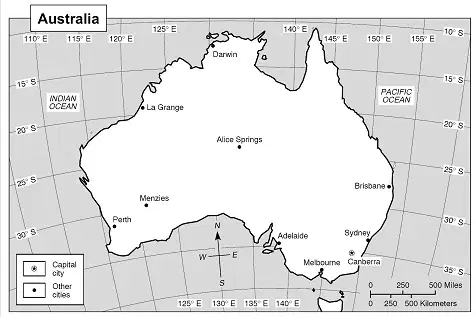
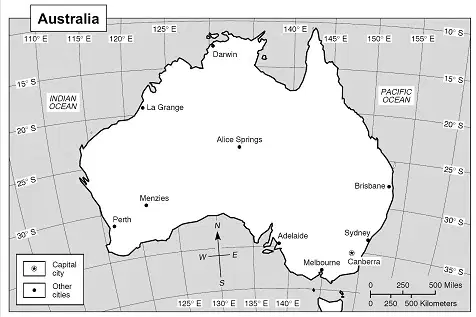
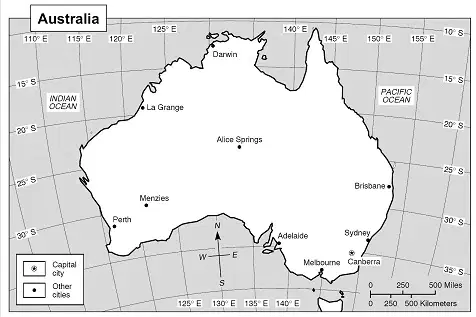
According to the map, what is the approximate longitude of the city of Melbourne?
a)
145ºE
b)
33ºS
c)
140ºE
d)
33ºE
56.
What is the approximate latitude and longitude of the city of Canberra?
a)
36ºS, 149ºE
b)
36ºN, 149ºW
c)
36ºN, 149ºE
d)
36ºE, 149ºS
57.
What is the approximate latitude of the city of Menzies?
a)
30ºS
b)
30ºN
c)
116ºE
d)
30ºE
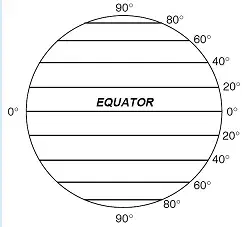
58.
What is depicted on the diagram?
a)
Lines of sight
b)
Lines of distance
c)
Lines of longitude
d)
Lines of latitude
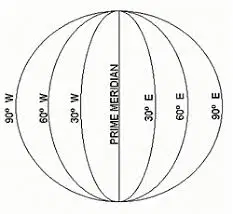
59.
What is depicted on the diagram?
a)
Lines of sight
b)
Lines of distance
c)
Lines of longitude
d)
Lines of latitude
60.
Which hemisphere is depicted in the diagram?
a)
Northern Hemisphere
b)
Southern Hemisphere
c)
Eastern Hemisphere
d)
Western Hemisphere
61.
The TOP of this map pictures which hemisphere?
a)
Northern Hemisphere
b)
Southern Hemisphere
c)
Eastern Hemisphere
d)
Western Hemisphere
62.
Which hemisphere is pictured in the diagram?
a)
Northern Hemisphere
b)
Southern Hemisphere
c)
Eastern Hemisphere
d)
Western Hemisphere
63.
What part of a map explains its symbols, colors, and lines?
a)
scale bar
b)
key
c)
title
d)
compass rose
64.
Which of the following would be shown on a physical map?
a)
railroad lines
b)
roads and roadways
c)
relief and elevation
d)
state lines
65.

Identify the body of water.

a)

Rio Grande

b)

Gulf of Mexico

c)

Pacific Ocean

d)

Atlantic Ocean

66.

Identify the body of water.

a)

Pacific Ocean

b)

Atlantic Ocean

c)

Rio Grande

d)

Gulf of Mexico

67.

Which river is highlighted in blue?

a)

Mississippi River

b)

Missouri River

c)

Colorado River

d)

Ohio River

68.

Which river is highlighted in blue?

a)

Mississippi River

b)

Missouri River

c)

Colorado River

d)

Ohio River

69.

Which river is highlighted in blue?

a)

Mississippi River

b)

Missouri River

c)

Colorado River

d)

Ohio River

70.

Which river is highlighted in blue?

a)

Rio Grande

b)

Ohio River

c)

Columbia River

d)

Colorado River

71.

Which river is highlighted in blue?

a)

Mississippi River

b)

Missouri River

c)

Colorado River

d)

Ohio River

72.

Identify the land feature.

a)

Appalachian Mountains

b)

Great Plains

c)

Rocky Mountains

d)

Gulf Coastal Plains

73.

Name the body of water shown here between Florida and Texas/Mexico.

a)

Pacific Ocean

b)

Atlantic Ocean

c)

Gulf of Mexico

d)

Chesapeake Bay

74.

What physical feature is represented by the triangles on the map?

a)

Appalachian Mountains

b)

Rocky Mountains

c)

Catskill Mountains

d)

Sierra Nevada Mountains

75.

What is the capital of Nicaragua?

a)
Tegucigalpa
b)

Lima

c)
Havana
d)
Managua
76.

What is the capital of Peru?

a)
Tegucigalpa
b)

Lima

c)
Havana
d)
Managua
77.

What is the capital of Honduras?

a)
Tegucigalpa
b)

Lima

c)
Havana
d)
Managua
78.

What is the capital of Venezuela?

a)

Caracas

b)
Bogotá
c)

La Paz/Sucre

d)

Brasília

79.

What is the capital of Argentina?

a)
Santiago
b)

Belmopan

c)

Quito

d)
Buenos Aires
80.

What is the capital of Jamaica?

a)
Asunción
b)

Montevideo

c)

Kingston

d)

Port-au-Prince

81.

What is the capital of Haiti?

a)
Asunción
b)

Montevideo

c)

Kingston

d)

Port-au-Prince

82.

What is the capital of Uruguay?

a)
Asunción
b)

Montevideo

c)

Kingston

d)

Port-au-Prince

83.

What is the capital of Brazil?

a)

Caracas

b)
Bogotá
c)

La Paz/Sucre

d)

Brasília

84.

What is the capital of Canada?

a)

Mexico City

b)

Washington D.C.

c)

Ottawa

d)

Havana

85.

What is the capital of the United States?

a)

Mexico City

b)

Washington D.C.

c)

Ottawa

d)

Havana

86.

What is the capital of Mexico?

a)

Mexico City

b)

Washington D.C.

c)

Ottawa

d)

Havana

87.

Which country is number #1?

a)

Haiti

b)

Mexico

c)

Cuba

d)

Dominican Republic

88.

Which country is number #2?

a)

Haiti

b)

Mexico

c)

Cuba

d)

Dominican Republic

89.

Which country is number #9?

a)

Nicaragua

b)

Panama

c)

Costa Rica

d)

Honduras

90.

Which country is number #10?

a)

Nicaragua

b)

Panama

c)

Costa Rica

d)

Honduras

91.

Which country is number #16?

a)

Suriname

b)

French Guiana

c)

Guyana

d)

Venezuela

92.

Which country is number #17?

a)

Peru

b)

Colombia

c)

Chile

d)

Ecuador

93.

Which country is number #19?

a)

Peru

b)

Colombia

c)

Chile

d)

Ecuador

94.

Which country is number #20?

a)

Peru

b)

Colombia

c)

Chile

d)

Ecuador

95.

Which country is number #21?

a)

Brazil

b)

Paraguay

c)

Argentina

d)

Bolivia

e)

Uruguay

96.

Which country is number #23?

a)

Brazil

b)

Paraguay

c)

Argentina

d)

Bolivia

e)

Uruguay

97.

What is the name for twisting funnels of air with winds that can reach 300 miles per hour?

a)

Tornado

b)

Earthquake

c)

Hurricane

d)

Blizzard

98.

What is the name for a snowstorm with winds of more than 35 miles per hour, heavy or blowing snow, and low visibility for three hours or more?

a)

Tornado

b)

Earthquake

c)

Hurricane

d)

Blizzard

99.

What is the name for an ocean storm hundreds of miles wide with winds of 74 miles per hour or more?

a)

Tornado

b)

Earthquake

c)

Hurricane

d)

Blizzard

100.

What is the name for sudden, violent movements of tectonic plates along a fault line?

a)

Tornado

b)

Earthquake

c)

Hurricane

d)

Blizzard