
 Worksheets
coastlines revision
Total questions: 99
Worksheet time: 49mins
What are the benefits of a seaway? (choose 2)
Safe passage for boats
Flood mitigation
Great sand banks
Nice place to snorkel
What is a feature of a constructive wave?
High wave frequency
Weak backwash
Strong backwash
High wave height
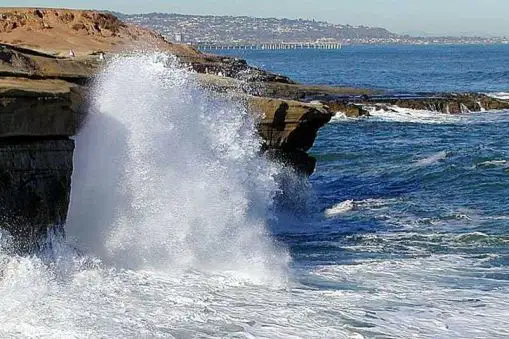
This wave is an example of
Refraction
Diffraction
Reflection

The image is of a _______ wave?
Surging
Plunging
Spilling
Cresting
Permanent rips exist
over a sand bar
Between 2 sand bars
parallel to the beach
Next to or under solid objects
What is a feature of a constructive wave?
High wave frequency
Weak backwash
Strong backwash
High wave height
Permanent rips exist
over a sand bar
Between 2 sand bars
parallel to the beach
Next to or under solid objects
This wave is an example of
Refraction
Diffraction
Reflection
What is a feature of a constructive wave?
High wave frequency
Weak backwash
Strong backwash
High wave height
Permanent rips exist
over a sand bar
Between 2 sand bars
parallel to the beach
Next to or under solid objects
What problems does a seaway create
great surfing
stops longshore drift
people don't like it
gets in the way of boats
A seawall is used
to increase sand on the beach
last line of defence
increase longshore drift
to increase the usable area available to the public

Identify the coastal defense feature.
Sea wall
groyne
breakwater
barrages

Identify the coastal defense feature.
sea wall
revetment
gabion
groyne
What is a disadvantage of groynes?
They stop the process of longshore drift and so they stop sediment from reaching beaches further down the coast.
They don't last very long
They involve the loss of land

What is the dumping of new sand onto an eroded beach to restore it?
barrier island
beach nourishment
dredging
jetty
What is the main disadvantage of a sea wall?
Aesthetically displeasing
Encourages tourism, and thus litter
Creates strong backwash, causing erosion beneath the wall
Expensive

If the photo is facing south, which direction is longshore drift working in?
west to east
east to west
south to north
north to south

Identify the 2 methods of coastal management in the image
rip rap
groynes
beach nourishment
sea wall

The main management strategy seen in this picture is a ...
Marina
Coral reef
Groyne
Sea wall

This is an example of what type of management strategy?
(a)
Permanent rips exist
over a sand bar
Between 2 sand bars
parallel to the beach
Next to or under solid objects
Groynes are an effective technique because they slow down the process of what occurring?
Transportation
Longshore drift
Nearshore drift
Deposition

How do groynes work to protect the coastline?
They trap sediment by slowing down longshore drift, thereby building up a wide beach
They absorb wave energy so that the cliffs behind are protected
They act as a hard rock barrier at foot of cliff to provide a buffer again the sea
They allow rapid longshore drift along the coastline
What is the main disadvantage of using groynes?
They can starve other beaches of sediment
Look ugly and unnatural
Expensive
What is the primary purpose of creating an artificial reef at narrowneck?
To provide a habitat for coral reefs
To attract tourists for snorkeling and diving
To enhance marine biodiversity and fish populations
To prevent erosion along coastlines
What materials were used to construct the artificial reef at narrowneck?
a) Geotextile bags filled with sand
b) Concrete structures
c) Metal barrels
d) All of the above
The secondary benefits of the artifical reef at Narrowneck are
Improvement in surfing conditions increased biodiversity
Where have permanent dredging solutions been set up on the Gold Coast?
Tweed heads and the Spit
Surfers Paradise and Currumbin
Narrowneck Reef and Palm beach Reef
Tallebudgera Creek and Currumbin Creek
Where does sand go during a storm
Large waves push the sand to the north end of the beach
Sand is pushed up into the sand dunes increasing size of the hill
The sand is taken offshore and creates a storm bar.
It doesn't go anywhere
How does sand get onto the beach?
Sand gets onto the beach through a process called accretion
Sand gets onto the beach through a process called secretion
Fish droppings go hard and become sand
Wind blows sand from the dunes onto the beach
What solutions have been used on the Gold Coast so far to reduce erosion
Sand Pumping Jetty
Rock groynes
Rock wall
Dredging
All of the above
Where is the sand pumping jetty located?
Charis Seafood, near where you feed the Pelicans
The Spit Beach
North Stradbroke Island
Sundale Bridge
What happens where rock groynes are located.
2.8m Flatties frequently caught near these.
Sand builds up on one side but erodes on the other.
Great White Shark breeding grounds
This is the area where erosion has the greatest impact.
What purpose does a rock wall serve on Gold Coast beaches?
Prevents sand being washed into carparks during large storms.
It's the last line of defense against erosion
Creates habitat for Soldier Crabs
Gives people easy access to the beach
What is the purpose of dredging?
Prevents shores breaks which can be dangerous for surfers
Promotes tourism opportunities by creating dive sites
Sand is removed from ocean floor and sold to landscaping companies
Sand is taken from an area of high concentration and placed in an area of need
All of the above
A high energy environment causes __________ to occur?
Erosion
Deposition
Gravity
Sand Dunes
When backwash is stronger than swash, what occurs?
Erosion
Depositon
Sand Dunes
Urban Development
What is Hydraulic action?
The weight and impact of water against the coastline which cause cracks/caves to form.
The way a coastal feature transitions into a new feature
The time it takes for erosion to occur
The way a wave moves up the beach and interacts with the coastline.
What wave type is associated with Erosion?
Constructive Waves
Destructive Waves
Radio Waves
Polar Waves
What wave type is associated with Deposition?
Constructive Waves
Destructive Waves
Radio Waves
Polar Waves
What pattern does Long Shore Drift create?
Zig-Zag
Ripple
Circular
Straight Lines

What is key in the creation of sand dunes? (Select 2)
Onshore Winds to transport sand up the beach
Constructive waves
Off-Shore Winds to transport sand up the beach
High Energy wave environment
What is contributes to the Long Shore Drift Current? (select 2)
Ocean Currents
Wind Direction
Accretion
Sand Dunes

What Erosional Features are Present in this image? (Select 3)
Stack
Stump
Cliff
Arch
Cave

This is an example of what coastal process...
Deposition
Erosion
A Volcano
Tectonic Plates

These coastal features are all a result of...
Deposition
Erosion
Haiku
World War I

These coastal features are all a result of...
Deposition
Erosion
William Shakespere
Nuclear Warfare
Constructive waves have a
Strong swash and weak backwash
Weak swash and strong backash
Strong swash and strong backwash
Weak swash and weak backwash
Destructive waves have
Weak swash and strong backwash
Strong swash and weak backwash
Weak swash weak backwash
Strong swash and strong backwash
Micro ridge is
a small amount of sand left behind from a destructive wave
the small amount of sand left behind after a constructive wave washes up the beach
a small rise in the sand dune
multiple ridges running along the beach
What is a sand budget
The way we use sand
The amount of money spent on keeping sand on our beaches
A tool used to analyze and describe the different sand inputs and outputs
A way to describe sand banks and sand dunes
Can a river be a source of sediment
Only if the river consists of salt water
No
Yes
only if the river comes from the mountains
The 12 apostles are an example of a
Cliff
Stack
Arch
Stump
Is longshore drift a source of sand in a sand budget
yes
no
only in the southern hemisphere
only if there is a cliff that is eroding
What are 2 natural inputs for the sand budget
Fences
sand pumping
Longshore drift
river
Which of the following best describes longshore drift?
The process of sediment being carried perpendicular to the shoreline by waves.
The process of sediment being carried parallel to the shoreline by waves.
The process of sediment being deposited by rivers along the coastline.
The process of sediment being eroded from the beach by wind.
Which direction does a rip current usually flow?
To the rocks
Away from the shore
Parraellel to the shore
Towards the shore
What is the best way to escape a rip current if you get caught in one?
Swim directly against the current towards the shore
Dive underwater and swim beneath the current
Swim parallel to the shore until you reach a sandbar then come in with the waves
Float on your back until the current subsides
Fixed rips occur
Between 2 sandbars
Under a jetty
Next to a rock wall
Over a sand bar
Permanent rips exist
over a sand bar
Between 2 sand bars
parallel to the beach
Next to or under solid objects
Flash rips occur
Over a sand bar
next to a jetty
next to a rock wall
between two sandbars
Rips are more likely to occur
During low tide
During high tide
next to permanent structures
on windy days
When waves bounce off a surface, it is called
Diffraction
Reflection
Refraction
When waves bend around a point, it is called
Refraction
Reflection
Diffraction
The spreading out of waves as they pass through a narrow opening is called
Reflection
Diffraction
Reflection
What is the main factor that causes waves to break as they approach the shore?
An increase in water depth
A decrease in water depth
A change in wind direction
The presence of underwater rocks
When waves approach shallow waters, their speed decreases, causing the waves to:
Increase in amplitude
Decrease in amplitude
Increase in frequency
Break

A point break is an example of
Diffraction
Reflection
Refraction

This wave is
Spilling
Plunging
Surging

This wave is
Spilling
Plunging
Surging
The process of wave breaking is primarily caused by:
Refraction
Diffraction
Dispersion
Friction between the wave and the seabed
This wave is an example of
Refraction
Diffraction
Reflection
What happens to the wave's energy when it breaks near the shore?
The energy is lost and disappears
The energy is transferred to the sand, causing erosion
The energy is converted into heat
The energy is reflected back into the ocean

This wave is an example of
Refraction
Reflection
Diffraction
rip tides
Which of the following is the primary cause of ocean waves?
Wind
Tides
Earthquakes
Underwater currents

What is the most common type of wave in the ocean?
Swell
Tsunami
Rogue wave
Wind wave
What is the crest of a wave?
Highest point of a wave
Lowest point of a wave
The point where the wave breaks
The point where the wave starts
What is the trough of a wave?
The highest point of the wave
The lowest point of the wave
The point where the wave breaks
The point where the wave starts
What is the wavelength of a wave?
The distance between two adjacent crests or troughs
The height of the wave from the trough to the crest
The distance between the wave and the shore
The distance a wave travels in a specific time period
What is the period of a wave?
The distance between two adjacent crests or troughs
The height of the wave from the trough to the crest
The time it takes for a complete wave cycle to pass a fixed point
The time it takes for a wave to travel a certain distance
Which of the following factors affects the size of ocean waves?
Wind speed
Water depth
Duration of wind
All of the above
What is the fetch of a wave?
The distance between two adjacent crests or troughs
The height of the wave from the trough to the crest
The distance a wave travels in a specific time period
The distance over which the wind blows without interruption
Which of the following wave types is primarily caused by earthquakes or volcanic eruptions?
Swell
Tsunami
Rogue wave
Wind wave
How does water depth affect wave speed?
Deeper water slows down waves
Deeper water speeds up waves
Water depth has no effect on wave speed
Water depth only affects the height of the wave
What happens to a wave as it approaches the shore?
It slows down and increases in height
It speeds up and decreases in height
It maintains its speed and height
It disappears completely
Which part of a wave breaks first as it approaches the shore?
The crest
The trough
The middle section
The entire wave breaks simultaneously
What is a rogue wave?
A wave that travels faster than other waves
A wave with a crest higher than surrounding waves
A wave that moves in the opposite direction of other waves
A wave that occurs during a lunar eclipse
Which of the following factors contributes to the formation of a tsunami?
a) Earthquakes
b) Volcanic eruptions
c) Underwater landslides
d) All of the above
Which type of wave is characterized by a gentle slope, with the crest rolling onto the shore?
Plunging wave
Surging wave
Spilling wave
None of the above
What is the primary factor that determines the wave type (plunging, surging, or spilling)?
Wind speed
Wave height
Water depth
Slope
Which type of wave is typically preferred by advanced surfers for riding?
Spilling wave
Surging wave
Plunging wave
None of the above

This is an example of a _______ wave
Surging
Plunging
Barreling
Spilling

