
Font size
 Worksheets
K2 Revision
Total questions: 149
Worksheet time: 4hrs 39mins

From diagram, what 1.5 V refers to
Internal resistance
Potential difference
Electromotive force
Voltage

From the graph, what is given by the gradient?
Resistance
Internal resistance
Potential difference
Electromotive force

What is the electromotive force of battery?
0.5 V
1.0 V
1.5 V
2.0 V

Calculate the internal resistance, r
0.1 ohm
0.2 ohm
0.3 ohm
0.4 ohm

The voltmeter is recording the reading of
(a)
It is an energy supply by a battery/ electrical source to a coulumb unit of charge.
This refers to
Potential difference
Internal resistance
Electromotive force
Current
It is a work done or energy supply to move a unit of charge from 1 point to another point in a closed circuit
This refers to
Internal resistance
Potential difference
Electromotive force
Resistance

What is the reading of voltmeter when the switch is closed?
What is the value of the internal resistance?
Correct
r=Iϵ−R
undefined
ϵ=V
A battery of e.m.f. 12 V and internal resistance 1.5 Ω was connected to a 4.5 Ω resistor, what is the value for current?
4A
6A
2A
8A
A battery of e.m.f. 12.0 V, with an internal resistance of 3.0 Ω, is connected in series with a 15.0 Ω resistor and a battery of e.m.f. 9.0 V, which has an internal resistance of 2.0 Ω. Calculate the p.d. of the 15Ω resistor.
15.75V
5.25V
15.25V
15.50V
Ω
CJ−1A−1
AC−1J−1
undefined


The graph shows the change in current with potential difference for
an LED
a filament lamp
a diode
a thermistor
To calculate the resistance of the component at a particular potential difference you
read the current at that point on the graph and calculate p.d divided by current
draw a tangent to the line at that point and calculate the gradient
draw a tangent to the line at that point and calculate 1/gradient
read the current at that point on the graph and calculate current/p.d

Which component has the highest resistance?
1
2

Where would you place a voltmeter in the circuit?
Green ?
Red ?
Where would you place an ammeter in the circuit?
Green ?
Red ?

What is the relationship between the readings on Ammeters A1, A2 and A3
A1 = A2 + A3
A3 = A1 + A2
A1 = A2 = A3
A3 = A1-A2

What is the relationship between the readings on Ammeters A1, A2 and A3?
A1 = A2 = A3
A1 = A2 - A3
A3 = A1 + A2
A3 = A1 - A2

The p.d. across a resistor is 12 V. The power dissipated is 6.0 W.
Which statement is correct?
The charge passing through the resistor in one second is 2.0 coulomb.
The resistor transfers 6.0 joule for each coulomb passing through the resistor.
The resistor transfers 12 joule in 2.0 second.
The resistor dissipates 6.0 joule when the current is 2.0 ampere.
A copper rod of cross-sectional area 3.0 × 10⁻⁴ m2 is used to transmit large currents.
A charge of 650 C passes along the rod every 5.0 s. Calculate the current I in the rod.
(a)
A battery charger contains a microprocessor circuit so that it can charge an AA rechargeable cell at a constant current of 450 mA. It takes 4 hours 40 minutes to charge a 1.5 V cell from a fully discharged state.
Calculate the charge Q passing through the cell during the charging process. (2 sig fig with units)
(a)
What is the amount of current flowing through an electric press, if the amount of charge passing through a conductor in 10 minutes is 300 0 C?
30 A
.3 A
.5 A
5 A

Which resistor is in series with resistor R?
R1
R2
R3
R4
The two ends of a 3.0-ohm resistor are connected to a 9.0-V battery. What is the current through the resistor?
27 A
6.3 A
3.0 A
0.33 A
The two ends of a 3.0-ohm resistor are connected to a 9.0-V battery. What is the total power delivered by the battery to the circuit?
3.0 W
27 W
0.33 W
0.11 W
The basic function of an electromotive force in a circuit is to do which of the following?
Convert electrical energy into some other form.
Convert some other form of energy into electrical.
None of the above choices are valid.
Three resistors connected in parallel have individual values of 4.0, 6.0 and 10.0 ohm, respectively. If this combination is connected in series with a 12-V battery and a 2.0-ohm resistor, what is the current in the 10-ohm resistor?
0.59 A
1.0 A
11 A
16 A
Three resistors connected in parallel each carry currents labeled I1, I2 and I3. Which of the following expresses the value of the total current IT in the combined system?
IT = I1 + I2 + I3
IT = (1/I1 + 1/I2 + 1/I3)
IT = I1 = I2 = I3
IT = (1/I1 + 1/I2 + 1/I3)-1

Which two resistors are in parallel with each other?
R and R4
R2 and R3
R2 and R4
R and R1
If R1 < R2 < R3, and if these resistors are connected in parallel in a circuit, which one has the highest current?
R1
R2
R3
All have the same current.
What is the maximum number of 60-W light bulbs you can connect in parallel in a 120-V home circuit without tripping the 30-A circuit breaker?
11
35
59
3600
Household circuits are wired in ___________________.
series
parallel
both series and parallel
neither series nor parallel

Find V5
10.78 V
7.65 V
21.56 V
7.56 V
Find I1
10.78 A
7.19 A
3.59 A
7.65 A
In circuit with battery, current flow from terminal __________ to terminal _________
positive......negative
negative......positive
negative.....negative
positive......positive
What is the definition of current?
rate of electron flow
rate of charge flow
rate of charge
flow of charge
if a charge with 60 C flow through a bulb in one minute. What is the value of the current?
120 A
30 A
60 A
1 A
What is the meaning of 7 Volt?
7 Coulomb charge required to move 1 Joule energy from a point to another point.
7 Joule of energy required to move 7 Coulomb charge from a point to another point.
7 Joule of energy required to move 1 Coulomb charge from a point to another point.
7 Coulomb required to move 7 Joule energy from a point to another point.
Ohm's Law states
the current through a conductor between two points is directly proportional to the voltage across the two points
the current through a conductor between two points is inversely proportional to the voltage across the two points
the current through a conductor between two points is directly proportional to the resistance across the two points
the voltage through a conductor between two points is directly proportional to the resistance across the two points
Which are the Equations for Power?
Power = Energy Transferred / Time (P=E/t)
Power = Work Done / Time (P=W/t)
Power = Energy Transferred x Time (P=Et)
Power = Work Done x Time (P=Wt)
What is the Equation for Charge Flow?
Charge Flow = Current x Time (Q=It)
Charge Flow = Current / Time (Q=I/t)
Charge Flow = Time / Current (Q=t/I)
What is another Equation for Power?
Power = Potential Difference x Current (P=IV)
Power = Potential Difference / Current (P=V/I)
Power = Current / Potential Difference (P=I/V)

PD
potential difference = current × resistance
potential difference = current / resistance
potential difference = resistance / current
Select all units of current in the list below:
mA
C
V
A
m
How much charge flows through a wire in 80s if the current is a constant 5.4A?
432C
360C
524C
344C
A wire has a resistance of 10 Ω . It's length is now tripled, what would its new resistance be?
30Ω
20Ω
10Ω
40Ω
What is the voltage of a bulb which produces 20J of energy for 2 Coulombs of charge?
10V
40V
0.1V
15V
What is the equation for energy transferred in a circuit?
E=IVt
E=tVI
E=tIV
E=IVt
The current I in a conductor is given by the equation shown. What does the letter n represent in this equation?
charge carried per charge carrier
number of charge carriers per unit area
number of charge carriers per unit volume
total mass of charge carriers per unit volume
Which charge can be carried by a charge carrier?
1.1 x 10^–19 C
4.0 x 10^–19 C
4.8 x 10^–19 C
9.1 x 10^–19 C
The electric current in a metal wire is 4.0 mA. How many electrons pass a fixed point in the wire in a time of 10 hours?
2.5 x 10^17
2.5 x 10^20
9.0 x 10^20
9.0 x 10^23
A wire carries a current of 0.10 µA. The potential difference across the wire is 10 mV. How much energy is dissipated by the wire in a time of 10 s?
1.0 pJ
10 pJ
1.0 nJ
10 nJ
A resistor of resistance R is connected across a cell of electromotive force (e.m.f.) E and negligible internal resistance. Which single change to the circuit would lead to the largest increase in the power dissipated in the resistor?
doubling the value of E
doubling the value of R
halving the value of E
halving the value of R
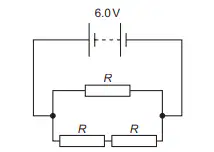
In the circuit shown, the battery has an electromotive force (e.m.f.) of 6.0V and negligible internal resistance. The three resistors each have resistance R. The total power dissipated in the resistor network is 24W. What is the value of R?
0.50 ohm
1.0 ohm
1.5 ohm
2.3 ohm
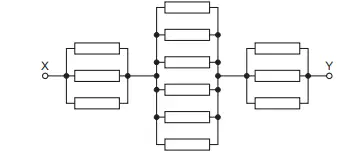
The diagram shows a network of resistors. Each resistor has a resistance of 6.0Ω. What is the total resistance of the network between points X and Y?
3.0Ω
5.0Ω
7.2Ω
18Ω

Which graph could show how the resistance R of a filament lamp varies with the applied potential difference (p.d.) V, as V is increased to the normal operating p.d.?
A
B
C
D
The potential difference across a metal wire is kept constant. The length l and the diameter d of the wire are both varied. The type of metal is kept the same. How is the current in the wire related to l and d ?
It is directly proportional to l and inversely proportional to d
It is directly proportional to l and inversely proportional to d^2 .
It is inversely proportional to l and directly proportional to d
It is inversely proportional to l and directly proportional to d^2 .
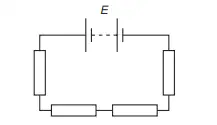
Some resistors and a battery of electromotive force (e.m.f.) E and negligible internal resistance are connected in series, as shown. Which statement is correct?
The e.m.f. across each resistor equals the potential difference across the battery.
The potential difference across each resistor equals the e.m.f. E of the battery
The sum of the e.m.f.s across the resistors equals the potential difference across the battery
The sum of the potential differences across the resistors equals the e.m.f. E of the battery.
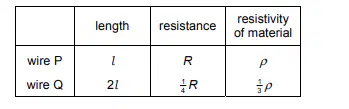
The table shows the properties of two different wires, P and Q. Wire P has a cross-section of diameter d. What is the diameter of the cross-section of wire Q?
0.41d
1.6d
2.7d
7.1d
A piece of conducting putty is in the shape of a cylinder of length 60 mm and diameter 20 mm. The resistance between the ends of the cylinder is 20Ω. What is the resistivity of the putty?
0.033Ω m
0.10Ω m
0.42Ω m
5.2Ω m
A metal wire has a length of 2.50 m and a cross-sectional area of 4.50 X 10^–6 m2 . The resistivity of the metal is 3.50 x 10^–7 ohm.meter. The wire is stretched so that its length increases to 2.65 m. The wire remains cylindrical and the volume of the wire remains constant. What is the change in the resistance of the wire?
0.012 ohm
0.024 ohm
0.19 ohm
0.22 ohm
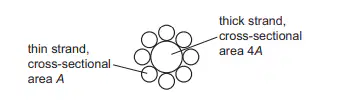
An electrical cable is made up of one thick strand of copper wire that is surrounded by eight thin strands of copper wire. All nine strands of wire are connected in parallel with each other. A cross-section of the cable is shown. Each thin strand of wire has cross-sectional area A and length L. The thick strand of wire has cross-sectional area 4A and length L. The cable has total resistance R. Which expression gives the resistivity of copper?


Which statement about the electromotive force (e.m.f.) of a cell is always correct?
The e.m.f. is the energy converted from electrical to other forms in the cell
The e.m.f. is the energy provided by the cell per unit charge passing through it.
The e.m.f. is the potential difference across the internal resistance of the cell.
The e.m.f. is the potential difference across the terminals of the cell.
What is the definition of the potential difference across an electrical component?
the resistance per unit current
the charge per unit time passing through the component
the force per unit charge
the energy transferred per unit charge
A cell has a constant electromotive force. A variable resistor is connected between the terminals of the cell. The resistance of the variable resistor is decreased. Which statement about the change of the cell’s terminal potential difference (p.d.) is correct?
The terminal p.d. is decreased because more work is done moving unit charge through the internal resistance of the cell.
The terminal p.d. is increased because more work is done moving unit charge through the variable resistor
The terminal p.d. is decreased because the current in the variable resistor is decreased.
The terminal p.d. is increased because the current in the variable resistor is increased.
Kirchhoff’s first and second laws are a consequence of the conservation of which quantities?
charge and energy
charge and resistance
mass and energy
mass and resistance
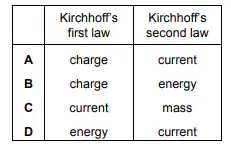
Kirchhoff’s two laws for electric circuits can be derived by using conservation laws. On which conservation laws do Kirchhoff’s laws depend?
A
B
C
D
A circuit contains a cell of electromotive force E and internal resistance r connected to a resistor of resistance R. The current in the circuit is I. Which equation is correct?
E + Ir = IR
E – Ir = IR
E = IR
E – Ir = IR
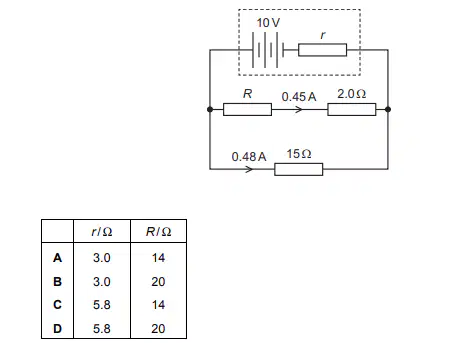
A battery of electromotive force (e.m.f.) 10V and internal resistance r is connected to three resistors of resistances R, 2.0Ω and 15Ω, as shown. A current of 0.45A is in the resistor of resistance 2.0Ω and a current of 0.48A is in the resistor of resistance 15Ω. What are the values of r and R?
A
B
C
D
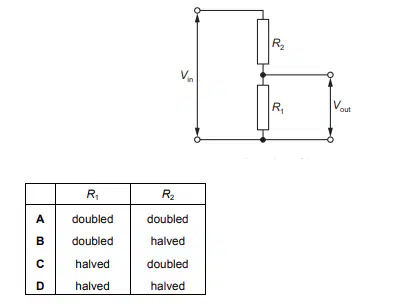
A potential divider consists of two resistors of resistances R1 and R2 connected in series across a source of potential difference (p.d.) Vin. The p.d. across R1 is Vout. Which changes to R1 and R2 will increase the value of Vout?
A
B
C
D
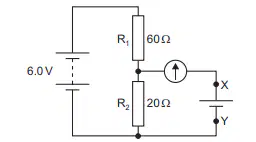
In the circuit shown, a battery of negligible internal resistance is connected in series with a pair of fixed resistors R1 and R2. The circuit is to be used to test whether the electromotive force (e.m.f.) of a particular cell is 1.5V. The cell is connected between terminals X and Y in parallel with R2 and in series with a galvanometer. Which statement about the test is correct?
Any non-zero reading on the galvanometer means the cell has an e.m.f. of 1.5V.
The battery does not need to have an e.m.f. of 6.0V.
The cell may be connected either way round between X and Y.
The galvanometer does not need a scale calibrated in amperes.

Four potential divider circuits each consist of a battery of electromotive force (e.m.f.) 9V and negligible internal resistance connected to a combination of resistors. Each of the resistors in the circuits has a resistance of X or 2X. Which circuit has the largest output voltage V?
A
B
C
D
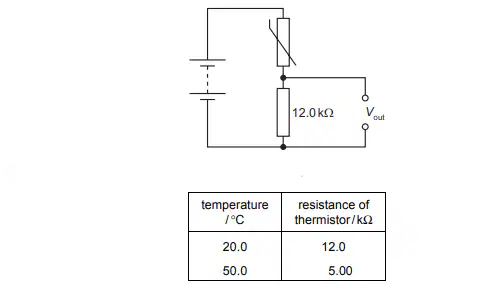
A battery of negligible internal resistance is connected in series with a thermistor and a fixed resistor of resistance 12.0kΩ, as shown. The table shows the resistance of the thermistor at two different temperatures.The potential difference Vout across the fixed resistor is 4.50V when the thermistor is at a temperature of 20.0°C. What is Vout when the thermistor is at a temperature of 50.0°C?
2.65V
3.18V
6.35V
10.8V
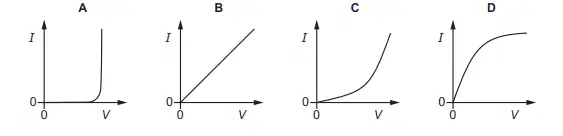
Which graph shows the I–V characteristic of a filament lamp?
A
B
C
D

A car has sensors for detecting the light intensity and temperature of its environment. The sensors make use of a light-dependent resistor (LDR) and a thermistor. The car moves from a warm and dark environment into a cold and bright environment. What are the changes to the resistances of the LDR and thermistor?
A
B
C
D

The two resistors shown are both uniform cylinders of equal length made from the same conducting putty.
The diameter of Y is twice that of X. The resistance of Y is R.
What is the total resistance of the combination?
54R
3R
4R
5R

A voltmeter is used to measure potential difference for a component X.
Which row gives the position and ideal resistance for the voltmeter?
A
B
C
D
The combined resistance of n identical resistors connected in parallel is Rn.
Which statement correctly describes the variation of Rn as n increases?
Rn decreases linearly as n increases
Rn decreases non-linearly as n increases
Rn increases linearly as n increases
Rn increases non-linearly as n increases

In the circuit below, the potential difference across the light emitting diode (LED) is 1.8 V when it is emitting light.The current in the circuit is 20 mA.
What is the value of the resistor R?
80 Ω
90 Ω
150 Ω
180 Ω

The table shows the resistivity, length and cross-sectional area of wires P and Q.
The resistance of wire P is R.
What is the total resistance of the wires when they are connected in parallel?
9R
3R
32R
23R

he figure shows a light dependent resistor (LDR) and fixed resistor R connected in series across a cell. The internal resistance of the cell is negligible.
Which row shows how the readings on the ammeter and the voltmeter change when the light intensity incident on the LDR is increased?
A
B
C
D
A wire has a resistance R.
What is the resistance when both the length and radius of the wire are doubled
4R
2R
2R
4R

The current in the cell is 10 A as shown.
What is the current in the 2.0 Ω resistor?
0.35A
2.86A
3.50A
7.14A

Which graph shows the variation of the resistance with temperature for an ntc thermistor?
A
B
C
D
Which statement about superconductors is correct?
When a material becomes a superconductor, its resistivity is almost zero.
The temperature at which a material becomes a superconductor is called the critical temperature.
When
current passes through a superconductor the pd across it becomes a maximum.
Copper is a superconductor at room temperature

Three cells each have an emf ε = 1.5 V and an internal resistance r = 0.6 Ω.
Which combination of these cells will deliver a total emf of 1.5 V and a maximum current of 7.5 A?
A
B
C
D
A battery of negligible internal resistance and an emf of 12 V is connected in series with a heating element. The heating element has a resistance of 6.5 Ω when in operation.
What is the energy transferred by the heating element when operating for 5 minutes?
111J
390J
6650J
23400J

A
B
C
D
A mobile phone operates at a constant power of 200 mW
It has a 3.7 V lithium-ion battery that has a charge capacity of 9400 C
What is the time taken for the battery to discharge completely?
2 hours
48 hours
120 hours
140 hours
A gas containing doubly-charged ions flows to give an electric current of 0.64 A
How many ions pass a point in 1.0 minute?
2.0 × 10¹⁸
4.0 × 10¹⁸
1.2 × 10²⁰
2.4 × 10²⁰
A student carries out an experiment to determine the resistivity of a metal wire.
She determines the resistance from measurements of potential difference between the ends of the wire and the corresponding current. She measures the length of the wire with a ruler and the diameter of the wire using a micrometer. Each measurement is made with an uncertainty of 1%
Which measurement gives the largest uncertainty in the calculated value of the resistivity?
current
diameter
length
potential difference

A
B
C
D
Which is equivalent to the ohm?
J C–2 s–1
J C–2 s
J s
J s–1

A circuit consists of two identical cells, a resistor, an ammeter and a voltmeter. The cells each have an emf of 3.0 V and the resistor has a resistance of 12 Ω
The cells have negligible internal resistance.
A
B
C
D

Which graph shows how power dissipated P varies with current I in a component that obeys Ohm’s law?
A
B
C
D
What is the direction of displacement of particles in longitudinal waves relative to the direction of energy propagation?
Perpendicular
Parallel
Random
None of the above
Which of the following is evidence for the nature of transverse waves?
Polarisation
Reflection
Refraction
Diffraction
At what speed do all electromagnetic waves travel in a vacuum?
3 x 10^8 m/s
1 x 10^6 m/s
2.5 x 10^8 m/s
5 x 10^8 m/s
What is the formula to calculate the speed of a wave?
c = λf
c = λ/f
c = fλ
c = f/λ
Which of the following is NOT an example of a transverse wave?
Polarised light
Waves on a string
Electromagnetic waves
Sound waves


What is the equation for total internal reflection?
sin Theta c = N1 / N2
sin Theta c = N2 / N1
cos Theta c = N2 / N1
cos Theta c = N1 / N2
What is the unit of refractive index?
Meter
Dimensionless
Radian
Second
2 points on a progressive wave are 1/3 of a wavelength apart. The distance between the two points is 2cm. If the speed of the wave is 10 ms-1 what is the frequency of the wave?
5Hz
20Hz
167Hz
1500Hz
What are the conditions for total internal reflection of light to occur
The light is travelling from a less optically dense medium to a more optically dense medium at an angle equal to the critical angle
The light is travelling between media of equal optical densities at an angle greater the critical angle
The light is travelling between media of equal optical densities at an angle equal to the critical angle
The light is travelling from a more optically dense medium to a less optically dense medium at an angle greater than the critical angle
The speed of light in a material is 1.7 x 10⁸ms-1. What is the refractive index of the material?
0.57
1.43
1.76
2.31
What is the energy in electron volts of a photon of ultra violet light of frequency 7.9 x 10¹⁴Hz?
3.27eV
1.48 eV
37.9 x 10⁴ eV
8.38 x 10-38eV
flint glass n=1.70
barium glass n=1.60
crown glass n=1.523
water n=1.33
diamond n=2.45
Photons of wavelength 290 nm are incident on a metal plate. The work function of the metal is 4.1 eV
What is the maximum kinetic energy of the emitted electrons?
0.19 eV
4.3 eV
6.9 eV
8.4 eV
A mobile phone operates at a constant power of 200 mW.
It has a 3.7 V lithium-ion battery that has a charge capacity of 9400 C
What is the time taken for the battery to discharge completely?
2 hours
48 hours
120 hours
140 hours
The resistance of a negative temperature coefficient (ntc) thermistor
increases as temperature increases.
is constant at temperatures below 0 °C.
increases as temperature decreases.
falls to zero when a critical temperature is reached.

Which dartboard contains a grouping of darts which are neither mathematically accurate nor precise?
A
B
C
D
Which dartboard contains a grouping of darts which are mathematically accurate, but not precise?
A
B
C
D
Which dartboard contains a grouping of darts which are mathematically precise, but not accurate?
A
B
C
D
Which dartboard contains a grouping of darts which are both mathematically precise, AND accurate?
A
B
C
D
Which shows the change in velocity, frequency and wavelength of an electromagnetic wave as it travels from an optically less dense to an optically more dense medium?
Velocity: decreases
Frequency: decreases
Wavelength: unchanged
Velocity: increases
Frequency: unchanged
Wavelength: increases
Velocity: decreases
Frequency: unchanged
Wavelength: decreases
Velocity: increases
Frequency: increases
Wavelength: unchanged

For waves on a water surface, the following graph shows how the displacement y of a water particle in the surface varies with the time t.
What are the quantities z and s?
z: frequency
s: amplitude
z: period
s: half-amplitude
z: wavelength
s: half-amplitude
z: period
s: amplitude
Sound waves cross a boundary between two media X and Y. The frequency of the waves in X is 400 Hz. The speed of the waves in X is 330 m s–1 and the speed of the waves in Y is 1320 m s–1. What are the correct frequency and wavelength in Y?
Frequency / Hz: 100
Wavelength / m: 0.82
Frequency / Hz: 400
Wavelength / m: 0.82
Frequency / Hz: 400
Wavelength / m: 3.3
Frequency / Hz: 1600
Wavelength / m: 3.3
Which statement is correct about the properties of an unpolarised electromagnetic wave as it passes through a polariser?
The wave remains unchanged.
The wave does not pass through the polariser.
The wave’s electric field oscillates along the direction of travel.
The intensity of the wave is reduced.

The graph shows how the vertical height of a travelling wave varies with distance along the path of the wave.
The speed of the wave is 20 cm s–1.
What is the period of the wave?
0.1 s
0.2 s
5.0 s
10.0 s
The sound quality of a portable radio is improved by adjusting the orientation of the aerial.
Which statement is a correct explanation of this improvement?
The radio waves from the transmitter are polarised.
The radio waves from the transmitter are unpolarised.
The radio waves become polarised as a result of adjusting the aerial.
The radio waves become unpolarised as a result of adjusting the aerial.
A progressive wave in a stretched string has a speed of 20 m s−1 and a frequency of 100 Hz.
What is the phase difference between two points 25 mm apart?
zero
π/4 rad
π/2 rad
π rad

A ray of light is incident on a glass–air boundary of a rectangular block as shown.
The refractive index of this glass is 1.5
The refractive index of air is 1.0
The angle of incidence of the light at the first glass–air boundary is 44°
What is the path of the ray of light?
A
B
C
D

Rays of light are incident at the same angle θ on the core–cladding boundary of optical fibres P and Q. The cores of P and Q have the same refractive index n.
P and Q are the same length L. The core diameter of P is half that of Q.
The time for the ray to travel along optical fibre P is (nL)/(csinθ) where c is the speed of light in a vacuum.
What is the time for the ray to travel along optical fibre Q?


An electromagnetic wave enters a fibre-optic cable from air. On entering the cable, the wave slows down to three-fifths of its original speed.
What is the refractive index of the core of the fibre-optic cable?
0.67
1.33
1.50
1.67

The diagram shows part of the path of a ray of light through a right-angled prism.
The prism is made of glass of refractive index 1.5.
The incident light ray is parallel to the face XY. The ray is refracted towards the face XY.
What is the path of the ray after it is incident on face XY?


Which row shows the change in velocity, frequency and wavelength of an electromagnetic wave as it travels from an optically less dense to an optically more dense medium?
A
B
C
D

The diagram shows a ray of light travelling in air and incident on a glass block of refractive index 1.5.
What is the angle of refraction in the glass?
22.5°
23.3°
33.1°
59.4°
A layer of liquid of refractive index 1.6 covers the horizontal flat surface of a glass block of refractive index 1.5. A ray of light strikes the boundary between them at an angle such that it travels along the boundary afterwards.
How does the ray strike the boundary?
it travels in glass at an angle of 70° to the boundary
it travels in glass at an angle of 20° to the boundary
it travels in the liquid at an angle of 70° to the boundary
it travels in the liquid at an angle of 20° to the boundary
Monochromatic light may be characterised by its speed, frequency and wavelength. Which of the following quantities change when monochromatic light passes from air into glass?
Speed only.
Speed and wavelength only.
Speed and frequency only.
Wavelength and frequency only.
Which of the following is correct when total internal reflection occurs?
the angle of incidence is less than the critical angle
the light meets an optically less dense medium
the light enters a medium with a higher refractive index
the angles that the incident and refracted rays make with the normal are the same
What is the speed of light in glass of refractive index 1.42?
4.26 × 10⁷ m s−1
2.11 × 10⁸ m s−1
3.00 × 10⁸ m s−1
4.73 × 10⁸ m s−1

Figures 1 and 2 each show a ray of light incident on a water-air boundary. A, B, C and D show ray directions at the interface. Which of the following corresponds to a direction in which a ray cannot occur.
A
B
C
D
Figures 1 and 2 each show a ray of light incident on a water-air boundary. A, B, C and D show ray directions at the interface. Which of the following corresponds to the direction of the faintest ray.
A
B
C
D

