
 Worksheets
matter in our surroundings ---- V
Total questions: 29
Worksheet time: 22mins
what do matter consist?
mass
volume
both mass and volume
Which one of the following is an example of a fluid?
Oxygen
Carbon
Phosphorus
Sulphur
235K = _________°C
38
-20
20
-38
Which of the following statements is NOT true?
The molecules in a liquid and a gas can flow.
The molecules in a liquid are arranged in a regular pattern.
The molecules in a gas move about randomly at high speed.
The molecules in a solid vibrate about a fixed position
Name the process by which dry ice changes into carbon dioxide gas.
Evaporation
Condensation
Sublimation
Vaporisation
At what temperature liquid water and steam co-exist?
At the melting point of ice
At the boiling point of water
At the freezing point of water
At the condensation point
Melting point of ice is
273.16K
373.15K
100°C
250.18K
Which of the following undergoes sublimation?
Sodium chloride
Potassium chloride
Ammonium sulphate
Ammonium chloride
In which of the following conditions, the distance between the molecules of hydrogen gas would decrease?
Increasing the pressure on hydrogen in a closed container
Increasing the volume of the container of hydrogen gas
Heating the container
Some hydrogen gas leaking out of container
Which one among the followings has a fixed volume but no fixed shape?
Carbon dioxide
Ice
Kerosene
Xenon
A few substances are arranged in the increasing order of ‘forces of attraction’ between their particles. Which one of the following is the correct arrangement?
oxygen – honey – sugar
oil – air– salt
juice – salt – oxygen
salt – air – sugar solution
The amount of heat which is used to change the state of matter not for increase the temperature is called
Latent heat
Specific heat
Heat capacity
None of the above.
Which of the following will produce severe burns ?
Cold water
Hot water
Boiling water
Steam
Ice floats on water because
it has higher density than water
it has lower density than water due to more volume
it is solid
it is low melting solid
Latent heat of fusion is amount of
heat energy required to change 1 kg solid into liquid completely at its melting point.
heat energy required to convert 1 kg solid into liquid at room temperature
heat energy required to change 1 g of solid into liquid completely
heat energy required to change 1 kg of solid into liquid at any temperature.
When heat is constantly supplied by a burner to boiling water, then the temperature of water during vapourisation
Rises very slowly
Rises rapidly until steam is produced
First rises and then becomes constant
Does not rise at all
When water at 0°C freezes to form ice at the same temperature of 0°C, then it
Absorbs some heat
Releases some heat
Neither absorbs nor releases heat
Absorbs exactly 3.34 x 10⁵J/kg of heat
A student heats a beaker containing ice and water. He measures the temperature of the content of the beaker as a function of time. Which of the following will correctly represent the result.
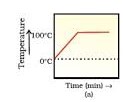
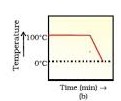
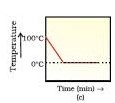
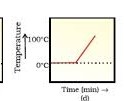
In which form, do the water molecules have less kinetic
energy?
(a) Ice
(b) Water
(c) Steam
(d) All of them have equal kinetic energy
Which of the following has highest kinetic energy?
(a) Particles of ice at 0 degree C
(b) Particles of water at 0 degree C
(c) Particles of water at 100 degree C
(d) Particles of steam at 100 degree C
235K = _________°C
38
-20
20
-38
At what temperature liquid water and steam co-exist?
At the melting point of ice
At the boiling point of water
At the freezing point of water
At the condensation point
Melting point of ice is
273.16K
373.15K
100°C
250.18K
The S.I unit of temperature is:
Celsius
Fahrenheit
Kelvin
None
On converting 308 K, 329 K and 391 K to Celsius scale, the correct sequence of temperatures will be:
33°C, 56°C and 118°C
35°C, 56°C and 119°C
35°C, 56°C and 118°C
56°, 119°C and 35° C
When water at 0°C freezes to form ice at the same temperature of 0°C, then it:
Absorbs some heat
Neither absorbs nor releases heat
Absorbs exactly 3.34 x 10⁵J/kg of heat
Releases some heat
When a solid is heated it's particles begin to vibrate with energy
true
false
Latent heat of vapourisation is amount of
heat energy required to change 1 kg liquid into vapours completely at its melting point.
heat energy required to convert 1 kg solid into liquid at room temperature
heat energy required to change 1 kg liquid into vapours completely at its boiling point.
heat energy required to change 1 kg of solid into liquid at any temperature.
20. For you, individually do you get an any better understanding of topics with my animations?
Answer Honestly with a little thinking.
Yes
No
It actually confuses me even more.
I don't know.

