
 Worksheets
2024 Midterm Review
Total questions: 53
Worksheet time: 27mins
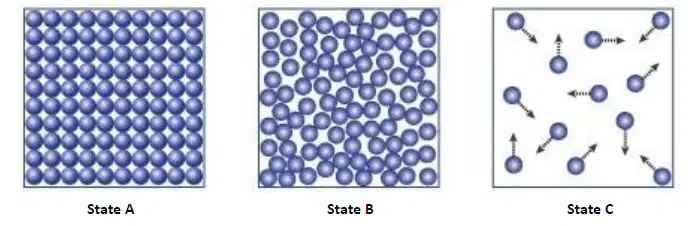
In which state of matter do the particles have the most energy?
State A
State B
State C
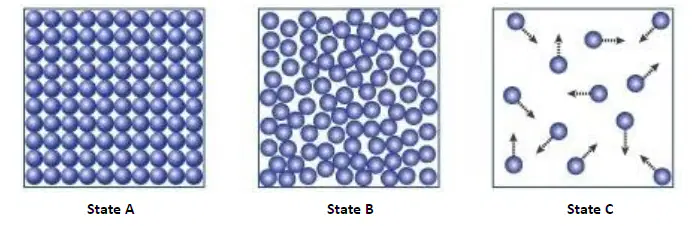
Which state of matter represents a liquid?
State A
State B
State C
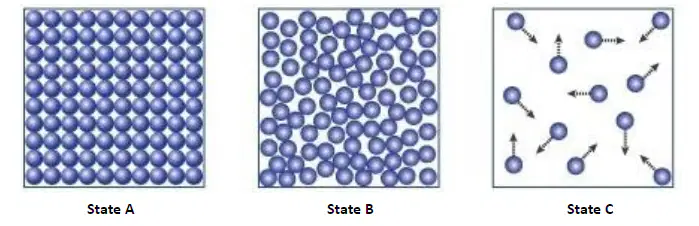
Which of the following describes what happens as a substance moves from State A to State B?
Potential energy is added.
Chemical energy is added.
Thermal energy (heat) is added.
Electrical energy is added.
In which state of matter is the connection between the molecules the strongest?
A gas
A liquid
A solid
All are equal
There is a solid wooden table with a cup of water sitting on it. Which of the following statements about the atoms & molecules of the table and the atoms & molecules of the water is TRUE?
The atoms and molecules of both the liquid water and the table are moving
The atoms and molecules of both the liquid water and the table are not moving.
The atoms & molecules of the liquid aren’t moving, & the atoms & molecules of the table are moving.
The atoms and molecules of the liquid water are moving, and the atoms and molecules of the table are not moving.
Earth’s gravity is 6 times greater than the moon’s gravity. If an object has a mass of 600 grams on Earth, what would its mass be if the object were transported to the moon?
600 grams
100 grams
60 grams
10 grams
Diane calculated the density of some objects in her science class. Which of the following measurements did Diane need to calculate the densities?
volume and mass
volume and weight
mass and temperature
mass and weight
Dissolving is testing what property?
relative density
solubility
mass
conductivity
Mass, relative density, solubility, color, texture, state of matter, conductivity, etc. are examples of what?
Physical state
Insulators
Physical Properties
Inferences
What type of molecules spread out and move fast?
Solid
Gas
Liquid
Nothing
The 3 states of matter are?
Idaho, Texas, and Florida
Matter, Mass, and Weight
Solid, Liquid, and Gas
Steel, Copper, and Brass
Anything that has mass and takes up space is called?
Volume
Matter
Magnetism
Electricity
What happens because particles in matter have energy?
The particles sometimes move.
You can see the particles move.
The particles stay rigid in all states.
The particles are always in motion
Which of the following is made up of atoms?
Heat and energy
Cells and rocks
Light and sound
Heat and Rocks
The elements of the periodic table ____________.
Have the same number of electrons.
Have the same number of protons.
Decrease in atomic mass from left to right.
Increase in atomic number from left to right.
How are elements on the periodic table arranged?
Atomic Mass
Atomic Number
Chemical symbol
State of matter
On the periodic table, how are elements in the same group (family) related to each other?
They have the same atomic mass.
They have very different properties.
They have the same atomic number.
They have similar properties
Using the periodic table, how can scientists find an element with properties similar to another element?
By comparing atomic masses
By finding its group or family
By comparing densities
By finding its period
An atom is _______.
Never moving.
Mostly empty space.
A compound.
A molecule.
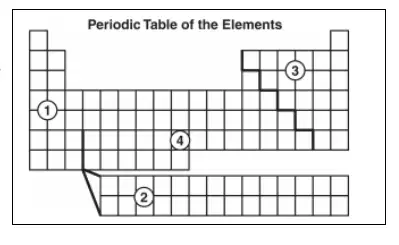
Use this diagram to answer the question. In which region would nonmetals be found?
Region 1
Region 2
Region 3
Region 4
The smallest particle into which an element can be divided and still be the same substance is called a(n) ____________.
Nucleus
Atom
Electron
Neutron
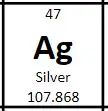
Identify the number of electrons in the element below:
108
107
47
61
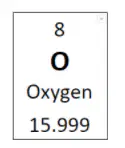
How many neutrons are in oxygen?
15
15.9
8
16
In 1911, Ernest Rutherford conducted his famous Gold Foil experiment. What did he learn from that experiment that led him to revise the current theory of atoms?
He concluded that atoms are made of tiny, solid, dense particles of matter.
He concluded that there must be particles included in the nucleus to hold the protons together.
He concluded that atoms are mostly empty space and electrons are not fixed in place, but move around a tiny, dense positively-charged nucleus.
He concluded that negatively-charged particles (electrons) are likely to be found in the nucleus of all atoms.
In general, why did the atomic theory change over time?
Scientists did experiments and gained new information about the structure of the atom.
Not enough scientists believed in the older models.
People got bored with the older atomic models.
Theories must change after a certain amount of time.
Which of the following substances is not a compound?
H₂O (water)
CO₂ (Carbon Dioxide)
NH₃ (Ammonia)
H₂ (Hydrogen)
Betty is mixing 20 grams of table salt (NaCl) into a beaker of 100 mL of water. She now needs to explain her procedures in making the solution in her science notebook. Which of the following terms should she use to describe the dissolved substance in the solution?
solute
mole
solvent
suspension
Which of the following is the best example to use to demonstrate a heterogeneous mixture?
Lemonade made of water, lemonade powder mix, and sugar.
An omelet made of scrambled eggs and cheddar cheese.
Trail mix made of raisins, peanuts, and chocolate candies.
A glass of ice water made of ice cubes and pure water.
Dawn noticed that each time before someone used the salad dressing, they needed to shake the bottle before pouring. When they set the bottle down, she could observe the ingredients of the salad dressing separating. Given Dawn's observations of the salad dressing, which of the terms below BEST describes the salad dressing?
mixture
element
solution
compound
Apple juice is an example of a(n) ________.
Compound
Heterogeneous mixture
Homogeneous mixture
Colloid
What type of mixture has easily seen, separate parts?
Colloid
Homogeneous mixture
Solution
Heterogeneous mixture
Which of the following does NOT describe a solution?
It is a mixture
It has the same properties throughout.
It contains a solvent and a solute.
It contains large particles that settle out.
Which of the following is an example of a homogeneous mixture?
Chicken noodle soup
Trail mix
Carbon dioxide
Tomato soup
Tom and Jerry were in science class. The teacher, Ms. Atkinson, was showing a short video on acids and bases. When the video stopped playing, she asked the following question: “Imagine you had a solution that had a pH of 5.2. Which of the following would you add in order to bring the pH to 7?”
A Base
An Acid
A Mixture
A Solution
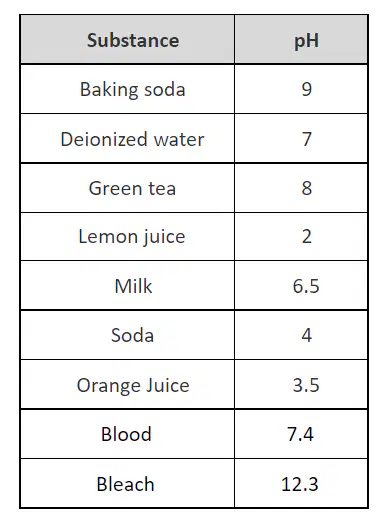
Which of the following should be categorized as an acid?
Baking Soda, Lemon Juice, Soda
Soda, Lemon Juice, Milk, Orange Juice
Deionized Water, Egg Whites, Lemon Juice
Baking Soda, Deionized water, Egg Whites, Baking Soda
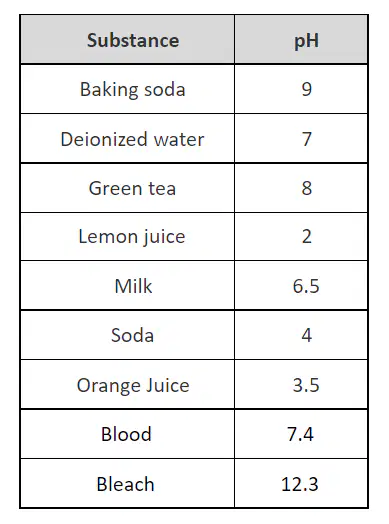
Based on the table below, what is the strongest acid?
Baking Soda
Green Tea
Milk
Lemon Juice
A neutral solution has a pH of _______.
7
1
3
9
When acids and bases of equal concentration come in contact with each other, they ________.
Explode
Become bitter
Make hydroxide
Neutralize each other
What substance is formed when an acid is combined with a base?
Acid
Salt
Base
Element
Which of the following values would represent the pH of a strong base?
1
3
7
13
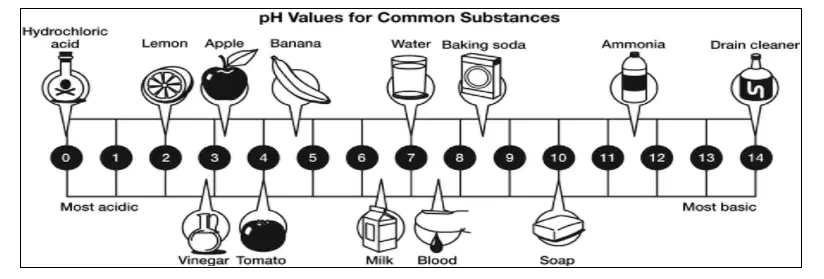
Based on the pH values given on the pH scale below, which of the following would be the most dangerous to handle?
Water
Soap
Apple juice
Hydrochloric Acid
Which of the following always results from a chemical reaction?
Fire
Bubbles
A new substance that is a solid
A new substance that can be a solid, liquid, or gas
Crumpling, then ripping paper is an example of a ___________.
Chemical Change
Chemical Reaction
Physical Change
Nothing, it's just paper
Which of the following shows a balanced chemical equation (the same number of atoms on each side)?




Which of the following is a physical change?
Burning Wood
Baking Cake
Rusty Nails
Boiling Water
Which statement best explains how temperature affects the rate of reaction for a chemical change?
As the temperature decreases, the rate of reaction increases
As the temperature increases, the rate of reaction increases
As the temperature increases, the rate of reaction stays the same
As the temperature decreases, the rate of reaction stays the same
A theory is different from a law. Which of the following describes a theory and NOT a law?
Theories are subject to change as scientists become famous.
Theories are subject to change as new evidence becomes available.
Laws are subject to change as scientists become famous.
Laws are subject to change as new evidence becomes available.
What variable is tested during an experiment?
Control Variable
Dependent variable
Independent variable
What variable is kept the same during an experiment?
Control Variable
Dependent variable
Independent variable
Greg was curious to know if different colors of light would affect the rate of photosynthesis in aquatic plants. He set up several tanks with the aquatic plants. The first tank was treated as a control group with normal conditions. The other tanks were given specific colors of light to grow the plants. Greg was able to record the rate of photosynthesis by counting the bubbles released by the plant. What was Greg’s tested variable (independent variable)?
the control group tank
the color of light
the rate of photosynthesis
the tanks with colored lights
In science, a hypothesis must be ___.
correct
controlled
manipulated
testable
A company wants to test a new dog food that is supposed to help overweight dogs lose weight. 50 dogs are chosen to get the new food, and 50 more continue their normal diets. After one month, the dogs are checked to see if they lost any weight. What is the Control variable?
Dogs given the normal diet
New dog food
Weight Loss
100 Dogs

