
 Worksheets
Weather Quiz Review 2023
Total questions: 48
Worksheet time: 2hrs 36mins
Regular, occasional, or rare conditions of weather, like thunderstorms, flooding, tornadoes, and snowstorms
weather conditions
weather events
Daily occurrences of weather, like temperature, atmospheric pressure, wind, and moisture that combine and interact to cause weather events
weather conditions
weather events
Can change day-to-day, hour-to-hour, or minute-to-minute
climate
weather
Minimum requirement of studying is 30 years
climate
weather
State of the atmosphere at a certain place and time
climate
weather
Occurs over a short period of time
weather
climate
NOT a factor in affecting an area's climate
Mars
human impact
land forms
winds
oceans
NOT a type of climate
subpolar
tropical
polar
highlands
cyclonic
Latin meaning is heap/pile; low clouds that indicate good weather if they are not too tall; wide and puffy and have flat bottoms
cumulonimbus
stratus
cirrus
cumulus
Latin meaning is layer; low clouds that may be associated with a light mist or drizzle and are usually gray in color
cumulonimbus
stratus
cirrus
cumulus
Latin meaning is curl/fringe; wispy, high clouds that usually indicate fair weather if there are a few; many in number means a cold front could be moving in
cumulonimbus
stratus
cirrus
cumulus
Latin name has both heap/pile and rainstorm/cloud; anvil shaped clouds start low but grow in height; associated with heavy rains and thunderstorms
cumulonimbus
stratus
cirrus
cumulus
The state of matter water turns into during evaporation
solid
liquid
gas
The state of matter that water is NOT when water vapor condenses in the sky to become clouds
solid
liquid
gas
Air that is heated will
rise and then cool.
sink and continue to warm.
rise and continue to warm.
sink and then cool.
Which process will occur when the water in a cloud becomes too heavy to stay suspended in the air?
Precipitate as a liquid
Precipitate as a liquid or a solid
Precipitate as a liquid or a gas
Evaporate as a liquid or a gas
Evaporate as a solid or a liquid
What are condensation nuclei?
Tiny particles of dust, salt, or pollution around which water vapor condenses on
Tiny particles of dust, salt, or pollution that destroy clouds
Tiny particles of dust, salt, or pollution that water vapor evaporates on
Tiny particles of dust, salt, or pollution around which water vapor precipitates on
Which process contributes the most to the creation of clouds in our atmosphere?
Rock Cycle
Carbon Cycle
Nutrient Cycle
Water Cycle
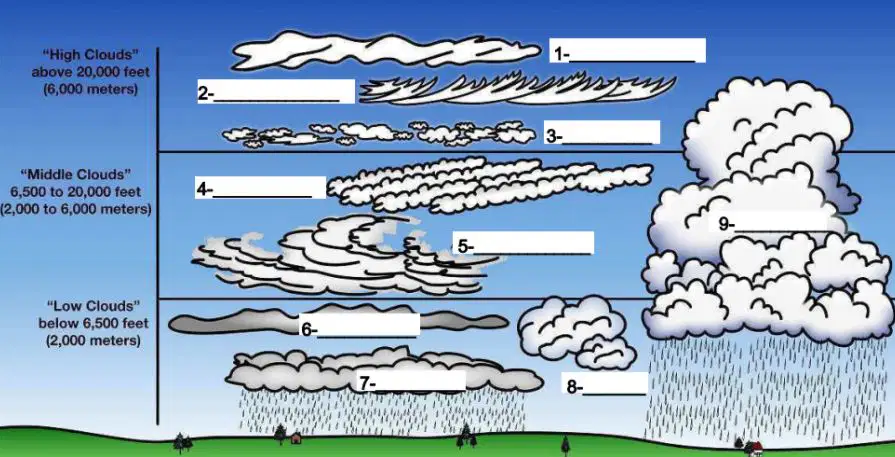
Cirrus cloud is number
4
2
7
5
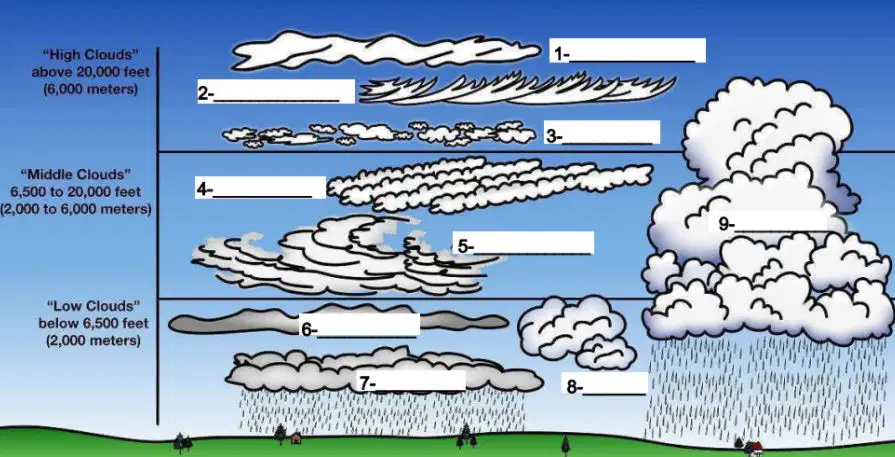
Stratus cloud is number
1
9
6
3
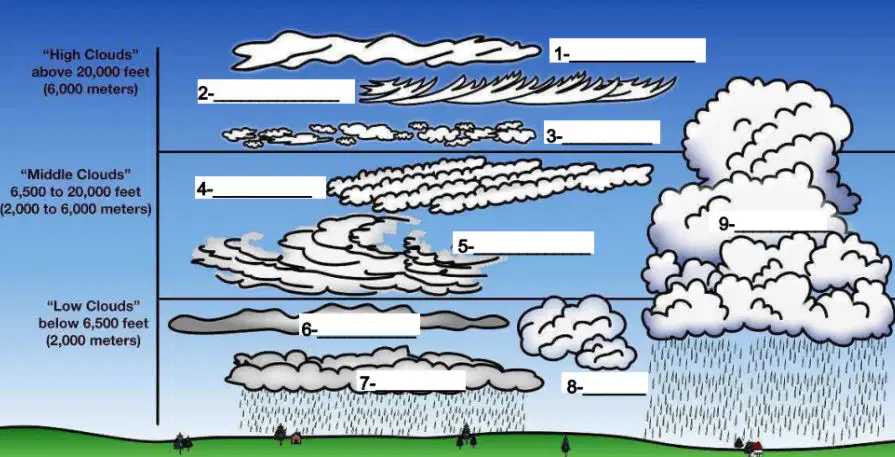
Cumulus cloud is number
4
2
5
8
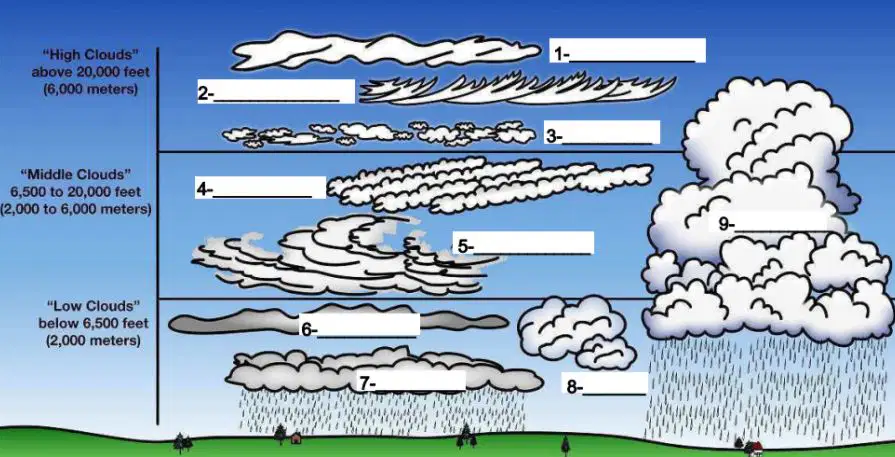
Cumulonimbus cloud is number
9
3
6
2
Prevailing winds traveling across large bodies of water affect climate by making it
more acidic
saltier
more humid
drier
Sunlight affects temperature of land and water by
increasing temperature of land but not temperature of water
increasing temperature of water but not temperature of land
increasing temperature of land and temperature of water
has no effect on temperature of land and water
Warm air rises in the atmosphere because
its density is higher than cool air.
its density is lower than cool air.
it has the same density as cool air.
Warm air doesn't rise. It falls.
A large body of air collected in a certain location with similar properties and moisture levels is known as _____.
air mass
temperature
wind
clouds
The moving air that is a result of convection is known as ____.
air mass
temperature
wind
clouds
_____ is the measurement for the amount of thermal energy in an object.
Air mass
Temperature
Wind
Clouds
An increase in thermal energy = _____ in speed, separation, and movement of particles of matter
increase
decrease
no change
A decrease in thermal energy = _____ in speed, separation, and movement of particles of matter
increase
decrease
no change
Explain how air that is in DIRECT CONTACT with the surfaces of Earth is heated.
Energy transfers from the sun to the surface, and conduction occurs from the air to the surface.
Energy transfers from the surface to the sun, and conduction occurs from the surface to the air.
Energy transfers from the sun to the surface, and conduction occurs from the surface to the air.
Energy transfers from the sun to the surface, and convection occurs from the surface to the air.
The energy that drives weather on Earth comes from _____.
the motion of Earth
the heat from Earth's core
the sun
the moon
Can the temperature of water affect the temperature of the air above the water?
Yes, only if the water is colder than the air, but not if the water is warmer than the air.
Yes, only if the water is warmer than the air, but not if the water is colder than the air.
Yes, if the water is warmer, or if the water is colder than the air.
No, because water does not change temperature.
Light traveling to Earth from the sun CANNOT be _____.
absorbed
scattered
reflected
transmitted
transfused
Majority of light that reaches Earth's surface is _____ making light energy convert to thermal energy
absorbed
scattered
reflected
transmitted
Occurs over a long period of time
weather
climate
Warm all year, no winter; near the equator; may be humid or dry
subtropical
tropical
polar
highland
cyclonic
Very cold; snow and ice covers land; may have permafrost
subtropical
tropical
polar
highland
cyclonic
North of the equator; cold air from the north and warm air from the south result in warm summers and colder winters
subtropical
tropical
polar
highland
cyclonic
North and south of the tropical climates; greater range of humidity and temperatures
subtropical
tropical
polar
highland
cyclonic
Great range of temperatures day/night; humid and cooler
subtropical
tropical
polar
highland
cyclonic
Transfer of energy in the form of light and / or heat
convection
conduction
radiation
Transfer of energy by indirect contact
convection
conduction
radiation
Transfer of energy by direct contact
convection
conduction
radiation
Light can be _____ back into space by Earth’s surfaces (24%).
absorbed
reflected
scattered
transmitted
Light can _____ when it hits gasses, clouds, water droplets, etc.
absorb
reflect
scatter
transmit
Light can _____ gasses, clouds, etc.
absorb
reflect
scatter
transmit
The majority of light from the sun is _____ either by Earth’s surface (51%) or clouds.
absorbed
reflected
scattered
transmited

