

wayground logo

Free Printable Worksheets

Font size

S
M
L
XL
Worksheets

Membrane structure and function

Total questions: 12

Worksheet time: 6mins

Name
Class
Date
1.
Which of these are functions of the cell membrane? Check all that apply.
a)
Acts as a barrier separating the interior and the external environment.
b)
Regulates the transport of substances into and out of the cell.
c)
Provides rigid structure for the cell.
d)
Allows for communication between the cell and its environment or other cells in the body.
e)

Source of long-term energy storage for the cell

2.

Which of the following macromolecule types are NOT found in the cell membrane?

a)

Glycolipids

b)

Polysaccharides

c)

Proteins

d)

Nucleic Acids

3.
Which of the following best describes the structure of the phospholipids in the plasma membrane?
a)
Hydrophobic phosphate heads align in the center of a double layer; hydrophilic tails point out towards the aqueous interior and exterior.
b)
Phospholipids form a single layer with the hydrophilic heads pointing towards the exterior of the cell.
c)
Phospholipids form two layers. Hydrophilic phosphate heads point to the aqueous interior and exterior; hydrophobic tails point towards each other in the center.
d)
Phospholipids form a single layer with the hydrophobic tails pointing towards the exterior environment and the hydrophilic heads pointing towards the interior of the cell.
4.

Which of the following should be unable to cross the phospholipid barrier of the membrane without assistance? Check all that apply
a)
Na+
b)
Glucose
c)
Proteins
d)
O2
e)
CO2
5.
Certain membrane proteins connect the extracellular matrix to the internal cytoskeleton. Which of the following must be true about this type of protein?
a)
It must be an integral protein.
b)
It must be a peripheral protein
c)
It must be shorter than a single phospholipid.
d)
It must float around freely in the fluid mosaic.
6.
Why do we describe the membrane as a “fluid mosaic.”
a)
While the membrane is made out of many different parts, only the phospholipids can move freely in the membrane.
b)
The membrane has many different proteins attached to it that “float” around the outside without disturbing the phospholipid layer below.
c)
The membrane is made out of phospholipids, proteins, cholesterol, and carbohydrates which all float fluidly around the membrane.
d)
The membrane is made out of many different types of lipids which form a barrier separating the fluid inside and outside of the cell.
7.
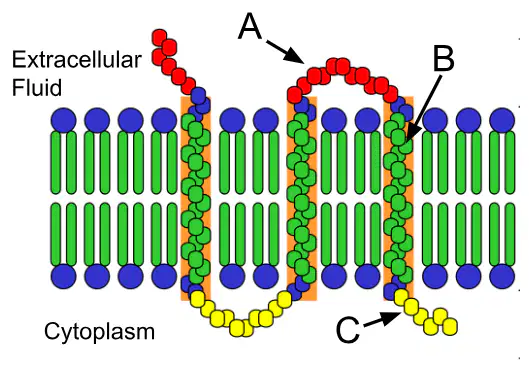
The diagram below shows the trans-membrane portions of a membrane-bound protein. Which of the following could be said about parts A, B, and C of the protein?
a)
A and B are hydrophilic, C is hydrophobic
b)
A and C are hydrophilic, B is hydrophobic
c)
A, B, and C are hydrophilic
d)
A and C are hydrophobic, B is hydrophilic
8.

Which of the following play a role in providing stability and fluidity at BOTH warm and cold temperatures?

a)
Saturated fatty acids
b)
Unsaturated fatty acids
c)
Cholesterol
d)
Glycoproteins
9.
How do larger substances like amino acids, sugars, and ions enter and leave the cell?
a)
Directly through the phospholipid bilayer.
b)
They can only enter and leave the cell when the membrane ruptures.
c)
They surround themselves with water molecules to trick the membrane into letting them through.
d)
They pass through the membrane barrier with the help of protein channels, transporters, and/or pumps.
10.
While reaching into a muddy drainpipe to retrieve a dropped earbud, Rina cuts her finger on a dirty piece of glass. Which of the following molecules helps her immune system differentiate her own cells from those of any microbes trying to invade her body through the cut in her finger?
a)
Glycoproteins
b)
Unsaturated fatty acids
c)
Cholesterol
d)
Receptor proteins
11.

Insulin is produced by pancreatic cells in response to elevated blood glucose levels. Insulin causes cells in the liver, muscles, and fatty tissue to activate glucose transporters to pull the excess glucose from the blood. To which of the following would insulin need to bind to first to initiate the uptake of glucose by these cells?
a)
Directly to genes in the nucleus.
b)
Unsaturated fatty acids in membrane phospholipids.
c)
Cholesterol in the cytoplasm of the cell.
d)
Receptor proteins on the cell membrane.
12.

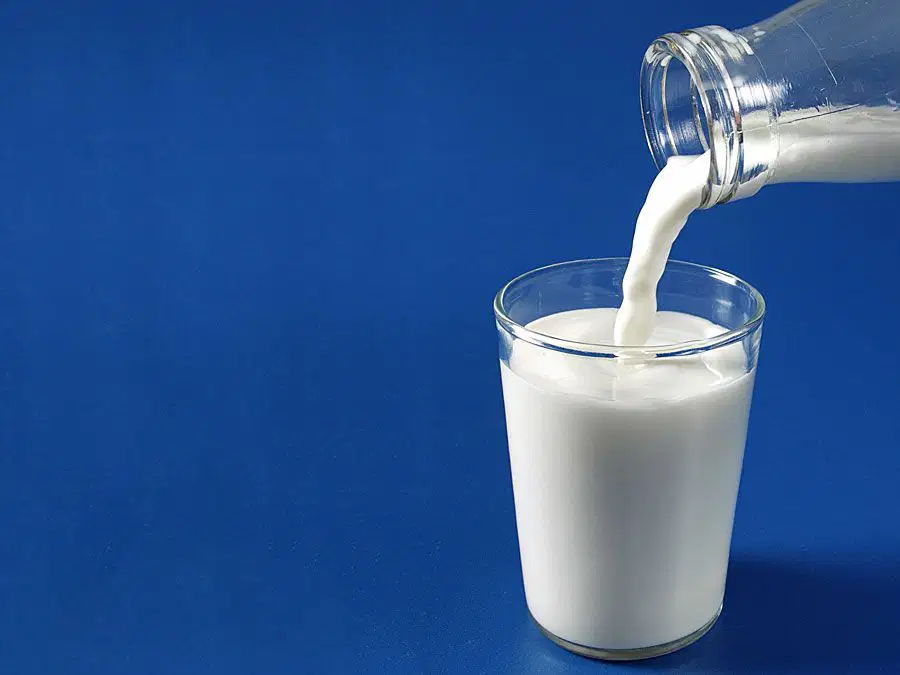
Fats in milk are found as globules of triglycerides surrounded by phospholipids dissolved in water. While a typical cell has a plasma membrane about 5 nm thick, milk fat globules have a membrane only 2.5 nm thick. Which of the following descriptions is most likely to be the structure of phospholipids in milk fat globules?

a)

A single layer of phospholipids surrounds the globule of triglycerides with the heads pointed towards the water and tails to the lipid center

b)

Phospholipids form a bilayer with the heads in the middle and the tails pointed towards the fats on one side and the water on the other

c)

A single layer of phospholipids surrounds the globule of triglycerides with the head oriented to the lipid center and the tails towards the water.

d)

Phospholipids form a bilayer with the heads pointed towards the water on the outside and the lipids in the middle.
