wayground logo

Free Printable Worksheets

Font size

S
M
L
XL
Worksheets

MP2 Science Content Overview 2024

Total questions: 44

Worksheet time: 48mins

Name
Class
Date
1.

Tides are caused by the difference in the gravitational force of the ________ and ________ across the ________.

a)

earth, sun, moon

b)

sun, mars, jupiter

c)

sun, moon, earth

d)

tide, water, sun

2.

A[n] ___________ tide occurs when the sun, Earth, and the moon are nearly in a line.

a)

spring

b)

high

c)

low

d)

neap

3.

A[n] ______________ tide occurs when the sun is at right angles to the line between Earth and the moon.

a)

high

b)

neap

c)

low

d)

spring

4.

Wha type of tide would this arrangement of earth-moon-sun create?

a)

full moon tide

b)

new moon tide

c)

neap tide

d)

spring tide

5.
What type of tides would this arrangement of earth-moon-sun create?
a)
neap tide
b)
spring tide
c)
new moon tide
d)
full moon tide
6.
What causes tides?
a)
gravity
b)
wind
c)
spring
d)
neap
7.

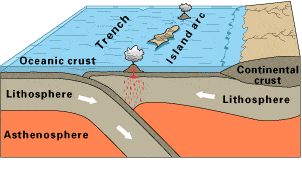
Observe this diagram of a plate boundary. One statement BEST describes what is happening. It is that

a)

the oceanic crust is melting.

b)

the denser ceanic crust is subducting under the less dense oceanic crust

c)

volcanic islands are forming.

d)

the tectonic plates are moving away from each other.

8.

The movement of the tectonic plates is caused by

a)

the rotation of the Earth.

b)

convection currents in the Asthenosphere

c)

the gravity of the iron-nickel core.

d)

the Moho discontinuity.

9.

Most geologists think that the movement of Earth’s plates is caused by _______

a)

convection.

b)

continental drift.

c)

subduction.

d)

conduction.

10.

A place where two plates slip past each other, moving in opposite directions, is known as a _______

a)

transform boundary

b)

divergent boundary.

c)

convergent boundary.

d)

rift valley.

11.

The place where two plates come together is known as a _______

a)

transform boundary.

b)

divergent boundary.

c)

convergent boundary.

d)

rift valley.

12.

Below is a picture of sea-floor spreading. How are the ocean crusts moving?

a)

Converging

b)

Diverging

c)

Sliding

d)

No movement

13.

The San Andreas Fault in California is known as an active earthquake area. What type of

boundary is it?

a)

Converging

b)

Diverging

c)

Transform

d)

Sea Floor Spreading

14.

Ocean Ridges are formed by _______ plate boundaries

a)

Convergent Oceanic / Continental

b)

Convergent Continental / Continental

c)

Convergent Oceanic / Oceanic

d)

Divergent

15.

The distance the medium rises depends on the (a)   of the wave.

16.

The distance between two corresponding parts of a wave is its (a)   .

17.
Which letter represents the wave crest?
a)
A
b)
B
c)
C
d)
D
18.
Why do we experience the changing of the season on the earth?
a)
distance from the sun
b)
rotation of the earth
c)
change in solar output
d)
tilt of the earth's axix
19.
Why is the Equator warmest?
a)
Because it is closest to the sun.
b)
Because it receives the most direct sunlight
c)
Because no clouds form here.
d)
Because it is far from the sun
20.
Which season is taking place in the Southern Hemisphere in Position 1?
a)
Winter
b)
Spring
c)
Summer
d)
Fall
21.
What are the reasons for the season?
a)
Earth's tilt & rotation
b)
Earth's tilt & revolution
c)
Earth's rotation & rovolution
d)
Earth's tilt & resolution
22.
The hemisphere where you live 
a)
equator
b)
southern
c)
northern
d)
eastern
23.
What causes there to be longer number of hours of light during the summer
a)
Earth tilt's away from the sun in summer
b)
Earth's revolves slower in summer
c)
Earth tilts toward the sun in summer
d)
Earth is closer to the sun
24.
In the diagram given, what happens as we move to the left?
a)
Stars Get Larger
b)
Stars get Colder
c)
Stars get hotter
25.
Which of these stars is hottest?
a)
Red Star
b)
Yellow Star
c)
Orange Star
d)
Blue Star
26.
Which star is the coldest?
a)
Yellow Star
b)
Red Star
c)
Orange Star
d)
Blue Star
27.
Compared to the rest of the stars, our sun is considered...
a)
Extremely Large and Cold
b)
Small with a medium temperature
c)
Medium size with medium temperature
28.
Which category is our Sun located in?
a)
White Dwarfs
b)
Supergiants
c)
Main Sequence
d)
Giants
29.

Which best describes stars in area C

a)

Brighter and Hotter

b)

Brighter an Cooler

c)

Dim and Hotter

d)

Dim and Cooler

30.

Which description best describes area B

a)

Brighter and Hotter

b)

Brighter and Cooler

c)

Dimmer and cooler

d)

Dimmer and Hotter

31.

Which best describes area D?

a)

Brighter and Cooler

b)

Brighter and Hotter

c)

Dimer and Cooler

d)

Dimmer and Hotter

32.
Which spectral class does our star, the sun, belong to?
a)
M
b)
K
c)
G
d)
F
33.
Galaxies are composed of (best answer)
a)
stars
b)
stars and gas
c)
stars, dust, and gas
d)
stars, dust, and gas held together by gravity
34.
The Milky Way Galaxy is a 
a)
spiral
b)
lenticular
c)
elliptical 
d)
irregular
35.
What type of galaxy is this?
a)
Spiral
b)
Elliptical
c)
Irregular 
d)
Irrational
36.
What type of galaxy is this?
a)
Spiral
b)
Elliptical
c)
Irregular
d)
Irrational
37.
What type of galaxy is this?
a)
Spiral
b)
Elliptical
c)
Irregular
d)
Irrational
38.

What galaxy do we live in?

a)

Irregular Galaxy

b)

Spiral Galaxy

c)

Elliptical Galaxy

d)

The toilet

39.
What is the name of our galaxy? 
a)
Our galaxy is called the Milky Way galaxy 
b)
Our galaxy is called the Andromeda galaxy 
c)
Our galaxy is called the Grand spiral  galaxy. 
d)
Our galaxy is called the Whirlpool galaxy.
40.
A _____ is body made of gas, held together by gravity and generates light by nuclear fusion.
a)
star
b)
galaxy
c)
nebula
d)
black hole
41.

Earth's spinning motion is called

a)

Revolution

b)

Orbit

c)

Rotation

d)

Leap Year

42.

The movement of the Earth around the Sun is called its _____

a)

revolution

b)

rotation

c)

precession

d)

regression

43.
In this simple diagram, the motion of both the blue and yellow dots can best be described as -
a)
Rotation
b)
Revolution
44.
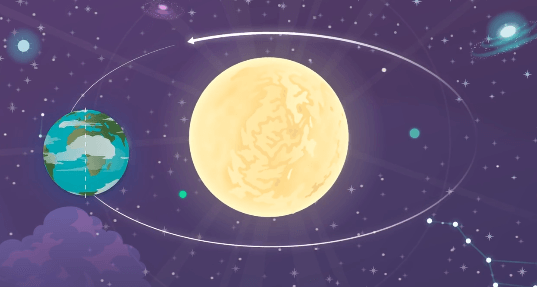
In this diagram, the motion of the Earth can best be described as -
a)
Rotation
b)
Revolution