
Font size
 Worksheets
Quiz on Mass and Conservation of Mass
Total questions: 21
Worksheet time: 5hrs 15mins
The amount of matter in an object is its ___________.
volume
density
mass
weight
Balance the chemical equation: ___FeBr₃ + ___H₂SO₄ → ___Fe₂(SO₄)₃ + ___HBr
2FeBr₃ + 3H₂SO₄ → Fe₂(SO₄)₃ + 6HBr
FeBr₃ + H₂SO₄ → Fe₂(SO₄)₃ + HBr
2FeBr₃ + 3H₂SO₄ → 2Fe₂(SO₄)₃ + 3HBr
2FeBr₃ + 3H₂SO₄ → Fe₂(SO₄)₃ + 3HBr
True or False: Mass is conserved in physical but not chemical changes in matter.
True
False
When a candle burns, all that remains is a small puddle of wax. The rest of the candle’s mass was
destroyed
changed to gases
measured incorrectly
none of above
A puddle of water slowly shrinks in the sun. After a few hours, the puddle has dried up completely. Is this an exception to the Law of Conservation of Mass?
Yes, because the water disappears.
No, because the water evaporates into the air.
Yes, because mass is lost.
No, because mass is destroyed.
True or False: Fire destroys the mass of the fuel that it burns.
True
False
True or False: The products of a chemical reaction can never have greater mass than the reactants.
True
False
Balance the chemical equation: ___C₅H₁₂ + ___O₂ → ___CO₂ + ___H₂O
C₅H₁₂ + 8O₂ → 5CO₂ + 6H₂O
C₅H₁₂ + 8O₂ → 5CO₂ + 12H₂O
C₅H₁₂ + 8O₂ → 5CO₂ + 5H₂O
C₅H₁₂ + 8O₂ → 5CO₂ + 8H₂O
In science, a law is
A rule governing what you are permitted to do.
A general rule about how the physical universe works.
A legal document that describes a rule of conduct.
A statute enacted by a legislative body.
What is true about a substance with a lot of mass?
It contains a lot of matter.
It has a large volume.
It has a high density of particles.
It has low frequency.
4 grams of hydrogen and 32 grams of oxygen will combine to form:
36 grams of water
28 grams of hydroxide
32 grams of oxygen
36 grams of deuterium
Which of the following describes a chemical reaction?
Oxygen interacts with iron to form rust
Ice melts into liquid water
Frozen carbon dioxide sublimates into gas
Rocks split apart after myriad years of weathering
Please balance the following equation: ___Fe + ___Cl₂ → ___FeCl₂
1, 1, 1
1, 2, 1
2, 1, 2
2, 2, 2
Balance the chemical equation: ___Fe + ___O₂ → ___Fe₂O₃
4Fe + 3O₂ → 2Fe₂O₃
2Fe + 3O₂ → 2Fe₂O₃
3Fe + 2O₂ → 2Fe₂O₃
2Fe + O₂ → Fe₂O₃
Balance the chemical equation: ___Al + ___Fe₂O₃ → ___Al₂O₃ + ___Fe
2Al + Fe₂O₃ → Al₂O₃ + 2Fe
2Al + 3Fe₂O₃ → Al₂O₃ + 6Fe
2Al + Fe₂O₃ → Al₂O₃ + Fe
4Al + 3Fe₂O₃ → 2Al₂O₃ + 6Fe
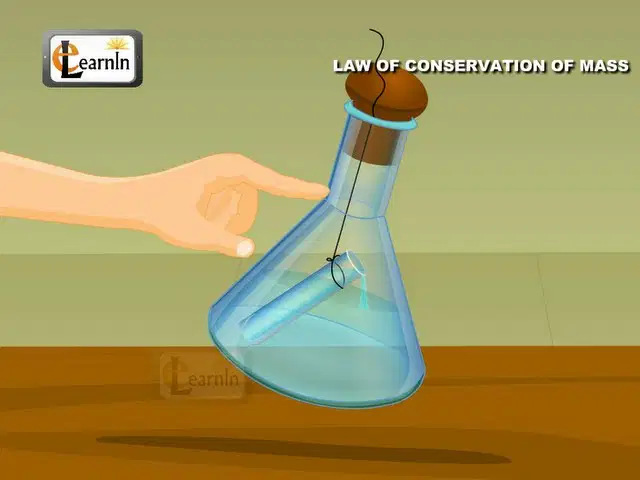
Please state the Law of Conservation of Mass in your own words and please provide at least one example.
Balance the following equation. Show your work.
KNO3 → KNO2 + O2

Balance this equation
_Al +_HCl --> _H2 +_AlCl3
2, 6, 3, 2
it is already balanced
4, 12, 3, 4
2, 1, 4, 5
Balance this equation-
__P4 + __O2 --> __P2O3
it is already balanced
2, 1, 3
1, 2, 3
1, 3, 2
Why can mass seem to "disappear" in open systems during a chemical reaction?
Because mass can be destroyed in an open system.
Because some products may be gases that escape into the atmosphere.
Because the Law of Conservation of Mass does not apply in open systems.
Because the reactants are not fully used up in the reaction.
In the equation 2H2+O2→2H2O , how does the Law of Conservation of Mass apply?
The mass of H2 and O2 is less than the mass of H2O produced.
The mass of H2 and O2 is greater than the mass of H2O produced.
The total mass of reactants equals the total mass of products.
The mass of H2O produced is twice the mass of H2 and O2 used.

