
 Worksheets
2024 AP Euro Final Exam
Total questions: 20
Worksheet time: 30mins

Vasari’s painting depicts an episode called the Saint Bartholomew’s Day Massacre (1572).
The above picture depicts which two groups engaged in battle?
The French Huguenots and Catholics
French and Austrian soldiers
Catholics and Anabaptists
Peasants and nobles
The use of propaganda through writing and imagery such as that seen above proliferated during the era of religious conflict in Europe, making which of the following a crucial reason for the success of the Protestant Reformation?
The widespread use of ballads as a way to share information between towns and villages.
The implementation and proliferation of the printing press.
The political conflict between the Catholic Church and Germanic princes.
The greatly improved travel network in the Holy Roman Empire.
Which of the following factors most influenced the image above depicting opposing groups regulating public morals.
The spread of Anabaptist ideas and ideals from Muenster to France causing armed insurrection.
The spread of Austrian nationalism throughout the Germanic states and Italy.
The spread of Calvinist ideas and ideals from Geneva into France causing religious conflict.
The spread of Anglicanism from England causing religious conflict.
The clash depicted above sparked a greater conflict sometimes characterized by historians as a civil war that was ended by which of the following movements toward religious toleration?
Elizabeth I issued her Elizabethan Settlement allowing private worship.
Louis XIV issued the Edict of Fontainebleau allowing many Protestants to worship as they pleased in fortified towns.
Henry of Navarre converted back to Catholicism, became Henry IV of France, and issued the Edict of Nantes allowing many Protestants to worship as they pleased in fortified towns.
The peace of Westphalia in 1648 allowed Calvinism to be practiced by people in principalities whose leaders chose to follow that religion and its offshoots.
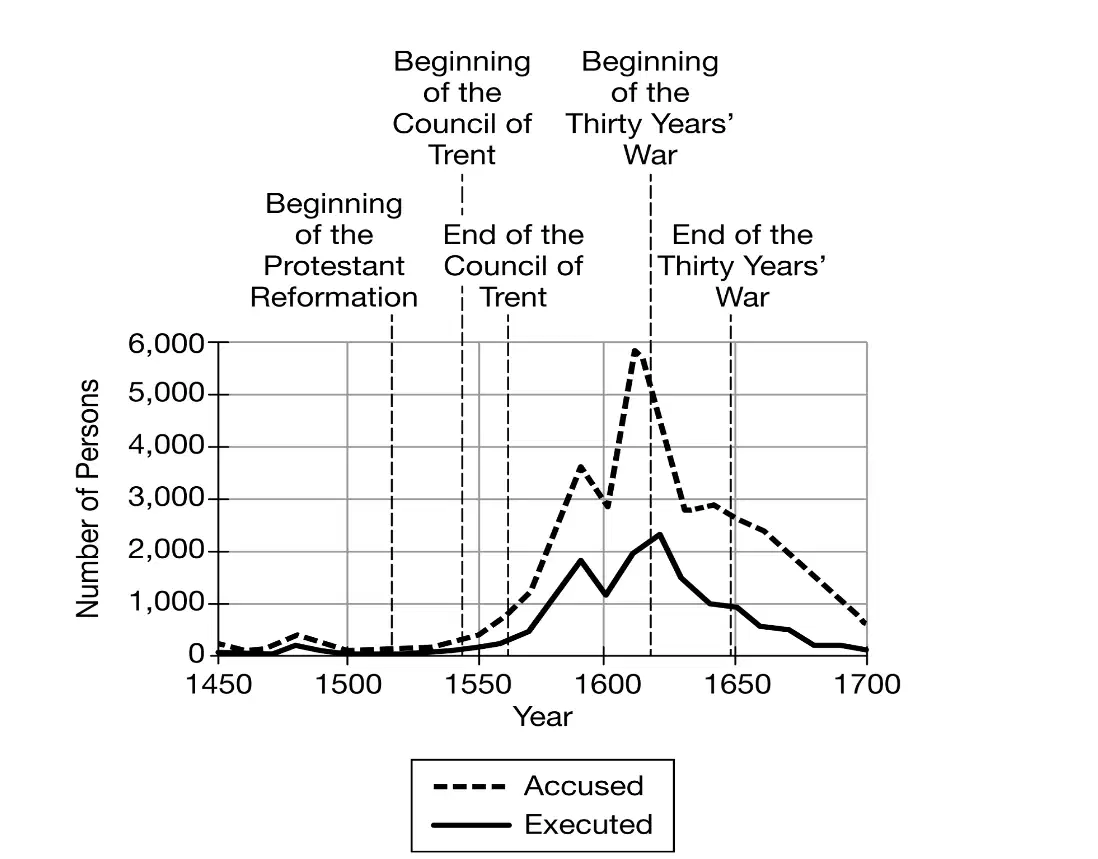
Which of the following most accurately describes a significant trend in witchcraft prosecutions shown by the graph?
The number of prosecutions increased sharply in the late 1500s and decreased sharply in the late 1600s.
The number of prosecutions increased continually throughout the period covered by the graph
The number of prosecutions increased steadily from 1550 to 1650.
The number of prosecutions from 1450 to 1600 remained largely the same each decade.

The patterns in the graph most strongly support which of the following conclusions about witchcraft prosecutions in the early modern period?
Witchcraft prosecutions are closely associated with economic stress.
Witchcraft prosecutions are closely associated with religious conflict.
Witchcraft prosecutions are closely associated with state centralization.
Witchcraft prosecutions are closely associated with immigration.
“[Parliament] being now assembled in a full and free representation of this nation…asserting their ancient rights and liberties declare…
That the pretended power of suspending the laws or the execution of laws by regal authority without consent of Parliament is illegal;
That the pretended power of dispensing with laws or execution of laws by regal authority without consent of Parliament is illegal….
That levying money for or to the use of the Crown by pretense of prerogative, without grant of Parliament is illegal….
That the freedom of speech and debates or proceedings in Parliament ought not to be impeached or questioned in any court or place outside of Parliament…
That the raising or keeping a standing army within the kingdom in time of peace, unless it be with the consent of Parliament, is against the law.…”
English Parliament, the Bill of Rights, 1689
The Bill of Rights challenged the traditional absolutist argument that:
the monarch should respond to the wishes of the people.
a powerful monarchy is needed to provide political stability.
the aristocracy and the church should share power with the king.
monarchical control is essential for encouraging free trade.
The excerpt of the document above most directly refers to which of the following policies of earlier Stuart rulers?
The creation of impositions to tax without parliamentary consent.
The failure to enforce the Test Act. (designed to exclude Catholics and Protestants (not part of the Church of England) from holding positions of power.)
The appointment of court favorites to positions they were unqualified for
The increasingly pro-Catholic sentiments of the Stuart monarchs
At last it seems to me that I have come to understand why man is the most fortunate of all creatures and conse-
quently worthy of all admiration. . . . The nature of all other beings is limited. . . . Imagine! The great generosity
of God! The happiness of man! To man it is allowed to be whatever he chooses to be!
Pico della Mirandola, Oration on the Dignity of Man, 1486
Pico della Mirandola was participating in which
cultural movement?
The Renaissance
The Reformation
The Scientific Revolution
The French Revolution
Pico della Mirandola believed that humankind
was unique in what way?
Human beings have a soul.
The potential of the human being is unlimited.
It is possible for human beings to go to heaven.
Human beings know that they will die.
Pico della Mirandola rejected which of the following notions?
That man was a unique kind of creature
That God intended man to strive to achieve
That man is unworthy of admiration
That humans are God’s equals
We have, by this perpetual and irrevocable edict, established and proclaimed:
“First, that the recollection of everything done be one party or the other . . . during all the preceding period of
troubles, remain obliterated and forgotten, as if no such things had ever happened. . . .
“We ordain that the Catholic Apostolic and Roman religion shall be restored and reestablished in all places and
localities of this our kingdom and countries subject to our sway, where the exercise of the same has been interrupted,
in order that it may be peaceably and freely exercised, without any trouble or hindrance. . . .
“And in order to leave no occasion for troubles or differences between our subjects, we have permitted, and
herewith permit, those of the said religion called Reformed to live and abide in all the cities and places of this our
kingdom and countries of our sway, and without being annoyed, molested, or compelled to do anything in the
matter of religion contrary to their consciences. . . .”
Henry IV of France, The Edict of Nantes, 1598
From the passage, one may infer, clearly guess, that
before 1598, France was stricken with religious conflict
before 1598, France had been free of religious conflict
Henry IV was a Protestant
Henry IV was a Catholic
The Edict of Nantes proclaimed which of the following?
The Catholic Church caused too much trou-
ble and hindrance in France.
The Catholic Church is the one true Church
The Catholic Church could exist in France.
The Catholic Church in France was banned.
Henry IV proposed which of the following in the Edict?
His own conversion to Protestantism
His own conversion to Roman Catholicism
Allowed Protestants to be able to live peacefully in his kingdom
Banning Protestants from France
Which invention played a crucial role in spreading the ideas of the Reformation across Europe?
The compass
The telescope
The printing press
The steam engine
What was an important effect of the invention of the printing press?
Gutenberg used his wealth from the invention to support artists
it led to the development of public libraries
it led to renewed study of Latin and Greek
it increased literacy and the use of the vernacular
Which classical civilization was a major influence on Renaissance humanism?
Mesopotamian
Egyptian
Greek and Roman
Chinese
How did humanism influence the art of the Renaissance?
Artists focused more on abstract, non-representational forms
Art became more focused on religious themes
Artists emphasized realism, human emotion, and the human form
Art was used primarily for propaganda purposes
Which of the following was a key cause of the Protestant Reformation?
The invention of the steam engine
Corruption within the Catholic Church
The signing of the Magna Carta
The fall of the Byzantine Empire
Who was a leading figure of the Protestant Reformation?
Leonardo da Vinci
Martin Luther
Galileo Galilei
Isaac Newton
Henry VIII had three children. What were their names?
Elizabeth I
Elizabeth II
Edward VI
Mary I
James VI

David by Michelangelo Buonarroti (1501-1504)
Michelangelo's David displays which of the following thematic innovations of Renaissance artists?
Depiction of religious persons
Accurate human anatomy
The use of marbel as a material
The portrayal of enigmatic expressions
The sculpture of David was placed in front of the new Republic's town hall, the Palazzo della Signoria, in Florence, facing Rome and the pope as a warning against the former power of which of the following families?
The Habsburgs, who dominated politics on the Italian Peninsula and through Europe for over a century.
The Valois, who dominated Italy and Germany as part of their dominance of religious and political life in the 1400s.
The Medici, who dominated Italy through banking and politics.
The Fuggers, ,who the pope owed huge amounts of money, which eventually led to the selling of Indulgences.
17th-century absolutism and constitutionalism were political responses to
Louis XIV's attempts to conquer western Europe.
the fear of disorder and breakdown that was the legacy of the Wars of Religion.
the rise of the middle classes, who threatened to seize power from monarchs and aristocrats.
the Catholic church's renewed efforts to assert its control over northern Germany.
The number of Africans who were transported to the "New World" between 1520 and 1867 is estimated at 10 million to 15 million
A: Explain TWO results of the European slave trade from Africa to the Americas.
The number of Africans who were transported to the "New World" between 1520 and 1867 is estimated at 10 million to 15 million
B: Explain one motivation for the European slave trade from Africa to the Americas.
Which of the following reforms were implemented by Peter the Great to modernize Russia?
Returning the capital to Moscow
Establishing an elected parliament
Creating a professional, Western-style military
Abolishing serfdom entirely
Why did Peter the Great impose a beard tax on Russian men?
To punish the nobility for opposing his reforms
To strengthen the authority of the Orthodox Church
To discourage traditional Russian customs and promote Westernization
To raise funds for military expansion

