
NEW
Font size
 Worksheets
AP Microecon Final
Total questions: 60
Worksheet time: 3600secs
Which of the following is a defining characteristic of a market economy?
Private ownership of resources
Equitable distribution of income
Taxation of personal income
Reliance on public goods
Government-guided resource allocation

The table above shows the maximum possible output combinations of good X and good Y that Microland can produce by using all of its available resources and technology. As the production of good X increases, what happens to the opportunity cost of producing good X?
It decreases, because the production of good Y decreases by greater amounts.
It decreases, because the production of good Y increases by smaller amounts.
It remains constant, because the production of good X increases by the same amount.
It increases, because the production of good Y decreases by greater amounts.
It increases, because the production of good Y increases by smaller amounts.
An increase in the supply of good X resulted in an increase in the price and quantity of good Y. It can be concluded that good Y is
(A) an inferior good
(B) a luxury good
(C) a normal good
(D) a substitute for good X
(E) a complement for good X
Which of the following will shift the supply curve for apples to the right?
(A) An increase in consumers’ income
(B) An increase in the price of apples
(C) An increase in the wages of apple pickers
(D) A decrease in the rental price for apple harvesting equipment
(E) A decrease in the demand for oranges, a substitute in consumption
Which of the following relationships among the price elasticity of demand, change in price, and change in total revenue is consistent?
(A) Elastic, Increase, Increase
(B) Elastic, Decrease, Decrease
(C) Unit Elastic, Decrease, Decrease
(D) Inelastic, Decrease, Increase
(E) Inelastic, Decrease, Decrease
Which of the following best describes how a consumer maximizes total utility from the consumption of a bundle of goods and services?
(A) By choosing the quantity of each good such that the quantity demanded of each good is equal to the quantity supplied
(B) By choosing the quantity of each good such that the marginal utility from each good is equal to zero
(C) By choosing the quantity of each good such that the price is equal to the marginal revenue
(D) By choosing the level of output where marginal revenue is equal to marginal cost
(E) By choosing the combination of goods such that the marginal utility per dollar spent on the last unit of each good is equal
The marginal benefit of consuming a good is
(A) the change in average utility that results from consuming one more unit of the good
(B) the same as the total benefit
(C) equal to the marginal cost of the good
(D) the change in total expenditures as a result of buying one more unit of the good
(E) the maximum amount a consumer is willing to pay for one more unit of the good
The economic concept of total consumer surplus refers to which of the following?
(A) The difference between the quantity of a good or service that people purchase and the amount that they actually consume
(B) The overproduction of goods and services relative to the socially optimal level of output
(C) The sum of the differences between the prices that consumers are willing to pay for a good or service and the price they actually pay
(D) The sum of the differences between the prices that consumers are willing to pay for a good or service and the minimum prices that sellers must receive to offer that quantity
(E) The difference between the quantity demanded and the quantity supplied of a product at a given price

The table below is partially filled in with the different types of costs for a firm. Based on the information in the table, what is the marginal cost of producing the second unit?
(A) $50
(B) $60
(C) $70
(D) $90
(E) $180
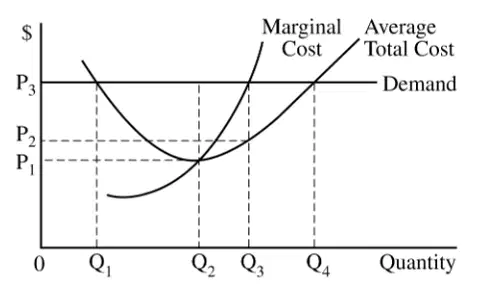
How many units of output should a firm with the cost and demand curves shown above produce to maximize profit?
0
Q1
Q2
Q3
Q4
Currently, XYZ Corporation can produce 50 units of output using 20 workers and 8 units of capital. Which of the following changes in the number of workers, units of capital, and quantity of output are consistent with constant returns to scale?
40 workers, 8 capital, 100 output
40 workers, 16 capital, 90 output
20 workers, 4 capital, 25 output
10 workers, 4 capital, 25 output
10 workers, 8 capital, 25 output
If the four largest firms in a market produce 88 percent of total industry output, the market is
perfectly competitive
a pure monopoly
a natural monopoly
an oligopoly
a monopsony
In monopolistic competition, an individual firm’s market power stems from which of the following?
Economies of scale in production
The production of a differentiated product
The absence of perfectly competitive firms that produce similar products
Barriers to entry allowing firms to earn economic profit
The maintenance of excess capacity to meet unexpected increase in demand
A profit-maximizing firm hires labor in a perfectly competitive market. Labor is the only variable input, and the marginal product of the last worker hired is 10 units per hour. If the hourly wage is $20, the firm’s marginal revenue
is $2
is $20
increases as more output is produced
increases first and then decreases as more output is produced
decreases first and then increases as more output is produced
Assume the demand curve for a good is perfectly inelastic and the production of each unit of this good generates external costs. A profit-maximizing firm producing the good in an unregulated free market will
generate deadweight loss because marginal social cost is greater than marginal private cost
generate deadweight loss only if marginal costs are constant
not generate deadweight loss because the equilibrium quantity is socially optimal
not generate deadweight loss unless marginal costs are constant
not generate deadweight loss unless fixed costs are zero
A linear production possibilities curve indicates which of the following?
Constant opportunity costs
Decreasing opportunity costs
Increasing opportunity costs
Diminishing marginal returns
Labor-intensive production
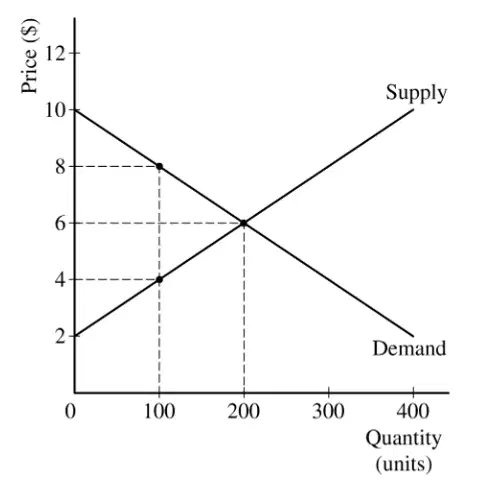
Assume that the government imposes a $4 per-unit tax on sellers of a good in the market described by the graph above. What are the price paid by buyers, the after-tax price received by sellers, and the deadweight loss?
Price Paid by Buyers: $8, Price Received by Sellers: $6, Deadweight Loss: $100
Price Paid by Buyers: $8, Price Received by Sellers: $4, Deadweight Loss: $200
Price Paid by Buyers: $6, Price Received by Sellers: $6, Deadweight Loss: $0
Price Paid by Buyers: $4, Price Received by Sellers: $8, Deadweight Loss: $100
Price Paid by Buyers: $4, Price Received by Sellers: $8, Deadweight Loss: $200
Which of the following must be true if at the tenth unit of output, marginal cost (MC) is $130 and average total cost (ATC) is $150?
ATC of producing the ninth unit is higher than $150.
ATC of producing the ninth unit is less than $150.
MC of producing the ninth unit is higher than $130.
Average variable cost of producing the tenth unit is higher than $150.
Average variable cost of producing the tenth unit is equal to $20.
Which of the following occurs as a result of the substitution effect of an increase in the price of a normal good?
The demand for the good decreases.
The demand for the complementary good increases.
The demand for the good becomes more elastic.
The quantity demanded of the substitute good decreases.
The quantity demanded of the good decreases.
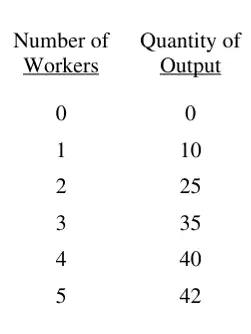
Given the production schedule above, what is the maximum number of workers the firm can hire before the effects of diminishing marginal returns set in?
1
2
3
4
5
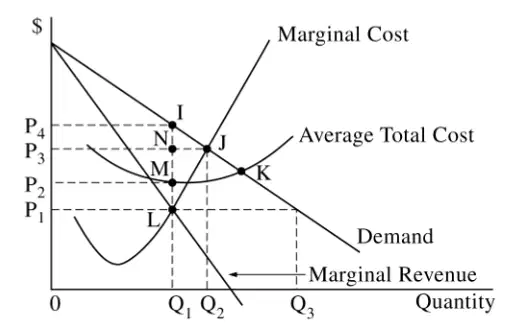
Which of the following combinations of output, price, and economic profit is consistent for the profit-maximizing monopolist depicted in the graph above?
Q1, P1, 0P1LQ1
Q1, P4, P1P4IL
Q1, P4, P2P4IM
Q2, P3, P2P3NM
Q3, P1, P1P2ML
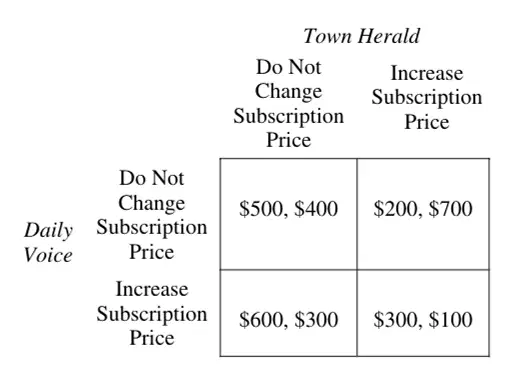
The two major newspapers in a city, Daily Voice and Town Herald, are considering whether to raise the subscription price. The first entries in the matrix above show the profits to Daily Voice, and the second entries show the profits to Town Herald. Which of the following is consistent with the above payoff matrix?
Do Not Change Subscription Price is a dominant strategy for Daily Voice.
Do Not Change Subscription Price is a dominant strategy for Town Herald.
Increase Subscription Price is a dominant strategy for Daily Voice.
Increase Subscription Price is a dominant strategy for Town Herald.
There are no dominant strategies in the above payoff matrix.
If a firm engages in perfect price discrimination, it charges
each customer the highest price the customer is willing to pay
each customer the average cost of the product
each customer the lowest price the customer is willing to pay
different prices to customers based on how old they are
different prices to customers based on how many units of output they buy
Assume a perfectly competitive firm is currently producing 100 units of output. Its marginal cost is $6 and rising at that output quantity. Its average variable cost is $7 and its average fixed cost is $3. If the product’s price is $6, which of the following will the firm do in the short run to maximize its profit?
Shut down
Produce, but less than 100 units of output
Produce more than 100 units of output
Continue to produce at exactly 100 units of output
Increase its price above $6
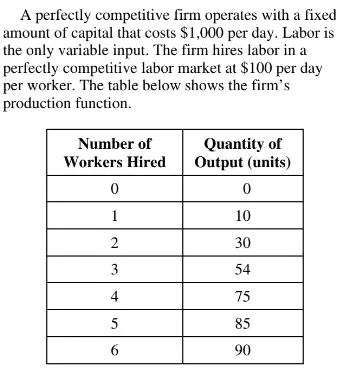
What is the marginal product of the third worker?
5
10
20
24
It cannot be determined from the information given.
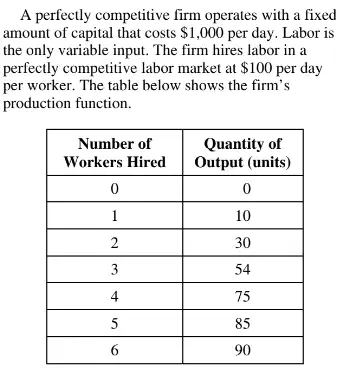
The firm will maximize profit in the short run if it
shuts down and the price is $10
produces 30 units and the price is $4
produces 30 units and the price is $10
produces 54 units and the price is $4
produces 85 units and the price is $10
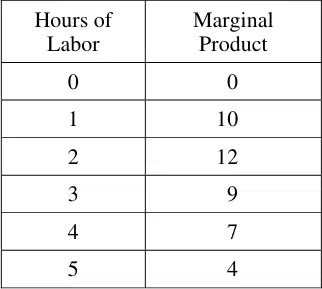
The table above shows how a firm’s hourly level of output changes as more of the labor input is employed. The firm sells its output and hires labor in perfectly competitive markets. The wage paid to labor is $10 per hour, and the price of the firm’s output is $2 per unit. Based on the data in the table, the marginal revenue product of the fourth hour of labor is equal to
$4
$7
$14
$26
$70
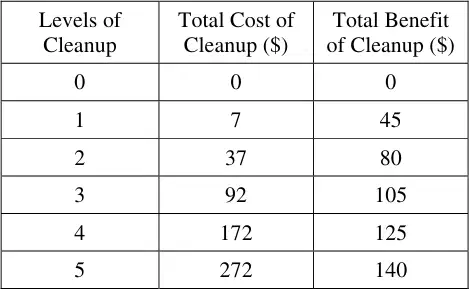
The table above shows the total cost and the total benefit of cleaning up pollution in a community. Which of the following cleanup levels is socially optimal?
1
2
3
4
5
The Lorenz curve represents the relationship between
the cumulative percentage of households and the cumulative percentage of income
income tax rates and income tax revenues
child labor rates and the poverty levels
income inequality and education level
market structure and the number of firms in the market
Antitrust laws are designed to maintain a competitive market environment by
eliminating monopolies wherever they exist
preventing monopolies from generating negative externalities
limiting practices that increase a firm’s market power
imposing price ceilings on products produced by monopolies
making charging a price above marginal cost illegal

The table above shows the opportunity costs of producing apples and oranges in Countries X and Y. Which of the following can be concluded based on the data given in the table?
Country Y has an absolute advantage in producing both goods.
Country Y has a comparative advantage in producing both goods.
Country X has an absolute advantage in producing both goods.
Country X has a comparative advantage in producing oranges.
Country X has a comparative advantage in producing apples.
If the price elasticity of supply for pickles is 2 and the price of pickles increases by 10 percent, then the quantity supplied of pickles will increase by
0.2%
5%
8%
12%
20%
If a 10 percent increase in the price of good X results in a 20 percent decrease in the quantity of good Y demanded, which of the following is true?
Good X and good Y are complementary goods, and the cross-price elasticity is –0.5.
Good X and good Y are substitute goods, and the income elasticity is +2.
Good X and good Y are complementary goods, and the cross-price elasticity is –2.
Good X and good Y are normal goods, and the income elasticity is +2.
Good X and good Y are substitute goods, and the cross-price elasticity is –2.
Which of the following provides a possible explanation for a simultaneous increase in the equilibrium price and the quantity of blueberries in a market?
An increase in the price of strawberries, a substitute
An increase in the supply of strawberries, a substitute
An increase in the price of farmland used to grow blueberries
A decrease in the price of blueberry harvesting equipment
Imposition of a price floor in the market for blueberries
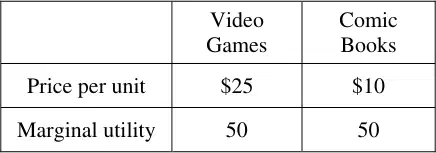
The table below shows the per-unit prices and marginal utility for the last unit of video games and comic books that Kyle purchased. Kyle spent all of his allocated budget on video games and comic books. To maximize his utility, Kyle should have purchased:
more video games and fewer comic books
fewer video games and more comic books
fewer of both goods
equal amounts of both goods
more of both goods
A perfectly competitive firm currently produces 1,000 units of output and hires its resources in a perfectly competitive factor market. It uses both labor and capital as inputs. The price of labor is $40; the price of capital is $100. The marginal product of labor is 8 units, and the marginal product of capital is 10 units. Which of the following must be true?
The firm is currently maximizing its profit.
The firm can produce more than 1,000 units without increasing the total cost if it uses more labor and less capital.
The firm can produce more than 1,000 units without increasing the total cost if it uses more capital and less labor.
The firm can reduce the cost of producing 1,000 units by using less capital and employing the same amount of labor.
The firm can reduce the cost of producing 1,000 units by employing less labor and using the same amount of capital.
When two firms interact in an oligopolistic market, which of the following statements is true?
If one firm has a dominant strategy, then the other firm does not have a dominant strategy.
If one firm has a dominant strategy, then the other firm also has a dominant strategy.
Both firms must have dominant strategies.
If one firm has a dominant strategy, then there is no Nash equilibrium.
If both firms have dominant strategies, then there is a Nash equilibrium.
Which of the following is true when a profit-maximizing monopolist produces in the elastic portion of its demand curve?
It can increase total revenue by raising price.
It can decrease average total cost by reducing output.
Price is equal to marginal revenue.
Marginal revenue is less than marginal cost.
Marginal revenue is positive.
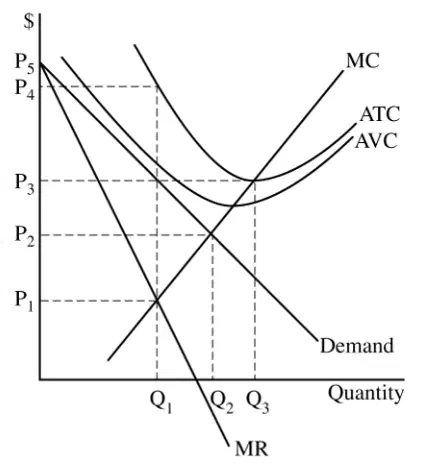
The firm’s profit-maximizing output in the short run is
zero, because P < AVC
Q1, because MR = MC
Q2, because P = MC
Q3, because MC = ATC
impossible to determine
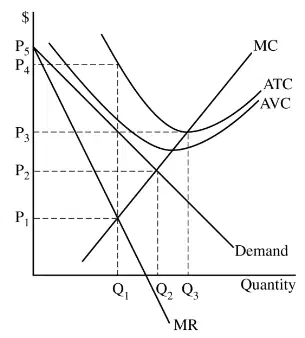
Which of the following will the firm do in the long run if market conditions do not change?
It will increase output to Q2 and lower price to P2 to minimize losses.
It will increase output to Q3 and raise price to P4 to earn zero economic profit.
It will produce Q1 and set price equal to marginal revenue.
It will exit the industry.
It will build a larger plant to achieve decreasing returns to scale.
At the current quantity that a firm is selling, the firm has marginal revenue of $750 and marginal cost of $800. Which of the following is true?
The firm is maximizing profit.
The firm’s profits would increase if the firm increased the quantity sold.
The firm’s profits would increase if the firm decreased the quantity sold.
The firm earns negative economic profit.
The firm earns zero accounting profit.
Which of the following is true of a monopsony in a labor market?
It faces a labor supply curve that is horizontal at the competitive market equilibrium wage.
Its marginal factor (resource) cost is the same as the market supply curve.
At its optimal level of employment, it pays a wage rate higher than the competitive market wage rate.
The imposition of a minimum wage results in a larger reduction in employment than is true in a competitive market.
Its marginal factor (resource) cost curve lies above the labor supply curve because hiring an extra worker means paying more to existing workers.
Which of the following indicates that a perfectly competitive firm has hired the profit-maximizing amount of labor?
The total product of labor exceeds the total real wage payments to workers.
The average product of labor exceeds the real wage paid to workers.
The marginal revenue product of labor is below the wage paid to workers.
The marginal revenue product of labor is above the wage paid to workers.
The marginal revenue product of labor equals the wage paid to workers.
In a competitive market in which the production of a good causes pollution, the socially optimal output is different from the competitive market equilibrium output of that good because the
marginal social benefit is higher than the marginal social cost
marginal social benefit is lower than the marginal private cost
marginal social cost is higher than the marginal private cost
marginal social benefit is higher than the marginal private benefit
total social cost is less than the total social benefit
Which of the following explains why free-riding can result in a market failure?
More than the socially optimal quantity is produced and consumed.
The socially optimal quantity is produced but less than the socially optimal quantity is consumed.
Private producers of nonexcludable goods are unable to charge everyone who consumes the good.
There is a market surplus of the good.
There is no consumer surplus derived from the good.
Individual private property rights provide people incentives to
meet societal goals rather than pursue their own self-interest
produce goods and services regardless of market demand
achieve equitable distribution of goods and services through competitive markets
focus only on benefits without regard to costs
produce goods and services that are valued in markets
Assume the market for disposable coffee cups is in equilibrium and disposable coffee cups are inputs for serving brewed coffee. Which of the following will result in a higher short-run equilibrium price of disposable coffee cups?
A decrease in the supply of coffee
A decrease in the number of locations serving brewed coffee
An increase in the supply of disposable coffee cups
An increase in the demand for brewed coffee
An increase in the price of tea, a complement for coffee
The equilibrium price for a good with a vertical supply curve and a downward-sloping demand curve is $20. If a binding price floor is set, which of the following will occur?
There will be a shortage of the good.
The sum of consumer and producer surpluses will decrease.
The equilibrium price of the good will decrease.
The quantity sold of the good will remain unchanged.
Demand for substitutes for the good will decrease.
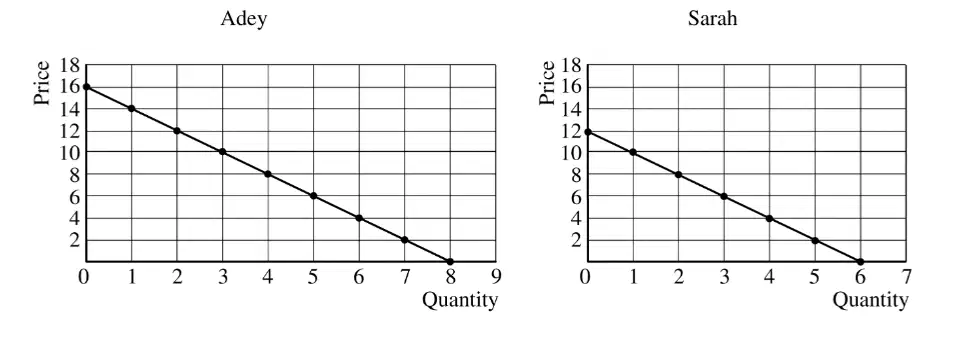
The graphs above show the individual demand curves for the only two consumers, Adey and Sarah, in the market for popcorn. As the price of popcorn decreases from $12 to $6, how does the quantity demanded change along the market demand curve?
It increases from 2 to 4 units.
It increases from 2 to 5 units.
It increases from 2 to 8 units.
It increases from 0 to 14 units.
It increases from 8 to 14 units.
Which of the following is true for a firm that uses labor as a variable input and capital as a fixed input in the short run?
If the marginal product of labor is negative, the average product of labor must also be negative.
If the marginal product of labor is rising, the average product of labor must be greater than the marginal product of labor.
If the average product of labor is rising, the marginal product of labor must be rising.
If the average product of labor is falling, the marginal product of labor must be less than the average product of labor.
The average product of labor can never be equal to the marginal product of labor.
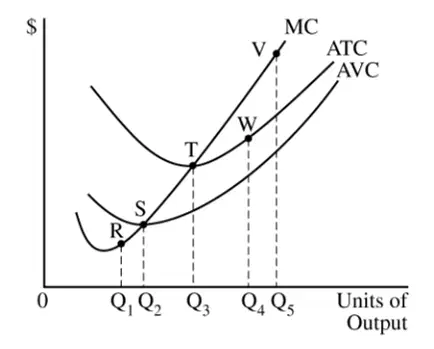
The graph above shows the cost curves facing May’s Fruit Farm, where MC is marginal cost, ATC is average total cost, and AVC is average variable cost. May’s short-run supply curve includes which of the following points?
TW
RST
STV
STW
RSTV
The characteristic that causes firms in a perfectly competitive industry to earn zero economic profits in the long run is
firms are price takers
firms produce identical products
individual firms account for a small fraction of the total market
the industry supply curve is horizontal
there are no barriers to entry or exit
If individual firms in a perfectly competitive market are earning positive economic profits, the number of firms and the price of the product in the market will most likely change in which of the following ways in the long run?
Increase, Increase
Decrease, Increase
Increase, Decrease
Decrease, Decrease
No change, Decrease
Jamal quits a job that was paying him $30,000 per year and decides to start his own business. He runs his business out of his house in a room he had been renting to his colleague for $12,000 a year. Jamal withdraws the $20,000 in his savings account that had been earning him a 10 percent annual interest to purchase computers and related accessories and equipment for the business. During the first year of operation, Jamal’s business incurred $30,000 in explicit costs and generated $60,000 in total sales. Jamal’s economic profit is
$30,000
$17,000
$0
–$2,000
–$14,000
Firms in monopolistic competition do not attain allocative efficiency because at the long-run equilibrium output, which of the following is true?
Price is greater than marginal cost.
Marginal cost is greater than minimum average total cost.
Marginal revenue is greater than marginal cost.
There is an overallocation of resources to the market.
Products are homogeneous.
A perfectly competitive firm is producing 10 units of output and sells the product for $5 per unit. At this level of output the average total cost is $4, the average variable cost is $3 and the marginal cost is $7. What should this firm do to maximize short-run profits?
Increase output until price equals average total cost.
Increase output until price equals marginal cost.
Leave output unchanged because price is greater than average total cost.
Decrease output until price is equal to marginal cost.
Decrease output until price is equal to average total cost.
Assume accountants and teachers have identical marginal revenue product schedules. Which of the following provides an explanation for why accountants receive higher starting salaries than school teachers?
Accountants have less human capital than school teachers.
Accountants have lower opportunity cost than school teachers.
Accounting firms provide a more pleasant work environment than schools provide.
The supply of accountants is low relative to the supply of teachers.
Fewer teaching majors graduate from college each year than accounting majors.
Assume that firms providing health-care services to older people operate in a perfectly competitive market. What must happen in the market for health-care workers if there is an increase in the number of older people in a country?
The demand for health-care workers will increase.
The marginal factor cost in the health-care industry will decrease.
The number of health-care workers will decrease.
The quality of health-care services will increase.
The wages of health-care workers will decrease.
As an unregulated monopolist, City Cable is earning positive economic profits. If the government regulated the firm by requiring it to produce the level of output that allowed the firm to earn zero economic profit, City Cable would set a price that is equal to its
marginal cost
marginal revenue
average total cost
average variable cost
total cost
A progressive income tax is characterized by
a higher average tax rate at low income levels than at high income levels
tax rates that increase total tax revenues
marginal tax rates that do not change as income changes
marginal tax rates that increase as income increases
marginal tax rates that decrease as income increases

