
 Worksheets
Lesson 8 grammar review
Total questions: 35
Worksheet time: 18mins
What does the character 来 indicate in directional complements?
A downward movement
A result or state of being.
A sideways movement
A backward movement
What do many directional complements actually express, according to the text?
Literal directions
Colors
Results or states of being
Emotions
What does the complement "下来" indicate in the context of directional complements?
The continuation of an action
The detachment or separation of one thing from another
The completion of an action
The repetition of an action
In the sentence "他们希望孩子们能受到良好的教育,所以孩子一生下来就开始给他们存教育费," what does "生下来" imply?
The children started school
The children were born
The children graduated
The children moved away
Which verb is used in the example to indicate "give birth to"?
走 (walk)
生 (give birth to)
吃 (eat)
看 (see)
What does the verb "拿" mean in the context of the sentence provided?
Give away
Take out
Hide
Bring in
What is the function of the complement "出来" in the sentence?
Indicating a decrease
Indicating a question
Indicating emergence, bringing something hidden or internal into the open
Indicating a location
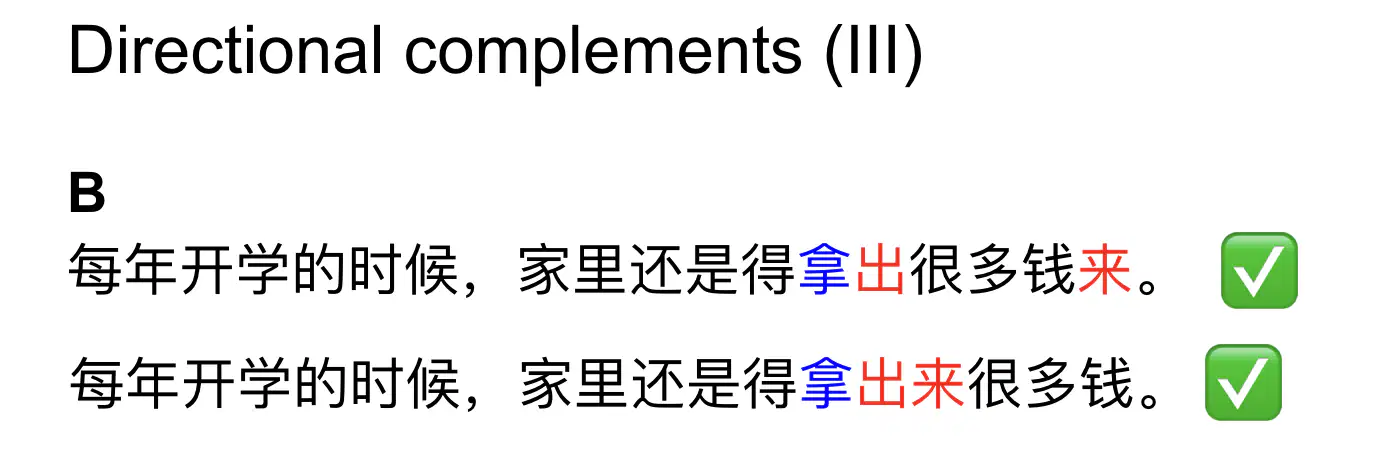
What is the result mentioned in the sentence about the family's financial situation?
The family saves a lot of money
The family spends a lot of money on vacations
The family has to come up with a significant amount of money
The family receives a lot of money
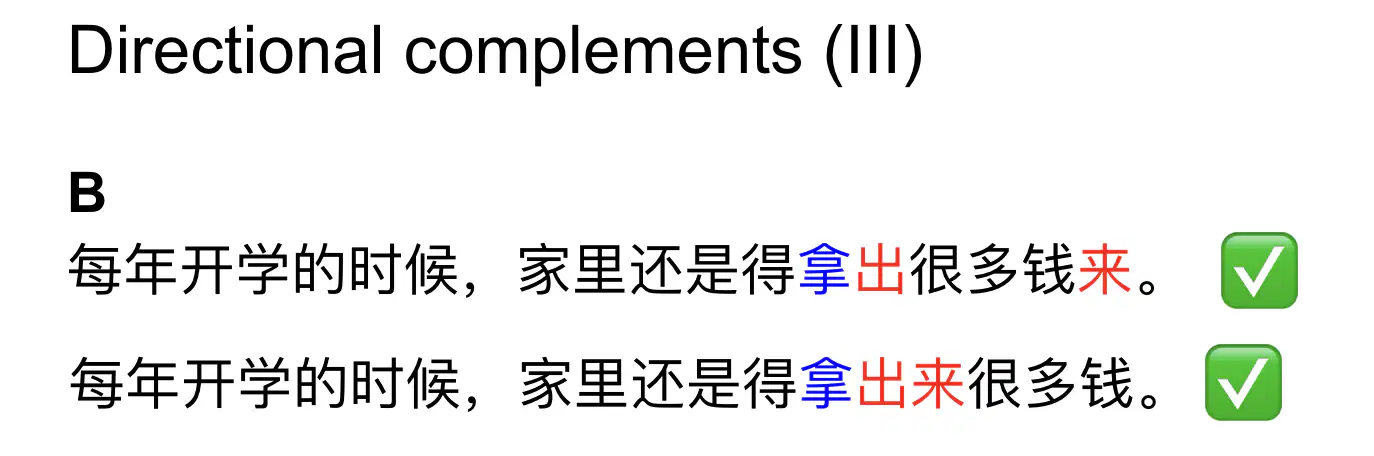
What does the complement "出来" indicate in the sentence provided?
Indicating a direction
Indicating emergence, bringing a hidden issue into the open
Indicating a question
Indicating a solution
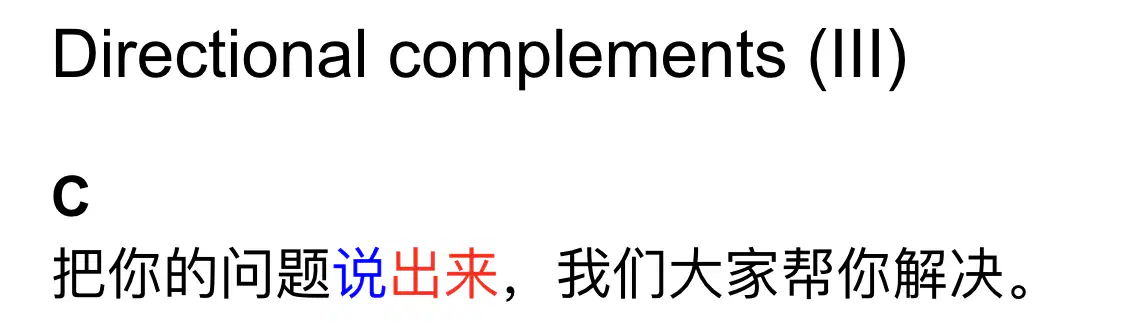
In the sentence "Get your problem out in the open," what is the result of using the verb and complement together?
The problem is ignored
The problem is expressed so it can be solved
The problem is hidden
The problem is made worse
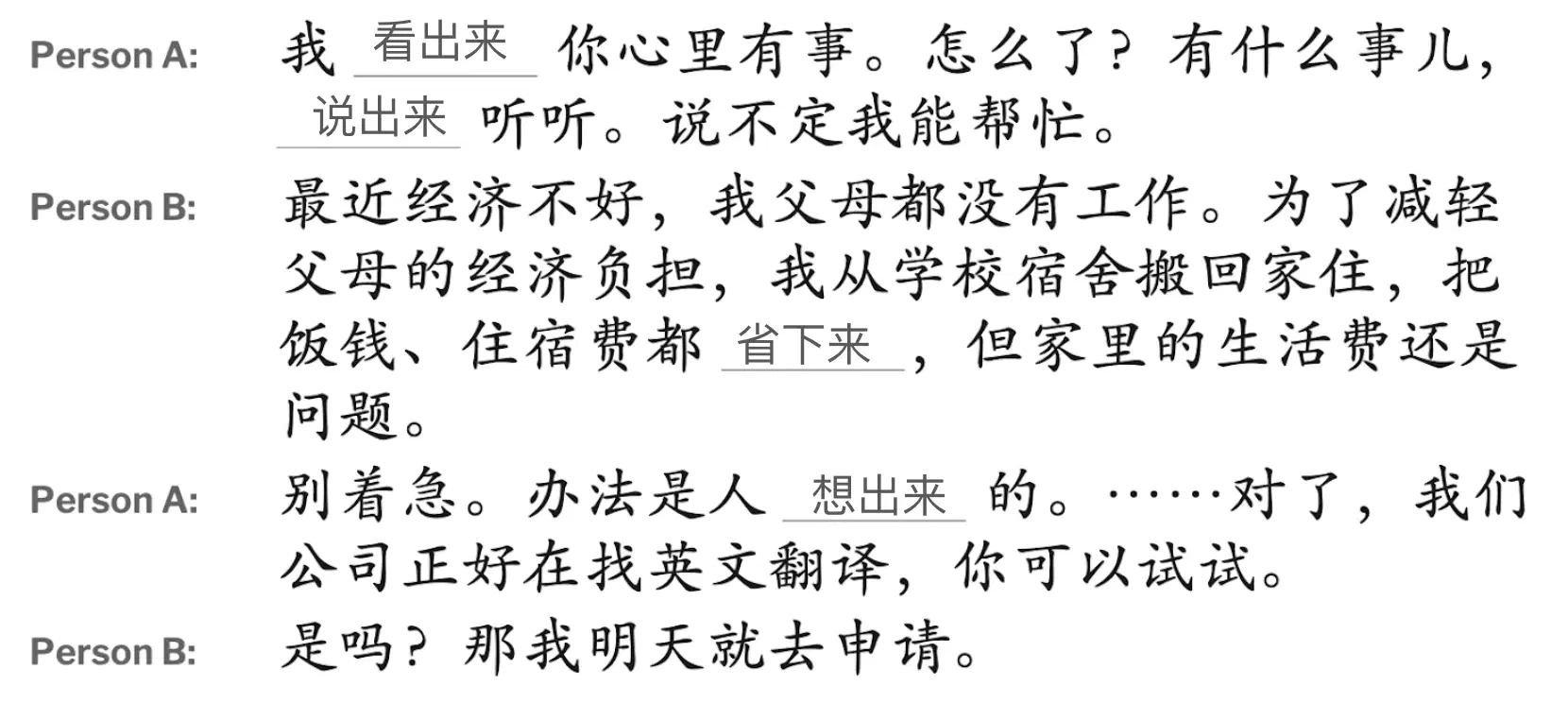
What has Person B done to help reduce their parents' financial burden?
Found a job
Moved back to school
Saved on living expenses
Asked for a loan

What opportunity does Person A mention to Person B?
A new job at a restaurant
A chance to translate English documents
A scholarship for school
A loan from the bank
What does the phrase "看出来" (See out) mean?
To express something that is hidden or unsaid
To save resources, such as money or time
To discern or notice something from observation
To come up with an idea or solution
What is the meaning of "说出来" (Speak out)?
To save resources, such as money or time
To express something that is hidden or unsaid
To discern or notice something from observation
To come up with an idea or solution
What does "省下来" (Save down) indicate?
To come up with an idea or solution
To express something that is hidden or unsaid
To save resources, such as money or time
To discern or notice something from observation
What is the meaning of "想出来" (Think out)?
To discern or notice something from observation
To express something that is hidden or unsaid
To save resources, such as money or time
To come up with an idea or solution
What does the idiomatic expression "办法是人想出来的" (solutions are created by people) encourage?
Discouragement and pessimism
Optimism and creative problem-solving
Saving resources and time
Expressing hidden thoughts
What does 下来 imply in Chinese directional complements?
Emergence or bringing a hidden issue into the open
Detachment or separation of one thing from another
Movement towards a higher place
Indicating completion of an action
What does 出来 indicate in Chinese directional complements?
Detachment or separation of one thing from another
Movement towards a lower place
Emergence or bringing a hidden issue into the open
Indicating a decrease in intensity
What is the purpose of using 来 to connect two verbs in a sentence?
To indicate the sequence of actions
To show contrast between actions
To indicate the purpose of the first action
To describe simultaneous actions
What is the English equivalent of 来 when used to connect two verbs?
because
in order to
while
after
What is the primary purpose of a rhetorical question?
To get an answer
To emphasize a point
To confuse the listener
To start a conversation
What does the speaker imply when using the rhetorical question in the example provided?
The person will definitely get full marks
The person has studied a lot
There is no way the person could get full marks
The person is confident about the exam
What is the meaning of the sentence "他已经学了三年化学了, 这么简单的问题他不会吗?" in English?
He has studied chemistry for three years, so he should know how to solve this simple problem.
He has studied chemistry for three years, but he cannot solve this simple problem.
He has not studied chemistry for three years, so he cannot solve this simple problem.
He has studied chemistry for three years, and he can solve this simple problem.
What is the form of the sentence "他不会吗?" in terms of its grammatical structure?
Positive form with negative meaning
Negative form with positive meaning
Positive form with positive meaning
Negative form with negative meaning
What meaning do rhetorical questions that are negative in form carry?
Emphatically negative meaning
Emphatically positive meaning
Neutral meaning
No specific meaning
What is the English translation of the Chinese word "压力"?
Pressure
Happiness
Sadness
Excitement
In the sentence "考试考得不好,怕妈妈生气,我觉得有压力," what is causing the pressure?
Fear of failing the exam
Fear of losing a job
Fear of speaking in public
Fear of heights
What type of noun is often used with the word 受到 (to receive) in Chinese?
Abstract noun
Concrete noun
Proper noun
Collective noun
Which of the following is an example of 受到 used with an abstract noun?
+ (大家的) 欢迎 (receive [everyone's] welcome)
+ 一封信 (receive a letter)
+ 一个礼物 (receive a gift)
+ 一个邮件 (receive an email)
What does the Chinese word "取得" mean in English?
To lose
To give
To obtain
To forget
Which of the following is an abstract noun that can follow "取得"?
经验 (experience)
苹果 (apple)
书 (book)
桌子 (table)
Which of the following is NOT an abstract noun that can follow "取得"?
同意 (agreement)
好成绩 (good grades)
进步 (progress)
汽车 (car)
What is the meaning of the Chinese word "适合"?
To eat
To suit
To run
To write
What is the meaning of the Chinese word "合适"?
Suitable
Fast
Expensive
Difficult

