
 Worksheets
Constitution Exam
Total questions: 37
Worksheet time: 19mins
Name
Class
Date
1.
Invoking the Fifth Amendment means an accused man or woman
a)
must be given a jury trial.
b)
is waiving the right to a jury trial.
c)
does not have to testify against themselves. (Keep Silent)
d)
want a change of venue (they want their trial moved).
2.
Shays’ Rebellion inspired most Americans to call for the
a)
A Nation Militia (National Guard)
b)
A national fast response police force
c)
State police forces in each state
d)
A stronger Central Government
3.
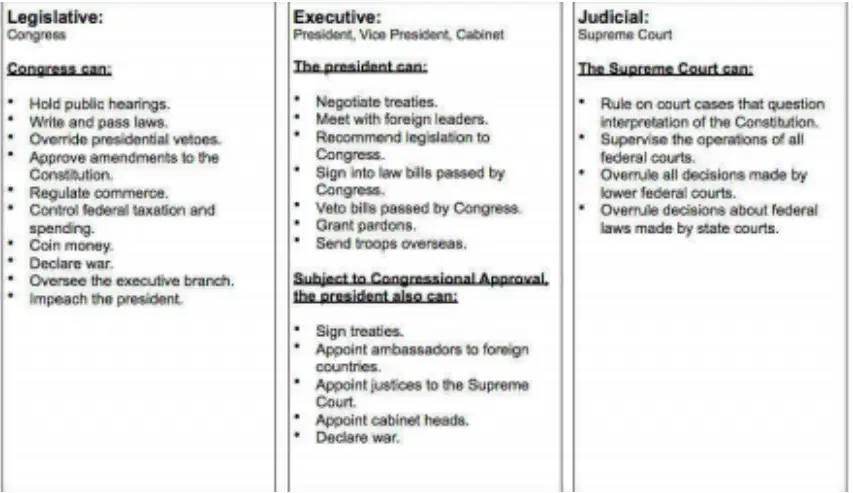
Based on the chart below identify one way the Legislative Branch can "check" the Executive.
a)
Appoint cabinet heads
b)
Override presidential vetoes
c)
Overrule decisions made by lower federal courts
d)
Veto bills passed by Congress
4.
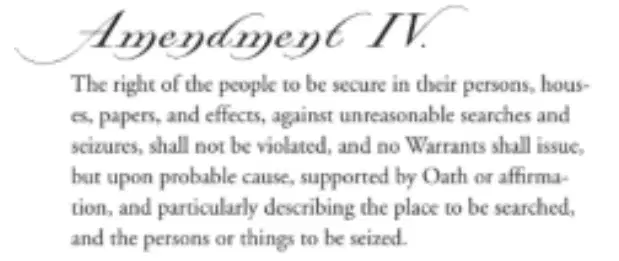
The police believe that Savannah has stolen a motorcycle, to legally search her property the police must show probable cause to a judge and obtain a
a)
bill of attainder.
b)
search warrant.
c)
writ of assistance.
d)
libeteriam ex macium.
5.
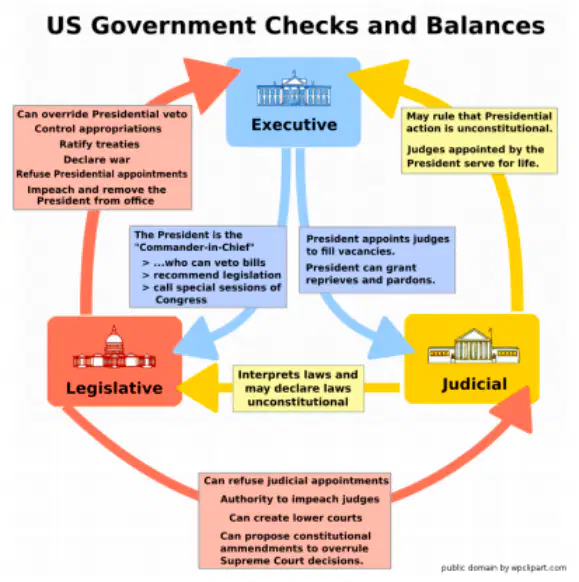
Based on the chart below, identify one way that the Judicial Branch can check the Executive
a)
The President can veto bills
b)
The Judicial Branch may rule that Presidential action is unconstitutional
c)
The Legislature can refuse judicial appointments
d)
The President appoints judges for the Judicial Branch
6.
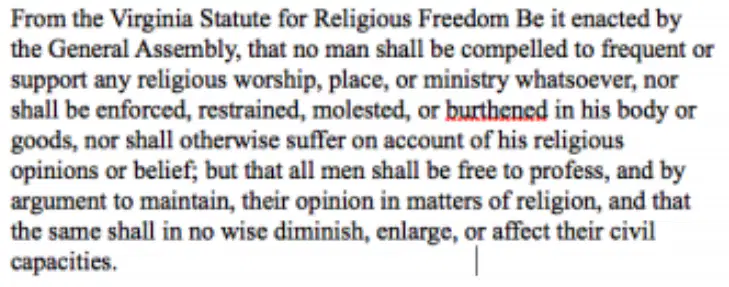
Based on the passage below, Thomas Jefferson’s Virginia Statute for Religious Freedom declared that
a)
governments must punish religious discrimination.
b)
Governments were responsible for funding churches
c)
No person who worked on behalf of a religious institution had to pay taxes.
d)
No person could be required to pay for a church with tax money.
7.
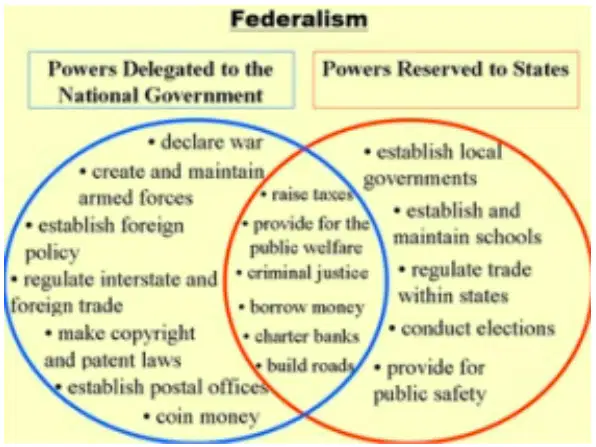
The powers which are not specifically enumerated in the Constitution as powers of the federal (National) government are
a)
reserved for the states
b)
delegated to the National government.
c)
concurrent between the levels.
d)
separated into branches
8.
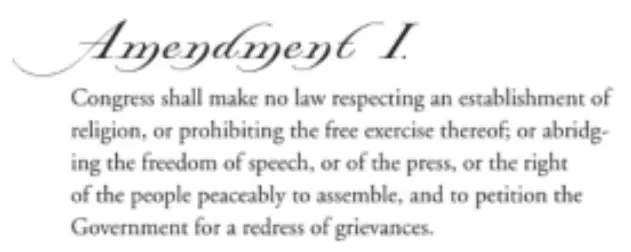
Which action would NOT be protected by the First Amendment to the Constitution
a)
Posting on Twitter that you think, "Dolly Parton pooped her pants."
b)
Threatening to beat up your neighbor because he kicked your dog.
c)
Wearing a black armband to protest immigration policies
d)
Publishing an editorial about animal cruelty.
9.
How many amendments have been added to the Constitution?
a)
10
b)
21
c)
27
d)
41
10.
Identify the document Anti- Federalists wanted added to the Constitution to protect the rights of citizens.
a)
The Ten Commandments
b)
The Bill of Rights
c)
The Federalist Papers
d)
The Madison Doctrine
11.
The __________ opposed the Constitution partly because it did not have a section protecting individual rights.
a)
Federalists
b)
AntiFederalists
c)
Democrats
d)
Republicans
12.
Which of the following defines a citizen of the United States?
a)
only those persons who are born on American soil
b)
persons born in the United States or naturalized as a United States citizen
c)
Only those persons who can pass the citizenship test
d)
only persons over the age of 18 who own property and pay taxes
13.
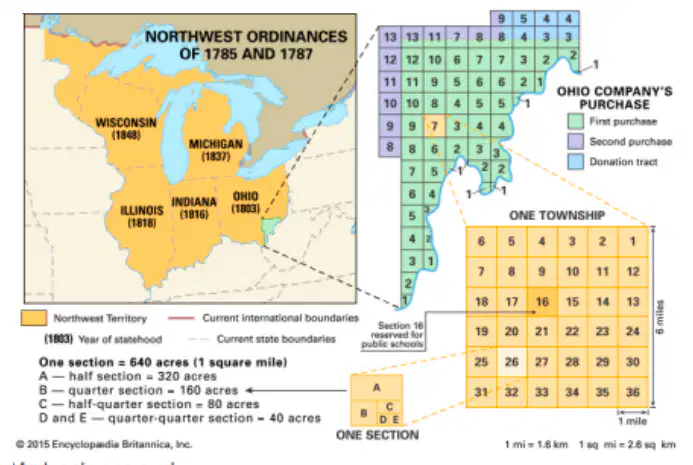
According to the map, how did the Land Ordinance of 1785 divide western land?
a)
Settlers could mark off their claims depending on the size of their families
b)
Using natural land features like creeks
c)
Each township contained 36 sections; each section was one square miles
d)
Townships could be no farther across that a day’s ride on a horse
14.
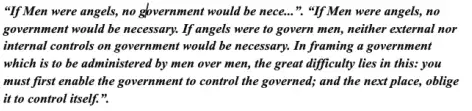
The passage below was most likely written by a
a)
A Republican
b)
A Democrat
c)
A Federalist
d)
A Whig
15.
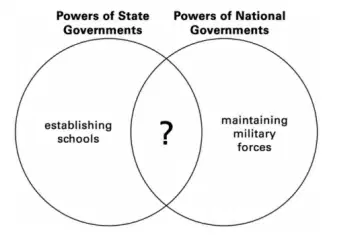
Which of these powers should be in the middle section of this Venn Diagram?
a)
raising taxes
b)
declaring war
c)
printing money
d)
negotiating treaties
16.
The Northwest Ordinance of 1787 established territorial representation, public education and prohibited ______________ in the Northwest Territory
a)
Free enterprise
b)
the production of alcohol
c)
slavery
d)
abusing Native Americans
17.
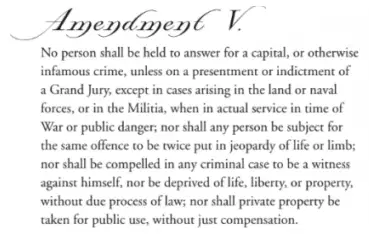
The Constitution suggests that no person may be deprived of:
a)
complete personal freedom.
b)
life, liberty or property without due process of law.
c)
Government sponsored subsidies.
d)
free access to commercial education
18.
What name is given to the Supreme Court’s power to declare a law unconstitutional?
a)
federalism
b)
veto power
c)
impeachment
d)
judicial review
19.
How does the Constitution of the United States provide for changes, so that it may be fluid with time and appropriate for future generations?
a)
Article 2 of the Constitution gives the president the power to change the Constitution
b)
Article 7 of the Constitution gives the legislature the power to change the Constitution by simple majority
c)
Article 5 of the Constitution provides for Amendments to be made to the Constitution
d)
The Constitution cannot be changed for any reason.
20.
There are ________ Articles (Not Amendments) in the United States Constitution
a)
seven (7)
b)
ten (10)
c)
twentyone (21)
d)
twentyseven (27)
21.
Courts may not deprive a man of his life or his liberty without
a)
due process of law.
b)
a really good reason
c)
a majority opinion.
d)
complete agreement among the courts.
22.
In the Second Amendment, the Constitution states that:
a)
Congress shall make no law respecting an establishment of religion, or prohibiting the free exercise thereof
b)
The right of citizens of the United States to vote shall not be denied or abridged by the United States or by any state on account of sex
c)
No person shall be compelled in any criminal case to be a witness against himself
d)
The right of the people to keep and bear arms shall not be infringed.
23.
To whom does the Constitution guarantee a right to vote?
a)
Only white males are guaranteed the right to vote in the Constitution
b)
Only females are guaranteed the right to vote in the Constitution, male voting is understood.
c)
Only natural born citizens are guaranteed the right to vote in the Constitution
d)
Natural born citizens and naturalized citizens are guaranteed the right to vote in the Constitution
24.
This method divides the functions of the Government into three branches, each with its own powers and responsibilities.
a)
Separation of powers
b)
Legislative Branch
c)
Executive Branch
d)
Judicial Branch
25.
This agreement created a two house legislature and ended the debate between large and small states
a)
Electoral College Compromise
b)
Three Fifths Compromise
c)
Great Compromise
d)
Commerce Compromise
26.
The Supreme Court has the power to
a)
review laws and executive actions in regards to the Constitution.
b)
Propose constitutional amendments.
c)
appoint judges to fill vacancies.
d)
override Presidential veto.
27.
This branch of government proposes and passes the laws.
a)
Legislative
b)
Executive
c)
Judicial
d)
Federal
28.
How does the Supreme Court prevent the President and Congress from abusing their power?
a)
The Supreme Court cannot prevent the president from abusing power
b)
The Supreme Court can reject laws and treaties that are unconstitutional.
c)
The Supreme Court gets to vote also
d)
The Supreme Court often defers these decisions to the state .
29.
All Federal and state officers must swear to
a)
uphold and protect the Constitution.
b)
defend the border of the United States
c)
expand the influence of the United States.
d)
support and protect the widows and orphans of fallen service members.
30.
The Constitution states that the people have a right to be secure against unreasonable searches and seizure and requires that warrants specify:
a)
The time and place of the suspected crime
b)
What is being looked for and who or what is being seized
c)
All possible accomplices associated with the suspected crime
d)
Search warrants are not required to specify more than the judge wants
31.
The number of Presidential electors a state gets is the same as
a)
the number of citizens in that state.
b)
the number of representatives
c)
the number of senators and representatives combined.
d)
the number of senators or representatives, whichever is larger.
32.
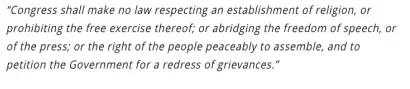
Based on the first Amendment Congress shall make no laws to
a)
address the issue of slavery
b)
establish a state religion
c)
deprive a citizen of property.
d)
deprive a citizen of the right to vote.
33.
Why did the delegates start the Preamble to the Constitution with the words “We, the people”?
a)
to record that all the citizens wrote the Constitution
b)
to state that government power comes from the people
c)
to declare that the people were separating from Great Britain
d)
to provide an introduction that would interest readers
34.
An amendment becomes part of the Constitution when it is ratified by
a)
three fourths of the states.
b)
all states must agree.
c)
a simple majority of the states.
d)
A numerical majority of the citizens agree
35.
This branch of government is responsible for interpreting the laws
a)
Legislative
b)
Executive
c)
Judicial
d)
Federal
36.
Congress can pass laws over the President's veto if both Houses have a majority of:
a)
A simple majority in the House and 2/3 in the Senate
b)
Presidential veto cannot be overridden
c)
A 2/3 majority in both Houses is required to pass laws over the President's veto
d)
A simple majority in both Houses is required to pass laws over the President's veto
37.
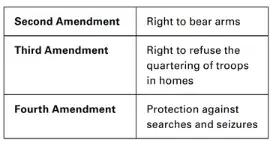
Examine the table:
To which of these experiences did these three amendments respond?
a)
slavery in America
b)
American Indian relocation
c)
British rule in colonial America
d)
immigrant treatment in America
100 %

