
 Worksheets
Waves Review
Total questions: 40
Worksheet time: 2hrs 3mins
A decibel measures the ______ of a sound
wavelength
frequency
speed
relative intensity
The amplitude of a wave is
length of one wave.
frequency.
state of rest.
displacement from its state of rest.
If a 60-dB sound increases to an intensity of 70 dB, about how much louder is the sound?
10 x
1 x
2 x
3 x
A sound with a large amplitude will transmit a
lot of energy
high frequency
long wavelength
low intensity
A denser medium will generally make a sound wave travel
slower
faster
the same speed
not at all
Which statement is NOT true?
Light travels with or without a medium.
Sound must have a medium to travel through.
Both light and sound must have a medium to travel through.
Light travels faster than sound.
What are the colors of the visible spectrum?
White, red, yellow, green, blue, violet
White, red, yellow, green, blue violet, ultraviolet
Red, orange, yellow, green, blue, violet
Red, yellow, green blue, violet, ultraviolet
When white light shines on a film and violet light is transmitted through the film, the film
added violet light to the white light.
added ultraviolet light to the white light.
absorbed ultraviolet light from the white light.
absorbed all the colors except violet from the white light.
Which material transmits the most visible light?
Sunglass lens
Mirror
Clear glass
Black cloth
Which material absorbs the most visible light?
Sunglass lens
Mirror
Clear glass
Black cloth
Which material reflects the most visible light?
Sunglass lens
Mirror
Clear glass
Black cloth
A reflected wave will
reflect at an angle equal to the incident angle
reflect at the angle of refraction.
not reflect off a shiny surface.
be absorbed by the surface it hits.
Light that is refracted is
reflected off a surface.
absorbed by a material.
transmitted around an object.
re-directed through another material.
Most of the energy from the sun that reaches the earth’s surface is in the form of
infrared light, visible light, and ultraviolet light.
radio waves, microwaves, and X-rays.
ultraviolet light, visible light, and gamma rays.
radio waves, gamma rays and X-rays.
Infrared radiation that reaches us on the Earth from the Sun
is not visible to humans.
damages the skin.
is a higher frequency than ultraviolet.
is a higher frequency than radio waves.
Light is (a) wave.
a transverse
a longitudinal
both a transverse and a longitudinal
neither a transverse nor a longitudinal
Frequency is
the amount of time for one wave cycle.
the number of wave cycles in a one second.
the total number of wave cycles.
the distance of one wave cycle.

Look at the transmission graph for two high-tech films below. Which film best blocks out ultraviolet rays?
Film A
Film B
If the frequency of a sound increases, what happens to its wavelength?
The wavelength increases
The wavelength decreases
The wavelength remains the same
The wavelength becomes zero
Noise-induced hearing loss can be prevented by which of the following methods?
Wearing ear protection in noisy environments
Listening to loud music regularly
Ignoring ear discomfort
Using cotton swabs to clean ears
Sunglasses protect the eyes from developing cataracts by:
blocking UV rays that can damage the lens of the eye.
providing a stylish accessory for outdoor activities.
enhancing the color perception of the surroundings.
improving night vision.
A black T-shirt and a white T-shirt are placed in the sun. After a few minutes, the black T-shirt feels hotter to the touch than the white T-shirt. What happens to the sunlight when it hits the black one in comparison to the white one?
The black T-shirt absorbs more sunlight than the white T-shirt.
The black T-shirt reflects more sunlight than the white T-shirt.
The black T-shirt transmits more sunlight than the white T-shirt.
The black T-shirt refracts more sunlight than the white T-shirt.
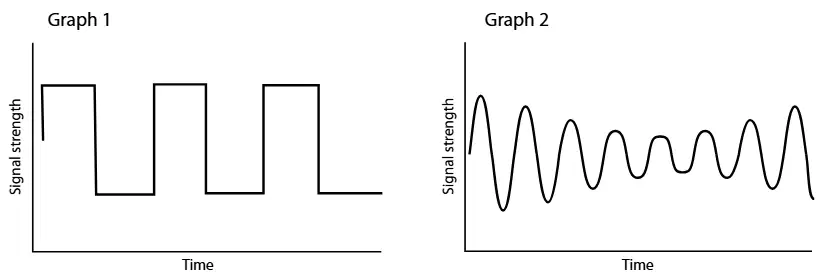
Which diagram represents a digital signal?
Graph 1
Graph 2

What do all waves transfer?
Matter
Heat
Electricity
Energy

Which of the following can waves transfer energy through?
solid
liquid
gas
empty space
all of the above

What are the two types of waves?
longitudinal and transverse
sound and light

What is frequency measured in?
Milliseconds
Miles
Hertz
Kilograms

Shorter wave lengths can carry more energy. Which of these probably carries the MOST energy:
Infrared light
Visible light
X-rays
UV light

What does #1 represent?
Period
Frequency
Wavelength
Amplitude

What does #2 represent?
Period
Frequency
Wavelength
Amplitude

It is the high pressure part of the wave where the particles are close together. It is part A on this picture.
Compression
Amplituide
Rarefaction
Wavelength

Which type of wave moves parallel to the direction of the wave?
transverse
longitudinal
surface
electromagnetic

Electromagnetic waves include the following except
radio waves
X-rays
ocean waves
microwaves

