
 Worksheets
Physical Science Exam Review - Physics
Total questions: 50
Worksheet time: 56mins
You drive 2 km to school and then 2 km back home. What is your displacement?
0 km. You are back where you started.
4 km. 2+2 = 4.
5 km. 2+2 = 5.
You drive 2 km to school and then 2 km back home. What is your distance travelled?
0 km. You are back where you started.
4 km. 2+2 = 4.
5 km. 2+2 = 5.

Two people walk across a parking lot. Their paths are shown in the image. Who traveled with a larger displacement?
Person A
Person B
They both had the same displacement.
A cheetah runs 220 km in 2 hours. What is the cheetah's speed?
110 km/hr west
110 km/hr
440 km/hr
440 km/hr west
A train travels 500 km north in 2 hours. What is the train's velocity?
250 km/hr
250 km/hr north
500 km/s
500 km/s north
The speed boats speed increased from 0m/s to 24m/s in a time span of 12 seconds. What is the acceleration?
Inertia can be described as "the tendency of an object to resist change in its motion."
True
False
What is Newton's 2nd Law?
Mass = force * acceleration
Force = mass * acceleration

How much force is needed to accelerate a 66 kg skier at 2 m/s/s?
13.2 Newtons
132 Newtons
1.33 m/s
13 kg
What is the acceleration of a 50 kg object pushed with a force of 500 newtons?
1 m/s/s
10 m/s
10 m/s/s
1 Newton
The sum of all forces acting on an object and direction is called the
Balanced Force
Net Force
Unbalanced Force
Contact Force
The force that keeps objects on top of surfaces instead of letting them sink into the surface is known as:
Normal Force
Gravitational Force
Friction Force
Air resistance
What is the definition of a force?
Net force equal 0N and there is no change in the object's motion
the overall force acting on an object after all forces are combined
a push or a pull that acts on an object
The force does not equal 0N, the object accelerates
What is the formula for momentum?
p = m / v
p = mv
p = mv^2
p = m + v
What is the unit of momentum?
kg m/s
Joule
m/s
N
The SI (standard) unit for power is...?

A cheetah can run briefly with a speed of 31.0 m/s. Suppose a cheetah with a mass of 47.0 kg runs at this speed. What is the cheetah’s kinetic energy?
1457 Joules
22,584 Joules
15 Joules
45,167Joules

What is the gravitational potential energy of an 85 kg mountain climber at the summit of a 6267 m volcano?
Let g = 9.8N/kg
5,220,411 J
532,695 J
73.7 J
54,356.6 J
What is static electricity (which can cause a shock)?
a build up of protons
a build up of neutrons
a build up of electrons
a build up in the nucleus
Charging by ____ occurs when electrons are transferred from a charged object to a neutral object by direct contact.
If an atom LOSES an electron
It discharges
It becomes positively charged
It becomes negatively charged
It dies
If the battery produced 12.6 Volts what would be the current flow for a 6 Ohm resistor?
2.1 Amps
2.4 Amps
1.71 Amps
15 Amps

What is the power of the circuit?
0.33 W
3 W
8 W
12 W
What unit is used to measure current?
Ohms
Omega
Volts
Amps
What unit is used to measure resistance?
Ohms
Omega
Volts
Amps


Parallel circuits are
a circuit that has only one path for current (charge flow) to travel
has more than one path for current (charge flow) to travel
a circuit that does not allow electricity to travel through it
magnets that cause electric current
Which type of current comes from a battery, which pushes electrons in only one direction?
What is electrical current?
The ability to do work
A complete path or circuit
The flow of electrons through a complete circuit
Something that resists the flow in a current
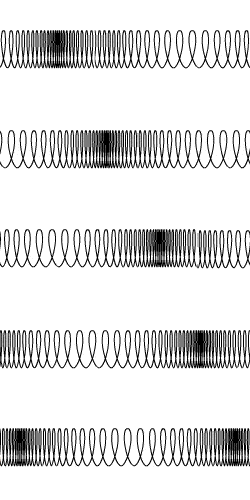
What type of wave is this?
Longitudinal
Transverse
Electromagnetic
x ray

What kind of wave is pictured below?
compressional wave
transverse wave
sound wave
longitudinal wave

Which color has the longest wavelength?
Yellow
Red
Green
Purple

