
 Worksheets
Discrete Mathematics Quiz
Total questions: 60
Worksheet time: 30mins
Let p be a proposition. The statement "It is not the case that p" is denoted by
¬p
⊕ p
p → ¬p
p ∧ ¬p
¬p ∨ p
Let p and q be propositions. The proposition that is true when both p and q are true and is false otherwise is denoted by
p ∧ q
p ∨ q
p → q
p ↔ q
p ⊕ q
Let p and q be propositions. The proposition that is false when p and q are both false and is true otherwise is denoted by
p ∨ q
p ∧ q
p → q
p ↔ q
p ⊕ q
Let p and q be propositions. The proposition that is true when exactly one of p and q is true and is false otherwise is denoted by
p ⊕ q
p ∨ q
p → q
p ↔ q
p ∧ q
Let p and q be propositions. The proposition that is false when p is true and q is false and is true otherwise is denoted by
p → q
p ∨ q
p ∧ q
p ↔ q
p ⊕ q
Let p and q be propositions. The proposition that is true when p and q have the same truth values and is false otherwise is denoted by
p ↔ q
p ∨ q
p → q
p ∧ q
p ⊕ q
Which of the following sentences is a proposition?
3 + 2 = 6
Can you help me?
Take this pencil.
x + 2 = 6
Find the converse of p → ¬q.
¬q → p
q → ¬p
q → p
¬q → ¬p
p → q
Find the contrapositive of ¬p → q.
¬q → p
q → ¬p
p → ¬q
¬q → ¬p
p → q
Find the bitwise OR of the bit strings 1011 0010 and 0110 0110.
1111 0110
0010 0011
0011 0011
1010 1001
0111 1100
Find the bitwise AND of the bit strings 1010 1010 and 1001 1001.
1000 1000
1011 1011
0011 0011
1100 1100
0101 0101
Find the bitwise XOR of the bit strings 0111 0101 and 1101 0101.
1010 0000
1111 0111
0101 0100
0110 1010
1101 0101

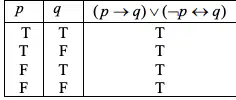
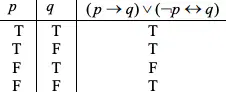
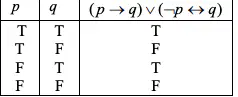

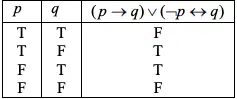



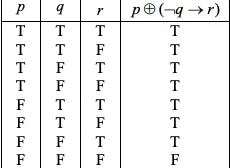
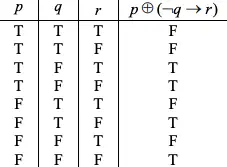
Let p, q and r be the propositions "You get an A on the final exam", "You do every exercise in this book" and "You get an A in this class" respectively. Write the proposition "Getting an A on the final and doing every exercise in this book is sufficient for getting an A in this class" using p, q and r and logical connectives.
( p ∧ q) → r
r → ( p ∧ q)
( p ∨ q) → r
( p ∧ q) ↔ r
¬r → (¬p ∧ ¬q)
Evaluate the expression (10 1100 ⊕ 01 0101) ∨ 11 0110 .
11 0000
11 0100
00 0110
11 1111
01 0101
Let p and q be the propositions "You get an A on the final exam" and "You get an A in this class" respectively. Write the proposition "To get an A in this class, it is necessary for you to get an A on the final" using p, q and logical connectives.
p → q
q → p
q ↔ p
p ⊕ q
¬p → ¬q
Find the implication that is false.
If 2 + 3 = 5, then pigs can fly.
If 2 + 3 = 6, then God exists.
If 2 + 3 = 4, then 3 + 3 = 5.
If pigs can fly, then 1 + 3 = 5.
If 2 + 3 = 5, then 1 + 3 = 4.
Let p and q be the propositions "It is below freezing" and "It is snowing" respectively. Express the proposition ( p ∨ q) ∧ ( p → ¬q) as an English sentence.
It is either below freezing or it is snowing, but it is not snowing if it is below freezing.
It is below freezing or snowing, but it is not snowing only if it is below freezing.
It is either below freezing or snowing, and it is not below freezing if it is snowing.
It is below freezing but not snowing.
If it is below freezing, then it is not snowing.
Let p and q be the propositions "You miss the final examination" and "You pass the course" respectively. Express the proposition ¬p ↔ q as an English sentence.
If you don't miss the final examination then you pass the course, and conversely.
That you don't miss the final examination is necessary for passing the course.
Missing the final examination is sufficient for passing the course by you.
You don't miss the final examination or you pass the course.
If you don't pass the course, you miss the final examination.
A compound proposition is a tautology if
it is always true, no matter what the truth values of the propositions that occur in it.
it is always false, no matter what the truth values of the propositions that occur in it.
it is always true whenever each of the propositions that occur in it is true.
it is only false when each of the propositions that occur in it is false.
it is always true whenever all the propositions that occur in it have the same truth values.
Find the proposition that is a tautology.
¬( p ∨ q) ↔ (¬p ∧ ¬q)
( p → q) ↔ (¬q ∨ p)
¬( p ∨ q) ↔ ( p ∨ q)
( p → q) ↔ (¬q → p)
(¬p ∨ ¬q) ↔ (q → p)
Which of the following logical equivalences is a distributive law?
p ∧ (q ∨ r) ⇔ ( p ∧ q) ∨ ( p ∧ r)
p ∨ (q ∨ r) ⇔ ( p ∨ q) ∨ r
p ∨ q ⇔ q ∨ p
p ∧ (q ∧ r) ⇔ p ∧ (q ∧ r)
p ∧ q ⇔ q ∧ p
Find the proposition that is logically equivalent to ¬p ∨ ¬q.
¬( p ∧ q)
¬( p ∨ q)
( p → q) ∨ (q → p)
¬( p ⊕ q)
¬p → q
Which implication is logically equivalent to the implication ¬r → s?
¬s → r
¬s→¬r
r→¬s
s ∧ r
s→¬r
A proposition is a contingency if
it is neither a tautology nor a contradiction
it is both a tautology and a contradiction
it is not a contradiction
it is not a tautology
it is not logically equivalent to any tautology
Find a compound proposition involving the propositions p, q and r that is true when p and q are false and r is true, but is false otherwise.
¬p ∧ ¬q ∧ r
p ∨ q ∨ r
(¬p ∧ ¬q) ∨ r
( p ∧ q) ∨ ¬r
( p ↔ q) ∧ r
Find a compound proposition involving the propositions p, q and r that is false when p is false and q and r are true, but is true otherwise.
p ∨ ¬q ∨ ¬r
¬p ∧ q ∧ r
p ∧ ¬q ∧ ¬r
p → ¬(q ∧ r)
¬p ∨ q ∨ r
Find a compound proposition involving the propositions p, q and r that is true when p and q are true and r is false, but is false otherwise.
p ∧ q ∧ ¬r
o ( p ∨ ¬r) ∧ (q ∨ ¬r)
o ( p ∨ q) ∧ ¬r
o r → ¬( p ∧ q)
( p ∧ q) → r
Let P(x) be the statement "x spends less than three hours every weekday in class", where the universe of discourse for x is the set of students. Express the proposition " ∃x¬P(x) " in English.
There is a student who spends no less than three hours every weekday in class.
Every student doesn't spend more than three hours every weekday in class.
There is a student who doesn't spend more than three hours every weekday in class.
There is a student who spends less than two hours every weekday in class.
Every student spends no more than six hours every weekday in class.
Let P(x) be the statement "x can speak Kazakh" and let Q(x) be the statement "x knows the computer language Delphi", where the universe of discourse for x is the set of all students at your university. Express the sentence "There is a student at your university who can speak Kazakh but who doesn't know Delphi" in terms of P(x), Q(x), quantifiers and logical connectives.
∃x(P(x) ∧ ¬Q(x))
∃x(P(x) ∨ ¬Q(x))
∀x(P(x) → ¬Q(x))
∃x(Q(x) → P(x))
∀x(¬P(x) ∨ Q(x))
Let S(x, y) be the statement "x + 3y = 3x - y", where the universe of discourse for both variables is the set of integers. Which of the following statements is true?
∀y∃x S (x, y)
∀x∀y ¬S (x, y)
∀x∃y S (x, y)
∃x∀y S (x, y)
∃y∀x S (x, y)
Rewrite the statement ¬∃y∀x P(x, y) so that negations appear only within predicates (that is, so that no negation is outside a quantifier or an expression involving logical connectives).
∀y∃x ¬P(x, y)
∀y∀x P(x, y)
∃y∀x ¬P(x, y)
∃x∀y ¬P(x, y)
∀x∃y P(x, y)
Rewrite the statement ¬∀y (P( y) ∨ ∃x ¬S (x, y)) so that negations appear only within predicates (that is, so that no negation is outside a quantifier or an expression involving logical connectives).
∃y(¬P( y) ∧ ∀x S(x, y))
∃y(¬P( y) ∨ ∃x ¬S (x, y))
∀y(¬P( y) ∧ ∀x S (x, y))
∀x(S (x, y) ∧ ∃y¬P( y))
∃y(P( y) ∧ ∀x ¬S(x, y))
Rewrite the statement ¬∃y (∀xP(x, y) ∧ ∃x R(x, y)) so that negations appear only within predicates (that is, so that no negation is outside a quantifier or an expression involving logical connectives).
∀y(∃x¬P(x, y) ∨ ∀x ¬R(x, y))
∀y(∃x¬P(x, y) ∧ ∀xR(x, y))
∃x (∀y¬P(x, y) ∨ ∀y ¬R(x, y))
∃y (∃x ¬P(x, y) ∨ ∀x R(x, y))
∃y(∀x ¬P(x, y) ∨ ∀x ¬R(x, y))
Rewrite the statement ¬∀y (∃x∀z¬P(x, y, z) ∧ ∀x∃z ¬S(x, y, z)) so that negations appear only within predicates (that is, so that no negation is outside a quantifier or an expression involving logical connectives).
∃y(∀x∃zP(x, y, z) ∨ ∃x∀z S (x, y, z))
∃y(∀x∃z¬P(x, y, z) ∧ ∃x∀z ¬S(x, y, z))
∀y(∀x∃zP(x, y, z) ∧ ∃x∀z S (x, y, z))
∀x(∃y∃z¬P(x, y, z) ∨ ∃y∀z S (x, y, z))
∃x∀z(∃y¬P(x, y, z) ∨ ∃y S(x, y, z))
Which of the following statements is true if the universe of discourse for all variables is the set of all integers?
∀n ∃m (n2 +1 < m −1)
∀n (n2 ≥ 1)
∃n (n2 = 8)
∃n ∀m (n < m3 )
∀n ∀m (n > m ∨ n2 ≤ m2 )
Which of the following statements is true if the universe of discourse of each variable is the set of real numbers?
∃x (x 2 = 8)
∀x∃y (x = y 2 )
∃x∀y (x ⋅ y = 4)
∀x∃y (x + y ≠ y + x)
∃y∀x (x3 = y)
Find the power set of {1, 2}.
{ ∅, {1}, {2}, {1, 2}}
{ ∅, {1, 2}}
{{0}, {1}, {1, 2}}
{{0}, {1}}
{ ∅, {2}}
List the members of the set {x | x is a negative integer greater than (- 8)}.
{- 7, - 6, - 5, - 4, - 3, - 2, -1}
{- 8, -7, - 6, - 5, - 4, - 3, - 2, -1}
{-9, -10, -11, …}
{0, 1, 2, 3, 4, 5, 6, 7}
{9, 10, 11, 12, …}
List the members of the set {x | x is an integer such that . x2 = 5 }
{− 5; 5}
{25}
{-2, -1, 0, 1, 2}
{- 5; 5}
∅
Find the power set of {0, 1}.
{ ∅, {0}, {1}, {0, 1}}
{ ∅, {0, 1}}
{{0}, {1}, {0, 1}}
{{0}, {1}}
{ ∅, {1}}
Let A = {1, 2, 3, 4, 5}, B = {2, 4, 6, 8} and C = {2, 4}. Which of the following statements is true?
A ∩ B ⊆ C
A − C ⊆ B
A ⊆ B ∪ C
B − C ⊆ A
B ⊆ A ∩ C
Let A = {a, b, c, d, e, f}, B = {b, d, f, g, h, s} and C = {m, n, o, p, r, d, f}. Find
{b, d, f, g, h, s}
{b, m, n, o, p, r, d , f}
{a, b, c, d, e, f}
{m, n, o, p, r, d, f}
{b, d, e, f, g, h, r}
Let A = {0, 1, 2}, B = {y, z} and C = {b, c}. Find C × B × C. ( A ∩ C) ∪ B .
{(b, y, b), (b, y, c), (b, z, b), (b, z, c), (c, y, b), (c, y, c), (c, z, b), (c, z, c)}
{(0, y, b), (1, y, b), (2, y, b), (0, z, b), (1, z, c), (2, z, c), (0, y, c), (1, y, c), (2, y, c)}
{(b, y),(b, z), (c, y), (c, z)}
{(b, 0), (b, 1), (b, 2), (c, 0), (c, 1), (c, 2), (0, y), (1, y), (2, y)}
{(b, y, c), (c, y, b), (b, z, c), (c, z, b)}
Let U = {0, 1, 2, 3, 4, 5, 6, 7, 8, 9} be the universal set, and let A = {0, 1, 3, 4, 7, 8}, B = {0, 2, 4, 6, 7, 8, 9}. Find
{5}
∅
{0, 1, 2, 4, 6, 7, 8, 9}
{0,4,7,8}
{0, 1, 2, 3, 4, 6, 7, 8, 9}
Let U = {0, 1, 2, 3, 4, 5, 6, 7, 8, 9} be the universal set, and let A = {0, 1, 3, 4, 7, 8}, B = {0, 2, 4, 6, 7, 8, 9}. Find B- A.
{0, 1, 3, 4, 5, 7, 8}
{2, 6, 9}
{1, 3}
{5}
∅
. A set A is a proper subset of a set B if
every element of A is also an element of B and A = B
every element of A is also an element of B
there is an element of B that is not an element of A
there is an element of A that is also an element of B
. Let A be a set. The power set of A is
the set of all subsets of A
the set of all proper subsets of A
{ , A}
the set of all finite subsets of A
the set of all proper subsets of A and the empty set.
Let A and B be sets. The Cartesian product of A and B is
the set of all ordered pairs (a, b) where
a ∈ A and b ∈ B
the set of all ordered pairs (b, a) where
a ∈ A and b ∈ B
o the set of all two-element sets {a,b}where
a ∈ A and b ∈ B
{(a,b) |
(a ∈ A ∧ b ∈/ B) ∨ (a ∈/ A ∧ b ∈ B)}
Let U = {1, 2, 3, 4, 5, 6, 7, 8} be the universal set, and A = {1, 3, 4, 5, 8}, B = {2, 4, 5, 7, 8}. Find the complement of A.
{2, 6, 7}
{1, 3, 6}
{4, 5, 8}
{6}
{1, 2, 3, 4, 5, 7, 8}
Let U = {1, 2, 3, 4, 5, 6, 7, 8} be the universal set, and A = {1, 3, 4, 5, 8}, B = {2, 4, 5, 7, 8}. Find the complement of B.
{1, 3, 6}
{2, 6, 7}
{4, 5, 8}
{6}
{1, 2, 3, 4, 5, 7, 8}

{3, 4, 5, 6, 7}
{3}
{5, 6, 7}
{1, 2, 3, 4, 5}
{3, 4, 5}

{7, 8, 9,…}
{4, 5, 6, …}
{1, 2, 3, …}
{4, 5, 6, 7}
{1, 2, 3, 4}
55. Let f be a function from A to B. Then the codomain of f is
the set B
the set A



What is the Cartesian product of A = {a, b} and B = {1, 2}?
{(a, 1), (b, 1), (a, 2), (b, 2)}
{(1, a), (1, b), (2, a), (b, b)}
{(1, 1), (2, 2), (a, a), (b, b)}
{(1, a), (a, a), (1, b), (b, b)}
{(1, 1), (a, a), (2, a), (1, b)}
Let A = {a, b, c, d, e, g, h} and B = {0, 1, 3, 4, 5} with f(a) = 3, f(b) = 2, f(c) = 4, f(d) = 0, f(e) = 5, f(g) = 1 and f(h) = 3. Find the image of S = {c, d, e, g}.
{0, 1, 4, 5}
{4, 0, 3, 1}
{0, 1, 2, 3, 4, 5}
{4, 0, 5, 1, 3}
{1, 2, 3, 4}
Which of the following is true for all sets S and T?
(S −T )∩ (T − S) = ∅
∅ ∈ S ∪ T
S −T = ∅
S ∪ T = ∅
S ∩ T ≠ ∅
Which of the following is true for all sets S and T?
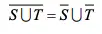
{a}
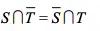
{ a ,{a}}

{{a}}

Let S = {a,{a}}. Which of the following is not an element of P(S) (the power set of S)?
{ ∅ , {a}}
∅
{a}
{ a ,{a}}
{{a}}

