
 Worksheets
chap 3
Total questions: 15
Worksheet time: 8mins
The opportunity cost of an item is
the number of hours that one must work in order to buy one unit of the item
what you give up to get that item
always less than the dollar value of the item
always greater than the cost of producing the item
Suppose a gardener produces both green beans and corn in her garden. If she must give up 14 bushels of corn to get 5 bushels of green beans, then her opportunity cost of 1 bushel of green beans is
0.36 bushel of corn
2.8 bushels of corn
14 bushels of corn
70 bushels of corn
Mike and Sandy are two woodworkers who both make tables and chairs. In one month, Mike can make 4 tables or 20 chairs, while Sandy can make 6 tables or 18 chairs. Given this, we know that
Mike has an absolute advantage in chairs
Mike has a comparative advantage in tables
Sandy has an absolute advantage in chairs
Sandy has a comparative advantage in chairs
If Shawn can produce donuts at a lower opportunity cost than Sue, then
Shawn has a comparative advantage in the production of donuts
Sue has a comparative advantage in the production of donuts
Shawn should not produce donuts
Shawn is capable of producing more donuts than Sue in a given amount of time
Comparative advantage is related most closely to which of the following?
output per hour
opportunity cost
efficiency
bargaining strength in international trade
Specialization and trade are closely linked to
absolute advantage
comparative advantage
gains to some traders that exactly offset losses to other traders
shrinkage of the economic pie
Trade can make everybody better off because it
increases cooperation among nations
allows people to specialize according to comparative advantage
requires some workers in an economy to be retrained
reduces competition among domestic companies
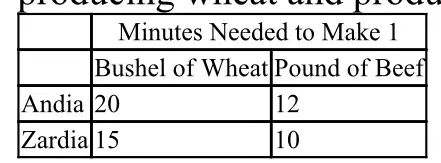
Refer to Table 3-1. What is Andia’s opportunity cost of producing one pound of beef?
3/5 bushel of wheat
6/5 bushel of wheat
4/3 bushel of wheat
5/3 bushel of wheat

Refer to Table 3-1. What is Andia’s opportunity cost of producing one bushel of wheat?
3/5 pound of beef
6/5 pound of beef
4/3 pound of beef
5/3 pound of beef
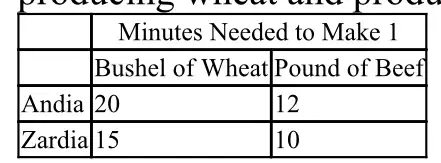
Refer to Table 3-1. What is Zardia’s opportunity cost of producing one bushel of wheat?
2/3 pound of beef
3/4 pound of beef
5/6 pound of beef
3/2 pound of beef
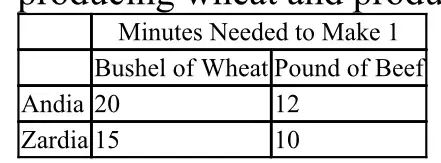
Refer to Table 3-1. What is Zardia’s opportunity cost of producing one pound of beef?
2/3 bushel of wheat
3/4 bushel of wheat
5/6 bushel of wheat
3/2 bushel of wheat
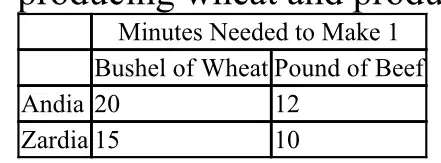
Refer to Table 3-1. Andia has an absolute advantage in the production of
wheat and Zardia has an absolute advantage in the production of beef.
beef and Zardia has an absolute advantage in the production of wheat
both goods and Zardia has an absolute advantage in the production of neither good
neither good and Zardia has an absolute advantage in the production of both goods
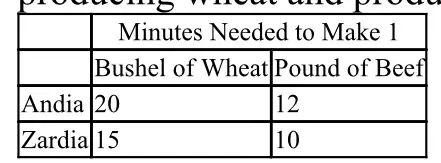
Refer to Table 3-1. Andia has a comparative advantage in the production of
wheat and Zardia has a comparative advantage in the production of beef
beef and Zardia has a comparative advantage in the production of wheat
both goods and Zardia has a comparative advantage in the production of neither good
neither good and Zardia has a comparative advantage in the production of both goods

Refer to Table 3-1. Andia should specialize in the production of
wheat and Zardia should specialize in the production of beef
beef and Zardia should specialize in the production of wheat
both goods and Zardia should specialize in the production of neither good
neither good and Zardia should specialize in the production of both goods

Refer to Table 3-1. Assume that Andia and Zardia each has 60 minutes available. If each person spends all his time producing the good in which he has a comparative advantage, then total production is
3 bushels of wheat and 6 pounds of beef
3.5 bushels of wheat and 5.5 pounds of beef.
4 bushels of wheat and 5 pounds of beef
7 bushels of wheat and 11 pounds of beef

