
 Worksheets
Thermal physics
Total questions: 36
Worksheet time: 25mins

The picture shows a bimetallic strip in a fire alarm. When there is a fire outbreak, the bimetallic strip will get hot, ....
bend downwards, complete the circuit and the alarm rings.
bend upwards, open the circuit and the alarm will not ring.
becomes longer, open the circuit and the alarm will not ring.
Assuming that the thermal energy supplied to each of them is same, which of following states of matter would expand the least?
Solid
Liquid
Gas
Evaporation happens
throughout the liquid
at the surface of a liquid
Evaporation takes place at any temperature
True
False
What effect does Evaporation cause ?
Heating Effect
Magnetic Effect
Cooling Effect
Warming Effect
What happens when a liquid perfume is sprayed on your palm ?
The liquid gain heat from the sanitizer and evaporate
The liquid gain heat from the surroundings and evaporate
The liquid gain heat from the palm and evaporate
The liquid gain heat from the palm or surroundings and evaporate
Sublimation is...
when a solid changes to a liquid
when a gas turns to a solid
when a liquid turns to a gas
when a solid turns to a gas
Condensation occurs when water vapour....
loses heat
gains heat
Which of the following speeds up evaporation?
larger surface area
no wind
cold weather
high humidity
Evaporation is a process where _____________________
liquid changes to gas
throughout whole water
on surface of water
at any temperature
at boiling point

The diagram shows a cooling curve for ice. Which line represents the ice in a liquid state (water)?
A
B
C
D
E

A
B
C
D

A pool of water evaporates. As molecules escape, the temperature of the water left in the pool
changes.
From where do the molecules escape and what is the effect on the temperature of the water in
the pool?
A
B
C
D

The diagram shows four beakers A, B, C and D. The beakers contain different amounts of the
same liquid at the same temperature. The beakers are left next to each other on a laboratory
bench overnight. The diagrams are all drawn to the same scale.
From which beaker does the largest quantity of liquid evaporate?
A
B
C
D

They are hit by air molecules.
They are less dense than air.
They are moved by convection currents.
They gain energy from the light.
The gas in a sealed container is compressed at constant temperature.
Which graph shows how the pressure of the gas changes with its volume?


completely changed to water is 1 and completely changed to steam is 3
completely changed to water is 1 and completely changed to steam is 4
completely changed to water is 2 and completely changed to steam is 3
completely changed to water is 2 and completely changed to steam is 4

The name of process A can be .................
Melting
Freezing
Sublimation
Evaporation
Solidification
Temperature relates to ...................
average potential energy
average kinetic energy
Solar energy
average chemical energy
Some air is trapped in a syringe by a movable piston. The initial volume of the trapped air is 0.25 m3 at a pressure of 800 mm Hg. The piston is pulled outwards such that the volume of air increases to 0.50 m3. Assuming that no air escapes or enters the syringe, and that the temperature inside the syringe remains constant, what is the new pressure inside the syringe?
400 mm Hg
760 mm Hg
800 mm Hg
1600 mm Hg
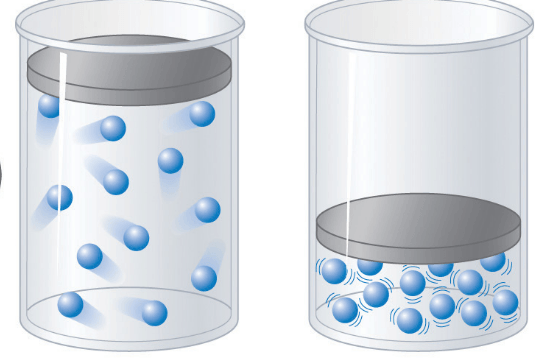

Which diagram shows the movement of a molecule in a gas?
A
B
C
D
Convert 5778K to celsius
5,505 °C
5,851 °C
5,508 °C
5,500 °C
The boiling point of water is ...
-173 K
100 K
173 K
373 K
If the temperature remains constant while the volume of a given amount of gas is tripled, the pressure will be ______.
9 times the original pressure
3 times the original pressure
6 times the original pressure
1/3 of the original pressure
The pressure of helium in a balloon is 100 000 Pa. The volume of the balloon is 0.030 m3. The balloon is compressed at a constant temperature causing the volume to decrease to 0.025 m3. No helium leaves the balloon. Calculate the new pressure in the balloon.
140 000 Pa
80 000 Pa
100 000Pa
120 000 Pa

Why can Eiffel tower, made by steel, "grow up"?
Knowing that, January in France is winter and July is summer.
Because July is hotter than January, the steel will expand more in July.
Because July is hotter than January, the steel will contract more in July.
Because July is hotter than January, the steel will expand more in January.

The metal plate ______________(lost / gained) heat from the heat source and _____________ (contracted / expanded).
gained, expanded
gained, contracted
lost, expanded
lost, contracted

When the metal ball is placed in a bowl of ice, ______________.
the metal ball gained heat and expanded
the metal ball gained heat and contracted
the metal ball lost heat and contracted
the metal ball lost heat and expanded

