
 Worksheets
POF - Straight and Level
Total questions: 16
Worksheet time: 9mins
The forces acting on an aircraft in straight and level flight are:
Weight, Lift, Thrust, Drag, Slipstream
Weight, Lift, Drag, Torque
Weight, Lift, Thrust, Drag
Weight, Lift, Thrust, Drag, Torque
The lift and weight forces form a couple:
True. A nose down couple
False
True. A nose up couple
Whats a couple
What forces create a nose up pitching moment?
Thrust and weight
Lift and Drag
Lift and Thrust
Thrust and Drag
What is the purpose of the tail plane
Balance the passengers incase one is much heavier
Balance residual rolling moments
Balance residual pitching moments
Hold the elevator on
In a low wing aircraft lowering flap will cause:
The change in the thrust/drag and lift/weight couples both cause a nose down pitching moment
The changes in the lift/weight couple causes a nose up pitching moment
The change in the thrust/drag and lift/weight couples both cause a nose up pitching moment
The changes in the thrust/drag couple cause a nose up pitching moment
Select all the correct statements regarding gear:
Raising and lowering the gear will cause a nose up moment
Raising and lowering the gear will cause a nose down moment
Raising the gear will cause a nose up moment
Raising the gear will cause a nose down moment
Lowering the gear will cause a nose down moment
To maintain S&L flight, if the speed increases:
The AoA must be increased
S&L cannot be maintained if speed is increased
The AoA must be decreased
Flaps must be lowered
The power required formula can be simply said to be:
Power = Thrust x TAS²
Power = Drag/TAS
Power = TAS/Thrust
Power = TAS x Drag
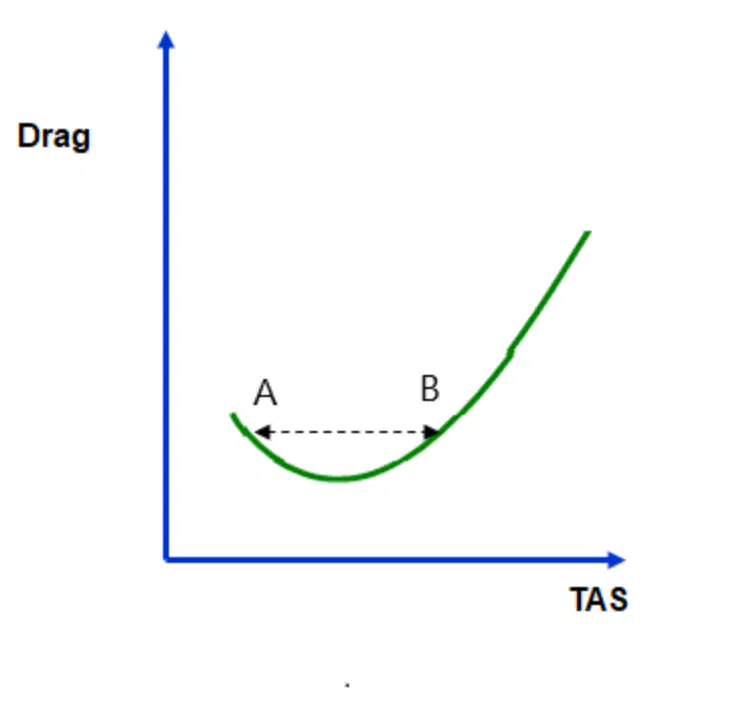
Consider points A and B. Will the power required to maintain S&L flight be the same at both points.
Yes because drag is the same
No the power required will be greater at A
No the power required at B will be greater
Yes
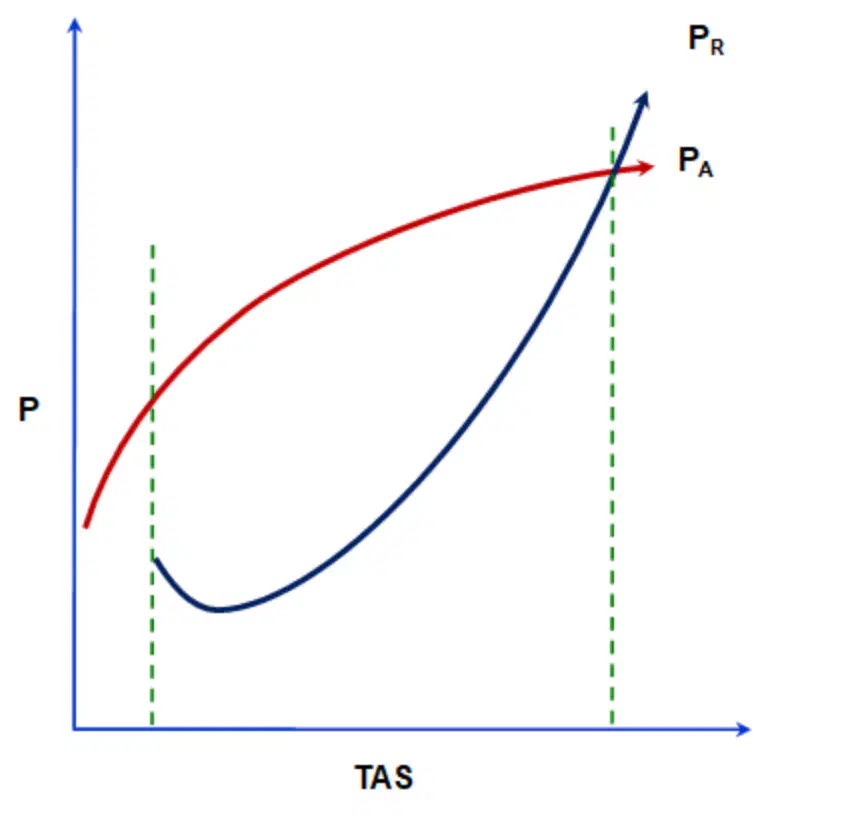
Considering this power available vs power required graph:
An increase in altitude would cause the Pr curve to move down. The Pa curve would move up.
An increase in altitude would have no effect
An increase in altitude will cause the Pr curve to move up and the Pa curve to move up
An increase in altitude will cause the Pr curve to move up and the Pa curve to move down
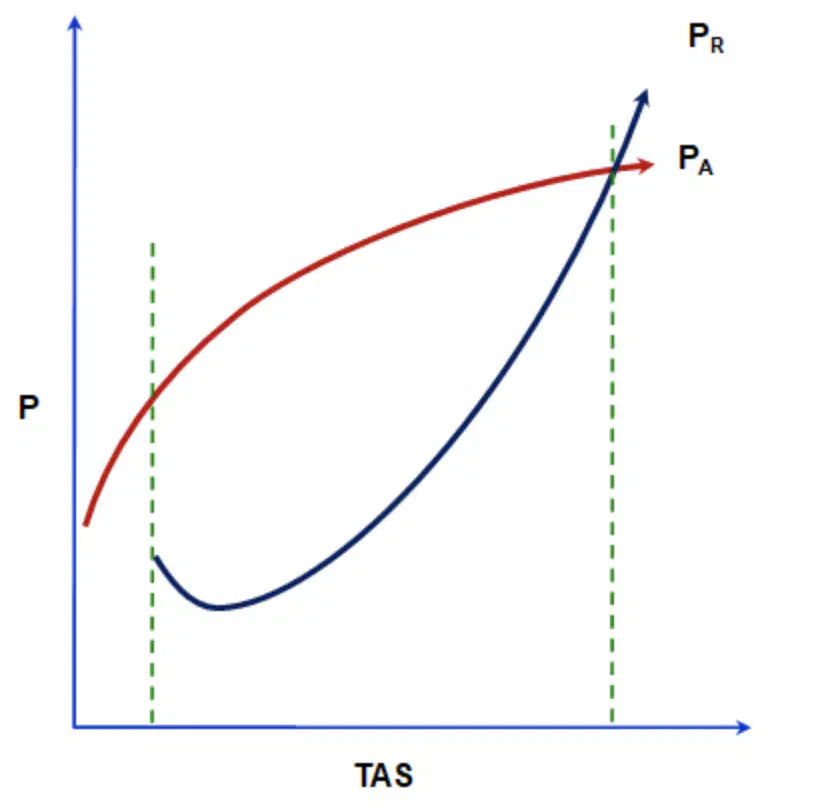
What happens when the Pr and Pa curves meet. (Select all that apply)
Maximum and minimum speed occur at the same time. This is called the service ceiling
The aircraft will stall
Maximum and minimum speed occur at the same time. This is called the absolute ceiling.
S&L will require full power
What happens to the power required for straight and level flight with an increase in weight
Pr decreases because the aircraft has more potential energy for a given altitude therefore requires less lift
Pr increases because the aircraft has more potential energy for a given altitude therefore requires more lift
Pr increases because of the increased requirement for lift
Pr decreases because of the decreased requirement for lift

Consider the above graph. Where does the minimum speed for straight and level flight occur
At the greatest distance between the Pa and Pr curves
At 25% of the Pr curve
Cannot be found on this graph
When the Pa and Pr curves meet at the lower TAS
In S&L flight:
Lift and thrust are equal
Weight and thrust are equal
Weight and drag are equal
Lift and weight are equal
It is impossible to maintain S&L flight when the aircraft is at 16° AoA
True
False
The power required versus TAS curve moves ________ as altitude is increased (aside from supercharging/turbo charging)
down and to the left
down and to the right
up and to the left
up and to the right

