Worksheets
Waves and Electromagnetic Spectrum Review
Total questions: 45
Worksheet time: 29mins
Aria, Samuel, and Ethan are studying for their physics exam. They are discussing how the energy of electromagnetic waves changes as you move from radio waves, which are used in their car radios, to gamma rays, which are used in cancer treatment. How does this energy change?
decreases
increases
Waves are...
Made up models and don't exist in real life
Never transverse
Fun ways to greet your friends
Energy being transferred from place to place
Electromagnetic waves can transfer energy through a vacuum.
True
False
Electromagnetic waves can travel through a medium
False, they are only able to travel through a vacuum
True, they can travel through a medium
True they can travel through a medium or a vacuum
False, they do not require a medium
How are electromagnetic waves organized on the electromagnetic spectrum?
By amplitude
By wavelength
By frequency
By speed
What is the relationship between frequency and energy in the electromagnetic spectrum?
Higher frequency means lower energy
Higher frequency means higher energy
Frequency and energy are unrelated
Lower frequency means higher energy
Which of the following is NOT an electromagnetic wave?
Ultraviolet
X-rays
Sound
Radio
Which of the following travels through the vacuum of space?
Mechanical waves
Electromagnetic waves
Seismic waves
Sound waves
What is the lowest frequency color of visible light?
Blue
Green
Red
Violet
What is a characteristic of radio waves?
Shorter wavelengths than microwaves
Higher energy than microwaves
Longest wavelength
Cannot be felt
Which type of wave is used in RADAR?
Radio waves
Microwaves
Infrared light
Visible light
What is a common use of x-rays?
Treating infections
Imaging of bones
Cooking food
Generating heat
What is a source of gamma rays?
The ocean
Stars and some radioactive materials
Plants
The atmosphere
What can gamma rays penetrate?
Only soft tissues
All human tissues
Only hard tissues
Only liquids
Which type of light is used in animal vision, such as in bees?
Infrared light
Ultraviolet light
X-rays
Gamma rays
What is the energy level of gamma rays compared to other rays?
Lowest
Moderate
Highest
Same as x-rays

True or false: as you move along the spectrum, left to right, the wavelengths decrease in size (get smaller)
true
false

Which has the LONGEST wavelength and, therefore, the lowest frequency/energy
Gamma Rays
Radio Waves
Visible Light
Infrared rays

Which has the SHORTEST wavelength and, therefore, the highest frequency/most energy
Radio waves
Ultraviolet Rays
Gamma Rays
X-rays

Put the visible light colors in order from longest wavelength to shortest wavelength
Violet, Indigo, Blue, Green, Orange, Yellow, Red
Red, Yellow, Green, Orange, Violet, Blue, Indigo
Red, Orange, Yellow, Green, Blue, Indigo, Violet

Which of the following electromagnetic waves has the lowest energy?
gamma ray
infrared wave
visible light wave
microwave

Which color has the highest frequency?
red
orange
green
blue

Which color has the least amount of energy?
red
orange
green
blue


This type of electromagnetic wave is used to treat cancer...
gamma ray
ultra violet
radio
This everyday object emits microwaves...
cell phone
TV
radio waves
This type of wave is used by snakes to find their food...
gamma ray
radio
infrared waves
Sunburns are a result of this type of electromagnetic wave...
ultraviolet
microwaves
infrared
Which of the following correctly shows the acronym used to remember the order of colors in the visible spectrum?
BOY G. RIV
ROY B. GVI
ROY G. BIV
Which of the following statements is TRUE?
Visible light is a tiny part of the electromagnetic spectrum.
Humans can see most of the waves on the electromagnetic spectrum.
Ultraviolet has less energy than visible light.
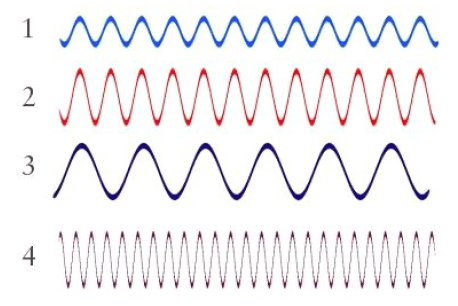
Reorder the following from highest frequency to lowest frequency.
(Left = Highest frequency, Right = Lowest frequency)


True or False: Electromagnetic waves can travel through space (Vaccum)
True
False