
 Worksheets
AI for SE Quiz
Total questions: 50
Worksheet time: 34mins
What is the Waterfall methodology primarily known for?
Its flexibility and adaptability
Its sequential development process
Its emphasis on rapid development
Its preference for small projects
Which of these is NOT a phase in the Waterfall methodology?
Requirements
Design
Continuous Integration
Implementation
What does the success of the Waterfall method heavily depend on?
The amount and quality of work done upfront
The ability to adapt to changes quickly
Minimal planning and documentation
Frequent customer feedback
Waterfall methodology is often compared to which other project management methodology for its flexibility?
Six Sigma
Scrum
Agile
Kanban
What is a major advantage of the Waterfall methodology?
High flexibility to change requirements
Shorter delivery times
Predictable release dates
Minimal initial planning
Which statement is true about making changes in the Waterfall process?
-
Changes can be easily accommodated at any stage
Changes are preferable at the design stage only
Changes are difficult and expensive late in the process
Changes are encouraged during the implementation phase
How does the Waterfall model handle project requirements?
Assumes all requirements can be gathered upfront
Encourages evolving requirements
Does not require documentation of requirements
Requirements are defined by the development team as they go
Which of the following is often considered a strength of the Waterfall methodology, rather than a disadvantage?
Flexibility to adapt to changes
Involvement of clients throughout the project
High predictability in costs and timelines
Suitability for projects with unclear requirements
Who is likely to use the Waterfall model?
Teams with ambiguous project requirements
Projects with a clear picture and unlikely scope changes
Projects that require frequent client input
Teams that prefer an iterative approach
Have you understood what a waterfall model is ?
Yes
No
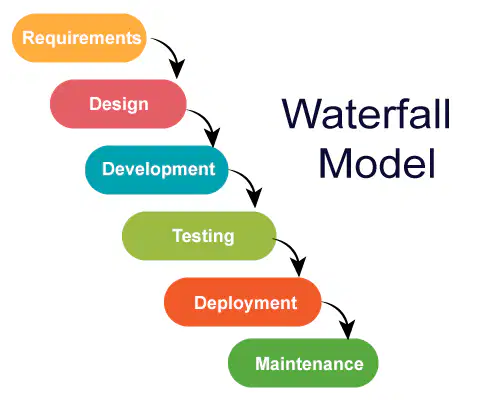
Write as much as you can about this image. What do you see, what do you understand, where it can be used, whatever that comes to your mind.
Which of the following is the first step of SDLC?
Coding
Design
Preliminary Investigation and Analysis
Testing
The process to gather the software requirements from client, analyze and document them is known as
Feasibility Study
Requirement Gathering
Requirement Engineering
System Requirements Specification
It is the process in which developers discuss with the client and end users and know their expectations from the software.
Requirements gathering
Organizing Requirements
Negotiation & discussion
Documentation
A waterfall model is most suitable model for smaller projects.
True
False
Amongst which of the following is/are the characteristics of Waterfall Model
Simplest model
Good to small / medium-sized projects where requirements are specified and do not frequently changed
Development phases executes sequentially
All of the mentioned above
The waterfall model is the most suitable model when the ------------------
are crystal clear and don't change frequently.
(a)
Amongst which one is a correct order of the waterfall model,
design, analysis, problem identification, testing, deployment, maintenance, and implementation
analysis, problem identification, design, testing, deployment, maintenance, and implementation
maintenance, analysis, problem identification, testing, deployment, design, and implementation
problem identification, analysis, design, implementation, testing, deployment, and implementation
With reference to waterfall model, each phase must be completed before the ----------------------- an begin and there is no overlapping in the phases
A. Previous phase
B. Next phase
C. Both A and B
None of the mentioned above
After a successful deployment of the system at customers end, it is compulsory to ------------------------ it from time to time, so that system can successfully run to a long period
Testing
Maintain
Development
Design
A selection of a particular model for system development is based on
Technical knowledge of development team
Requirements
Project types and associated risks
All of the mentioned above
1. Prototype uses which of the following to refine the requirements of the software?
Quick plan
Quick design
Feed back
Construction
Rigorous process model is also referred to as
Inclement process model
Bleak process model
Prescriptive process model
Severe process model
AOP stands for
Angle oriented programming
Arc oriented programming
Apple oriented programming
Aspect oriented programming
Pattern can be defined at
First level of abstraction
Second level of abstraction
Third level of abstraction
Any level of abstraction
Which of the following are examples of prototype modelling?
Series of sketches
Powerpoint slideshow
Storyboard
All the above
Which one of the following is not a phase of prototype modelling?
Coding
Engineering Product
Prototype refinement
Quick design
In prototype modelling, iteration is planned quickly in,
Quick Plan
Quick Design
Deployment
Construction of pr
What should be needed to the prototype, if the user is not happy with the current prototype?
Redefine
Refine
Define
All the ab
Is customer feedback helpful in preventing unnecessary design faults?
True
False
Why is prototyping essential?
To get quick feedback on the product/application
Experiment with multiple alternatives
Both
None
How many dimensions are there for a prototype modelling?
Vertical
Horizontal
Both
None
Evolutionary prototyping is also called as
Extreme prototyping
Feedback prototyping Q
Breadboard prototypin
None
For rapid prototyping a 3D CAD model should be converted into a ______ file.
SGC
STC
STL
SLS
What does RAD stand for in the context of software development models?
Rapid Application Development
Real-time Application Design
Reliable Application Deployment
Resource Allocation Design
Which of the following is a key feature of the RAD model?
Extensive documentation
Iterative development
Waterfall approach
Fixed requirements
What is one of the main advantages of using the RAD model?
High cost
Long development time
Quick delivery
Rigid structure
Which of the following is a disadvantage of the RAD model?
Requires minimal user involvement
Limited flexibility
High dependency on skilled developers
Slow prototyping
How does the RAD model compare to the Waterfall model?
RAD is more linear
RAD is less flexible
RAD allows for more user feedback
RAD has more documentation
In which scenario is the RAD model most suitable?
Projects with unclear requirements
Projects with a fixed budget
Projects with a long timeline
Projects with minimal user interaction
Which of the following is NOT a feature of the RAD model?
Prototyping
User involvement
Sequential phases
Iterative testing
What is a common use case for the RAD model?
Large-scale enterprise systems
Simple, small applications
Systems with high security requirements
Projects with strict regulatory compliance
Which of the following best describes the RAD model's approach to development?
Linear and sequential
Iterative and incremental
Predictive and planned
Rigid and structured
What is a key benefit of user involvement in the RAD model?
Increased development time
Higher costs
Better alignment with user needs
Less flexibility
Which of the following is a challenge when using the RAD model?
Lack of user feedback
Difficulty in managing changes
High demand for resources
Slow response to market changes
How does the RAD model handle changes in project requirements?
Changes are discouraged
Changes are easily accommodated
Changes are ignored
Changes are documented extensively
What is a potential disadvantage of the RAD model in terms of project scope?
Scope creep
Fixed scope
Limited scope
Undefined scope
Which of the following is a characteristic of the RAD model's prototyping phase?
Final product delivery
Minimal user feedback
Frequent iterations
Extensive documentation
What is a primary goal of the RAD model?
Minimise user involvement
Maximise development time
Deliver a working product quickly
Ensure extensive documentation
Which of the following best describes the RAD model's approach to user feedback?
User feedback is collected at the end
User feedback is ignored
User feedback is integral throughout
User feedback is minimal

