wayground logo

Free Printable Worksheets

Font size

S
M
L
XL
Worksheets

Waves Unit Test

Total questions: 43

Worksheet time: 31mins

Name
Class
Date
1.
Which best describes the relationship between waves and matter?
a)
All waves require matter in order to transfer energy.
b)
Mechanical waves require matter to transfer energy, but electromagnetic waves do not.
c)
Electromagnetic waves require matter to transfer energy, but mechanical waves do not.
d)
All waves transfer matter using energy.
2.
Which of the following pictures is depicting a transverse wave?
a)
Wave A
b)
Wave B
c)
Wave C
3.
The __________ of a wave is how many wavelengths pass a fixed point each second.
a)
Amplitude
b)
Wavelength
c)
Frequency
d)
Speed
4.
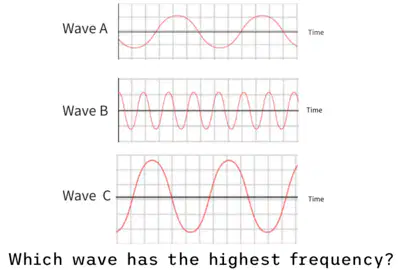
Which wave has the highest frequency?
a)
Wave A
b)
Wave B
c)
Wave C
5.
Which of the following would be true if a wave's frequency increased?
a)
the wave's amplitude would be lower
b)
the wave's amplitude would be higher
c)
the wave's wavelength would shorten
d)
the wave's wavelength would lengthen
6.
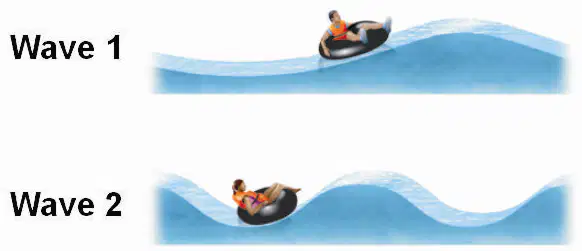
How are these two waves different?
a)
The amplitude of Wave 2 is twice the amplitude of Wave 1.
b)
The wavelength of Wave 2 is twice the wavelength of Wave 1.
c)
The frequency of Wave 2 is twice the frequency of Wave 1.
7.
Which statements is correct about the speed of sound waves?
a)
Sound waves travel fastest through solids because the particles are more tightly packed together.
b)
Sound waves travel fastest through liquids because the particles are touching but sliding past each other.
c)
Sound waves travel fastest through gases because the particles have more space around them for the wave to spread out.
d)
Sound waves travel the same speed through all states of matter.
8.
Which of the following statements are true about sound waves?
a)
they are longitudinal waves
b)
they are transverse waves
c)
the waves' motions happen in the same direction that the wave travels
d)
the waves' motions happen perpendicular to the direction that the wave travels
e)
as a sound wave passes through a medium, particles in the air bunch together and spread out, creating areas of high and low pressure
9.
How does a sound wave begin?
a)
vibration of a medium
b)
transfer of heat
c)
in our ears
d)
in empty space
10.
Which of the following waves would be the loudest and why?
a)
Wave A is the loudest because it has the longest wavelength
b)
Wave B is the loudest because it has the highest amplitude
c)
Wave C is the loudest because it has the shortest wavelength
d)
Wave D is the loudest because it has the lowest amplitude
11.
Which of the following best describes how high and low pitch are different?
a)
a high-pitched sound has a high amplitude and a low-pitched sound has a low amplitude
b)
a person is close to a high-pitched sound and far away from a low-pitched sound
c)
a high-pitched sound is loud while a low-pitched sound is quiet
d)
a high-pitched sound has a high frequency and a low-pitched sound has a low frequency
12.
What makes microwaves different from infrared waves?
a)
the color that we see
b)
their wavelengths
c)
their temperatures
13.
By passing a white light through a prism, you can tell...
a)
that white light is actually a mixture of different colors
b)
the original source of light
c)
that light speeds up when it goes through the prism
14.
A green object looks green because _____.
a)
the green object is opaque and not translucent
b)
the green object emits green light
c)
green light is absorbed while others are reflected
d)
green light is reflected while others are absorbed
15.
What causes light waves to refract?
a)
The speed of light is reduced to zero.
b)
The speed of light remains constant.
c)
The speed of light changes from one medium to the next.
d)
The light is repelled by some materials.
16.
Which of the following statements is NOT TRUE of DIGITAL SIGNALS?
a)
digital signals are wave pulses
b)
digital signals have only two values that they can send: on or off
c)
digital signals are very susceptible to interference (noise)
d)
digital signals are a more reliable way to encode and transmit information than analog signals
17.
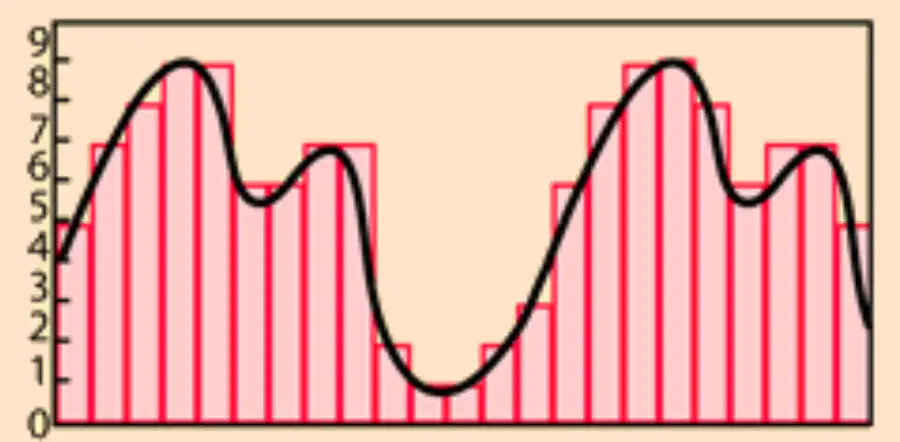
Which of the following statements is true about the information shown on this graph?
a)
The black line is showing the analog wave and the red bars are the digital sample.
b)
The black line is showing the digital signal and the red bars are the analog sample.
c)
The black lines and red bars are unrelated.
d)
18.

What happens to the wavelength of light as it enters a denser medium?

a)

The wavelength becomes zero.

b)

The wavelength increases.

c)

The wavelength remains the same.

d)

The wavelength decreases.

19.

Which of the following best explains why we see a rainbow?

a)

Light is absorbed by raindrops.

b)

Light is reflected by the ground.

c)

Light is refracted and dispersed by raindrops.

d)

Light is emitted by the sun.

20.

What is the primary difference between sound waves and light waves?

a)

Sound waves can travel through a vacuum, while light waves cannot.

b)

Sound waves travel faster than light waves.

c)

Sound waves require a medium to travel, while light waves do not.

d)

Sound waves are electromagnetic, while light waves are mechanical.

21.
Waves move ___ through vibrations
a)
Energy
b)
Matter
c)
Mass
d)
Weight
22.
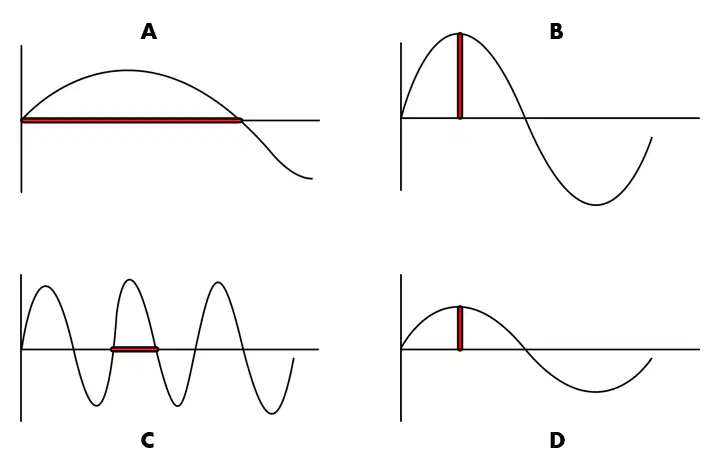
Which is the wavelength?
a)
1
b)
2
c)
3
d)
4
23.
Which type of wave does sound travel in?
a)
Transverse
b)
Longitudinal
24.
What type of wave is this?
a)
Transverse
b)
Longitudinal
25.
What is represented by the blue lines?
a)
Trough
b)
Crest
c)
Wavelength
d)
Amplitude
26.
What part is represented by the blue lines?
a)
Crest
b)
Resting Point
c)
Wavelength
d)
Amplitude
27.
What part is the arrow pointing to?
a)
Crest
b)
Trough
c)
Amplitude
d)
Wavelength
28.
What part is the arrow pointing to?
a)
Crest
b)
Trough
c)
Amplitude
d)
Wavelength
29.
What kind of wave is pictured?
a)
Transverse
b)
Longitudinal
c)
surface
d)
none of the above
30.
What kind of wave is pictured?
a)
Transverse
b)
Longitudinal
c)
surface
d)
none of the above
31.

A disturbance that transfers energy from place to place

a)

Wave

b)

Energy

c)

Interference

d)

Node

32.

The material through which a wave travels.

a)

Hertz

b)

Crest

c)

Medium

d)

Trough

33.

The part of a longitudinal wave where the particles of the medium are farther apart.

a)

Compression

b)

Crest

c)

Rarefaction

d)

Trough

34.

The part of a longitudinal wave where the particles of the medium are close together.

a)

Compression

b)

Crest

c)

Rarefaction

d)

Trough

35.

What do seismic waves and sound waves have in common?

a)

They're mechanical waves

b)

They're electromagnetic waves

c)

They're phonetic waves

d)

They're permanent waves

36.

What do waves carry from place to place?

a)

Energy, but not matter

b)

Energy and matter

c)

Matter, but not energy

d)

Neither energy nor matter

37.

How are electromagnetic waves different from mechanical waves?

a)

Electromagnetic waves need a medium to travel through; mechanical waves don't.

b)

Electromagnetic waves can travel through water; mechanical waves can only travel through solid matter.

c)

Electromagnetic waves can travel through empty space; mechanical waves can't

d)

Electromagnetic waves are long chains of vibrating molecules; mechanical waves aren't.

38.

How is wavelength measured?

a)
b)
c)
d)
39.

When you place things into water they sometimes look bent (see the image below). What is this an example of?

a)

Refraction

b)

Diffraction

c)

Transmission

d)

Absorption

40.

Which type of interaction is this?

a)

reflection

b)

refraction

c)

diffraction

41.

Which type of interaction is this?

a)

reflection

b)

refraction

c)

diffraction

42.

Which wave has the highest frequency?

a)

red

b)

green

c)

blue

d)

pink

43.

The image depicts which of the following wave behaviors?

a)

Resonance

b)

Doppler Effect

c)

Polarization

d)

Diffraction