
NEW
Font size
 Worksheets
Ch. 9 U.S. History Test Review
Total questions: 40
Worksheet time: 20mins
Why did James Monroe go to France in 1803?
to seek French help against Spanish territorial claims
to offer the French help in getting Saint-Domingue back
to purchase New Orleans and some surrounding territory
to convince the French not to purchase Louisiana from Spain
What was the result of the Battle of the Thames?
The British lost the War of 1812.
The British lost control of Detroit.
The British took control of Fort McHenry.
The British took control of Washington, D.C.
Why did the United States declare war on Great Britain in the War of 1812?
because the British were imposing high tariffs on American exports
because the British challenged the United States’ ownership of the Louisiana Territory
because the British forced American sailors to serve in the Royal Navy
because the United States had formed an alliance with France
The battle at which location inspired Francis Scott Key to write “The Star-Spangled Banner”?
Detroit
Lake Erie
Fort McHenry
Washington, D.C.
What is judicial review?
the Supreme Court’s right to determine the rights of the individual
the Supreme Court’s right to review every presidential appointment
the Supreme Court’s right to invalidate a law that is unconstitutional
the Supreme Court’s right to review a law before Congress passes it
What were the terms of the Treaty of Fort Wayne?
Native Americans would sell 2.9 million acres of land to the British for $1,000 per acre.
Native Americans would sell 2.9 million acres of land to the United States for less than a penny per acre.
Native Americans would trade 2.9 million acres of land to the British for weapons to fight against U.S. troops.
Native Americans would trade 2.9 million acres of land in the Northwest Territory to the United States for land in the South.
How did the Embargo Act of 1807 affect the U.S. economy?
by increasing exports to foreign markets
by decreasing illegal trade and smuggling
by increasing domestic demand for cash crops
by decreasing revenues made through customs
Where did Tecumseh establish Prophetstown?
Canada
Louisiana Territory
New Orleans
Indiana Territory
Which group did President Jefferson believe the Louisiana Purchase would benefit?
farmers
explorers
politicians
Native Americans
What was the purpose of the British policy of impressment?
to stop the United States from invading Europe
to attack coastal towns and small ports
to expand the size of the British navy
to cut off trade in the West Indies
What purpose did the Non-Importation Act serve?
It banned British imports.
It banned French imports.
It banned European imports.
It banned all foreign imports.
How did Britain respond to the Non-Importation Act?
Britain passed a similar act.
British ships fired on U.S. coastal towns.
Britain declared war on the United States.
Britain stopped capturing American ships.
Which group was particularly impacted by the Embargo Act of 1807?
southern manufacturers
mid-Atlantic merchants
New England farmers
western settlers
Why did Federalists in Congress pass the Judiciary Act of 1801?
to prevent Thomas Jefferson from reducing government spending
to limit Thomas Jefferson’s influence over the Supreme Court
to expand the power of the Democratic-Republicans
to allow John Adams to remain in office
What did the Treaty of Ghent give to the United States?
British North America (Canada)
territory lost during the war
land controlled by Tecumseh
control of the Mississippi River
What power did Marbury v. Madison help to establish?
judicial review
land acquisition
freedom of speech
presidential commissions
How did Thomas Jefferson promote unity between Federalists and Democratic-Republicans?
by reducing the size of the military
by leaving the National Bank intact
by supporting the French Revolution
by hosting expensive and show events
When did Toussaint L’Ouverture lead a revolution to free slaves in Saint-Domingue?
1791
1799
1802
1803
Why did Napoleon sell the Louisiana Territory to the United States?
He did not think it was valuable after losing Saint-Domingue.
He knew that the United States planned to form an alliance with Spain.
An outbreak of yellow fever had killed too many French settlers in Louisiana.
He was afraid that Jefferson would form an alliance with Toussaint L’Ouverture.
Why did Spain return Louisiana to France?
Spain wanted France to sell Louisiana to the United States.
Spain decided Louisiana was too expensive to maintain and unprofitable.
Spain wanted to help Napoleon invade the United States from the west.
Spain knew it could not defend Louisiana from an invasion by the United States.
Which idea did Jefferson emphasize in his inaugural address?
unity
states’ rights
revolution
limited government
Which city did British troops attack after the Treaty of Ghent was signed?
Detroit
Baltimore
New Orleans
Prophetstown
Why did Tecumseh want to form a confederation of Native American tribes?
to create a universal language to communicate
to stop the destruction of native economies
to fortify old settlements on the frontier
to increase the value of native lands
In 1814, what brought about an increase in British troops in the War of 1812?
The war between Britain and France was ending.
Native Americans joined British forces.
British forces from Canada arrived to support troops from Britain.
New England farmers and merchants started joining the British troops.
Why is Thomas Jefferson considered a man of conflicting values?
He loved to study the sciences, but he failed to review the reports of Lewis and Clark.
He wrote about equality in the Declaration of Independence, but he enslaved over 100 people.
He was a dedicated gardener at Monticello, but he refused to pass laws that benefited farmers.
He believed in the importance of education, but he prevented women from attending the University of Virginia.
Why did Thomas Jefferson have some misgivings about the Louisiana Purchase?
He thought it would be hard to govern.
He worried it was unconstitutional.
He believed it was too expensive.
He thought it would lead to war.
What was the final act of the Battle of Tippecanoe?
Americans burned Prophetstown.
Native Americans attacked the Americans’ camp.
Americans attacked Native Americans at Prophetstown.
Native Americans defended Prophetstown.
Why did Thomas Jefferson win the 1800 election?
Jefferson received more votes than Burr.
Burr decided to withdraw from the election.
Hamilton’s support helped him win votes in the House.
Jefferson persuaded members of the House to vote for him.
Which Shawnee chief worked to form a confederacy of Native American tribes in the early 1800s?
Tenskwatawa
Tecumseh
Sequoya
Black Hawk
How did the war between Britain and France affect the American shipping industry?
Both countries tried to block American ships from entering enemy ports.
The war had little effect on the shipping industry.
The shipping industry shut down.
All ships became armed and engaged in skirmishes with the British and French navies.
Which describes an effect of the Battle of Tippecanoe on the United States?
It led Congress to repeal a costly trade embargo against France.
It led William Henry Harrison to raid a Native American settlement.
It convinced Americans that Native Americans wanted to form an alliance.
It convinced War Hawks that the country had to take arms against the British.
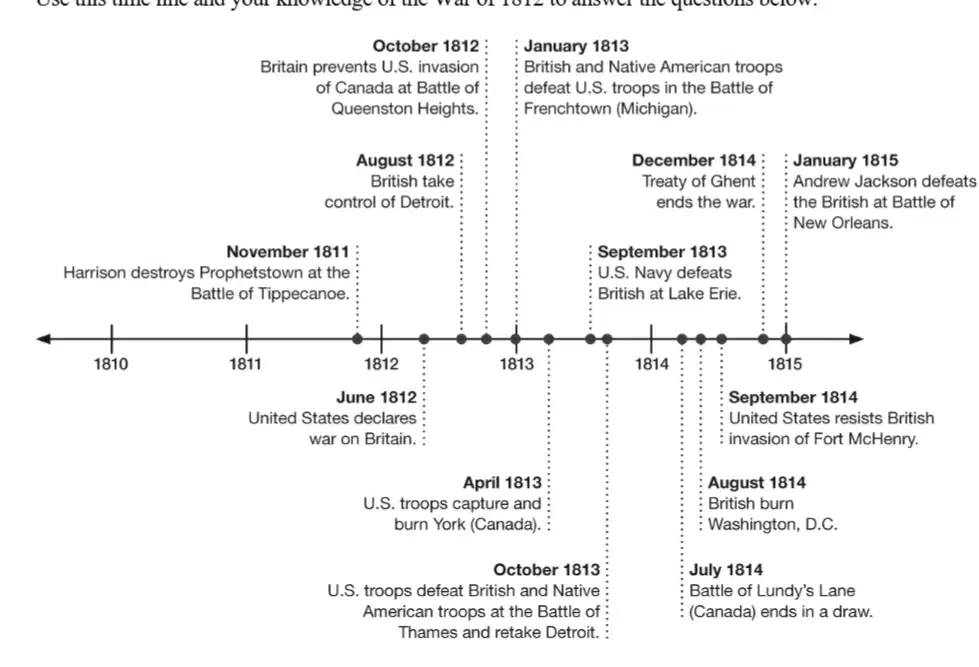
Use this time line and your knowledge of the War of 1812 to answer the questions below. In what year were there two major American victories?
1812
1813
1814
1815
Who went to France to negotiate the Louisiana Purchase?
Aaron Burr
James Monroe
James Madison
Thomas Jefferson
What did the British burn during the War of 1812?
Fort McHenry
the White House
a fort near Detroit
American ships on Lake Erie
Which fact supports the idea that Thomas Jefferson was a very popular president?
The Embargo Act of 1807 caused economic hardship.
Jefferson had a policy of neutrality.
The candidate Jefferson endorsed, John Madison, won the election of 1808.
Jefferson stopped most of the smuggling that followed the Non-Importation Act.
Which Federalist practice did Jefferson keep after he was elected in 1800?
lowering taxes
maintaining a national bank
decreasing government spending
limiting the federal government’s power
Who appointed “midnight judges” just before leaving office?
John Adams
John Marshall
James Madison
Thomas Jefferson
The list shows achievements of the Lewis and Clark Expedition. Which achievement belongs on the list?
changed American understanding of western physical geography
calculated the size of the North American bison population
located a northwest passage to the Pacific
discovered the Missouri River
Which describes the major outcome of the case Marbury v. Madison?
It forced James Madison to give William Marbury his commission.
It increased the number of justices on the Supreme Court.
It weakened the system of checks and balances.
It expanded the power of the Supreme Court.
Which individual helped Thomas Jefferson win the presidency over Aaron Burr?
John Adams
James Madison
William Marbury
Alexander Hamilton

