
NEW
Font size
 Worksheets
Database Usage Quiz
Total questions: 58
Worksheet time: 29mins
What is a database?
A type of software for creating graphics
An organized collection of information or data
A tool for editing videos
A programming language
Why do banks use a database package?
To create marketing materials
To store customers' accounts information
To design new bank branches
To train employees
How do schools use databases?
To manage sports events
To store information on all the pupils
To organize field trips
To plan school meals
What is one use of databases by the police?
To track weather patterns
To keep information on people with criminal records
To manage traffic signals
To organize community events
What is the whole set of data in a database called?
Record
Field
File
Entry
What is the set of information on one single subject in a database called?
File
Record
Field
Table
What is each separate heading of information inside a record called?
File
Record
Field
Data
What is a record in the context of databases?
A single piece of data
A complete set of information about one object/person
A type of software
A programming language
What do databases usually contain?
A single record
Many records
Only text files
Only images
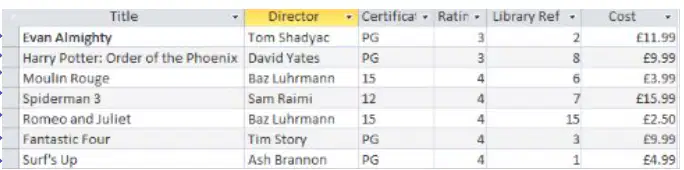
Which of the following is an example of a record from the table shown?
Title: Evan Almighty, Director: Tom Shadyac
Certification: PG, Rating: 3
Library Ref: 2, Cost: £11.99
All of the above
What is a field in the context of data?
A) A large open area of land
B) A single piece of information about an object/person
C) A type of software application
D) A method of data encryption
Which of the following is NOT a data type that a field can contain?
A) Numeric
B) Text
C) Calculated
D) Geometric
What type of information would typically be stored in a text field?
A) Boolean values
B) Telephone numbers
C) Currency values
D) Date/Time values
Can fields be left empty?
A) Yes
B) No
C) Only if they are numeric
D) Only if they are text
What is the term used to describe the columns in a database table?
Records
Fields
Entries
Cells
In a database, what do the rows represent?
Fields
Records
Cells
Columns
Which field type is used to hold alphanumeric data?
Number
Text
Date
Boolean
What type of data does the 'Number' field type hold?
Photographs
True or False values
Integer and real numbers
Dates
Which field type is used to store data that are dates?
Time
Date
Link
Object
What does the 'Boolean' field type hold?
Links to files
Photographs
True or False values
Alphanumeric data
Which field type is used to store any type of binary data, such as graphics, sound, or video?
Graphic
Object
Link
Text
What is a calculated field in a database?
A field that stores text data
A field that stores image data
A field that performs calculations on other fields
A field that stores date and time data
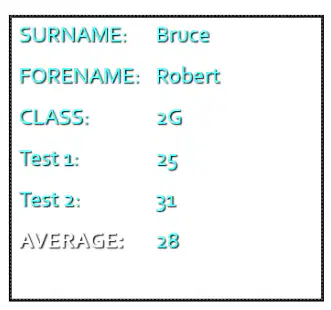
Based on the diagram, what is the average score of Test 1 and Test 2?
25
28
31
30
What is an example of a validation check that would not be allowed?
A numeric field containing text
A text field containing numbers
A field with a default value
A field with optional input
Which of the following is a presence check?
Ensuring a field is not left blank
Ensuring data is within a certain range
Ensuring data is selected from a drop-down menu
Ensuring data is of a specific type
What does a restricted choice validation check involve?
Data must be selected from a drop-down menu
Data must be within a certain range
Data must not be left blank
Data must be a specific length
What is the purpose of a range check in data validation?
To ensure data is within a certain range
To ensure data is not left blank
To ensure data is selected from a list
To ensure data is of a specific type
What is one of the main reasons for ensuring good design of a database?
To increase data duplication
To slow down searches and calculations
To store data efficiently and perform quick calculations
To make data insertion impossible
What is data duplication in the context of database design?
Efficient use of storage space
Needlessly duplicating data, which takes up storage space
Quick data retrieval
Improved data accuracy
Which of the following is a type of modification error in databases?
Data sorting
Data duplication
Data insertion
Data encryption
What happens during a deletion error in a database?
Data is encrypted
The only instance of data is deleted
Data is duplicated
Data is sorted incorrectly
What is a key characteristic of a relational database?
It stores all information in a single table.
It is subject to errors when updating records.
It links tables through primary and foreign keys.
It is an inefficient method of storing data.
Which type of database is more prone to errors when updating records?
Relational Database
Flat-File Database
Both A and B
Neither A nor B
What is a disadvantage of a flat-file database?
It is efficient in storing data.
It links multiple tables.
It is subject to errors when amending records.
It uses primary and foreign keys.
What is the purpose of a primary key in a database?
To link tables together
To uniquely identify a record
To store large amounts of data
To encrypt data
What is a foreign key used for in a database?
To create a link between tables
To store images
To perform calculations
To encrypt data
How can tables in a database be linked together?
Using primary and foreign keys
Using encryption
Using data compression
Using file extensions
What is a simple sort?
Arranging records by more than one field
Arranging records by one of the fields
Arranging records randomly
Arranging records by colour
What does a complex sort allow you to do?
Arrange records by one field
Arrange records randomly
Arrange records by more than one field
Arrange records by size
In a simple sort, how can records be arranged?
Only in descending order
Only in ascending order
In both ascending and descending order
In random order
Which of the following is an example of ascending numeric order?
Z, Y, X, W
4, 3, 2, 1
1, 2, 3, 4
W, X, Y, Z
What is a simple search in a database?
Searching on one field
Searching on multiple fields
Using logical operators
Searching with keywords
What is the advantage of using complex searches in a database?
It takes more time
It narrows down the information
It provides more data
It is easier to perform
Which logical operators can be used in a database search?
IF, ELSE, THEN
AND, OR, NOT
FOR, WHILE, DO
ADD, SUBTRACT, MULTIPLY
Which of the following is a part of the design phase in the topic content?
Analysis
Implementation
General Data Protection Regulation
Evaluation
Which phase comes after the design phase in the topic content?
Testing
Implementation
Evaluation
Analysis
What does the acronym GDPR stand for in the context of design?
General Data Protection Regulation
General Data Privacy Rule
Global Data Protection Rights
General Data Processing Regulation
What is one of the key requirements when identifying the end-user and functional requirements of a database?
Understanding user needs
Ignoring data security
Focusing only on aesthetics
Avoiding user feedback
What does DPA 1998 / GDPR primarily focus on?
Data protection and privacy
Database design
Network security
Software development
What is the purpose of implementing relational databases with 2 linked tables?
To manage related data efficiently
To increase data redundancy
To simplify user interfaces
To enhance network speed
What is the purpose of analysis in a database?
To create a user interface
To identify the end-user and functional requirements
To design the database schema
To implement security measures
Who are considered end-users in a database system?
Only customers
Only employees
People or groups interacting with the system
Only database administrators
What are functional requirements in a database system?
The design of the database
The exact specifications of what the system must do
The security protocols
The user interface layout
How is a school’s database system typically used by office staff?
To design classroom layouts
To manage pupil personal details
To conduct online classes
To create lesson plans
According to the GDPR, how must data be processed?
Randomly and without transparency
Lawfully, fairly, and in a transparent manner
Secretly and without consent
Quickly and without oversight
What is one of the requirements for data under the GDPR?
It must be shared with everyone
It must be used for any purpose
It must be accurate
It must be kept indefinitely
Under the GDPR, for how long can data be kept?
Indefinitely
For as long as desired
Not longer than necessary
Until the user requests deletion
What does the GDPR require regarding the security of data?
It must be held securely
It must be publicly accessible
It must be encrypted only
It must be shared with third parties

