
 Worksheets
AP Kinetics Review Game
Total questions: 22
Worksheet time: 22mins

Which of the following will most likely increase the rate of the reaction represented above?
Decreasing the temperature of the reaction system
Adding a heterogeneous catalyst to the reaction system
Increasing the volume of the reaction vessel using a piston
Removing some H2 (g) from the reaction system

The energy diagram for the reaction X + Y → Z is shown above. The addition of a catalyst to this reaction would cause a change in which of the indicated energy differences?
I only
II only
I and II only
I, II, and III

What effect will increasing [H+] at constant temperature have on the reaction represented?
The activation energy of the reaction will increase.
The activation energy of the reaction will decrease.
The frequency of collisions between H+ and ClO- will increase.
The value of the rate constant will increase.

Two sample of Mg of equal mass were placed in equal of HCl contained in two separate reaction containers. Particle diagrams of the mixing of Mg and HCl in the reaction containers are shown in Figures 1 and 2. Which of the reactions will proceed faster, and why?
The reaction in Figure 1, because the atoms of Mg are more concentrated than those in Figure 2.
The reaction in Figure 1, because the Mg in Figure 1 has a larger mass than the Mg in Figure 2.
The reaction in Figure 2, because more Mg atoms are exposed to HCl in Figure 2 than Figure 1.
The reaction in Figure 2, because the Mg in Figure 2 has less surface area than the Mg in Figure 1.
Two solid reactions of varying particle size are combined in a vessel. Assuming that the same mass of each reactant is used in each case, which of the following represents the conditions that will result in the fastest reaction rate?


Which of the following best helps explain why an increase in temperature increases the rate of a chemical reaction?
At higher temperatures, reactions have a lower activation energy.
At higher temperatures, reactions have a higher activation energy.
At higher temperatures, every collision results in the formation of a product.
At higher temperatures, high-energy collisions happen more frequently.

NO + NO3 → 2 NO2
The reaction between NO and NO3 is represented by the equation above. Which of the following orientations of collisions between NO and NO3 is most likely to be effective?


X → Products
Pure substance X decomposes according to the equation. Which of the following graphs indicates that the rate of decomposition is second order in X?


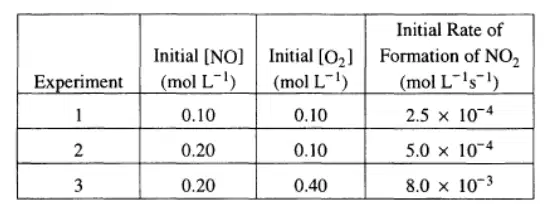
The initial-rate data in the table above were obtained for the reaction represented below. What is the experimental rate law for the reaction?
2 NO + O2 → NO2
Rate = k[NO][O2]
Rate = k[NO][O2]2
Rate = k[NO]2[O2]
Rate = k[NO]2[O2]2
After a certain pesticide compound is applied to crops, its decomposition is a first-order reaction with a half-life of 32.5 days. What is the rate constant, k, for the decomposition reaction?
0.0213 day-1
0.0308 day-1
32.5 day-1
46.9 day-1
The isomerization of cyclopropane to propylene is a first-order process with a half-life of 19 minutes at 500 C. The time it takes for the partial pressure of cyclopropane to decrease from 1.0 atm to 0.125 atm at 500 C is closest to
38 min
57 min
76 min
152 min

2 H2O2 → 2 H2O + O2
The decomposition of H2O2 is represented by the equation above. A student monitored the decomposition of a 1.0 L sample of H2O2 at a constant temperature of 300. K and recorded the concentration of H2O2 as a function of time. The results are given in the table.
Which of the following statements is a correct interpretation of the data regarding how the order of the reaction can be determined?
The reactant must be first order because there is only reactant species.
The reaction is first order if the plot of ln [H2O2] versus time is a straight line
The reaction is first order if the plot of 1/[H2O2] versus time is a straight line
The reaction is second order because 2 is coefficient of H2O2 in the chemical equation.
A 100 g sample of a substance decomposes so that 25 g of the original substance remains after 40. seconds. If the decomposition is first order, which of the following is the rate constant, k, of the reaction?
0.017 s-1
0.035 s-1
1.4 s-1
20 s-1

2 N2O5 (g) → 4 NO2 (g) + O2 (g)
A sample of N2O5 was placed in an evacuated container, and the reaction represented above occurred. The value of the PN205 the partial pressure of N2O5 was measured during the reaction and recorded in the table below. Which of the following describes the reaction?
The decomposition of N2O5 is a zero order reaction.
The decomposition of N2O5 is a first order reaction.
The decomposition of N2O5 is a second order reaction.
The overall reaction order is 3.

The table shows the results from a rate study of the reaction X + Y → Z. Starting with known concentrations of X and Y in Exp 1, the rate of formation of Z was measured. If the reaction was 1st order for X and 2nd Order for Y, the initial rate of formation of Z in Exp 2 would be
R / 2
R
2 R
4 R
2 NO + 2 H2 → N2 + 2 H2O
The rate law for the reaction represented is rate = k [NO]2[H2]. What happens to the rate of the reaction when the concentration of NO is doubled and the concentration of H2 is halved?
The rate is halved.
The rate is the same.
The rate is doubled.
The rate is quadrupled.

The particle models shown represent a proposed two-step mechanism for the destruction of ozone (O3) in the upper atmosphere.
Based on the models, which of the following represents a species that acts as a catalyst for the reaction?


Which of the following is the rate law for the reaction below that is consistent with the proposed mechanism?
NO2 + CO → NO + CO2
Rate = k[NO2][CO]
Rate = k[NO2]2
Rate = k[NO3][CO]
Rate=k[NO][NO3]

A proposed mechanism for a chemical reaction is shown. Which of the following rate laws is consistent with the mechanism?
Rate = k [NO2][F2]
Rate = k [NO2]2[F2]
Rate = k [NO2][F2]2
Rate = k [NO2]2[F2]2

A reaction mechanism for the destruction of ozone, O3, is represented. In the overall reaction, NO2 (g) is best described as
an inhibitor
an intermediate
a reactant
a catalyst

Two mechanisms have been proposed for the following reaction:
2 NO + Br2 → 2 NOBr
Which would support Mechanism 1 but NOT Mechanism 2?
The reaction rate is independent of NO.
The reaction rate is independent of Br2.
The reaction is exothermic.
The reaction is second order overall.
X + 2 Y → Z + 3 Q
For the reaction represented above, the initial rate decrease in [X] was 2.3 x 10⁻³ M/s. What was the initial rate of decrease in [Y]?
7.0 x 10⁻⁴ M/s
1.4 x 10⁻³ M/s
2.8 x 10⁻³ M/s
4.6 x 10⁻³ M/s

