
 Worksheets
Water review
Total questions: 20
Worksheet time: 44mins
What bonds are responsible for the cohesive properties of water molecules?
Hydrogen bonds between water molecules.
Hydrogen bonds within water molecules.
Covalent bonds between water molecules.
Covalent bonds within water molecules.
Which of the following properties helps in the transfer of water between the cells of a leaf and the external environment?
Tension in the xylem vessels.
Active transport of water from cell to cell.
Capillary action in the cell walls.
Condensation of water on the surface of the leaf.
Which of the following are properties of most enzymatic molecules?
Hydrophobic and insoluble.
Hydrophilic and soluble.
Hydrophobic and soluble.
Hydrophilic and insoluble.
Why is water a polar molecule?
Because it contains hydrogen.
Because hydrogen and oxygen are bonded by a covalent bond.
Because there are hydrogen bonds in the water molecule.
Because the electrons in the covalent bond are not shared equally.
How does hydrogen bonding contribute to the unique properties of water?
Hydrogen bonding in water molecules leads to high cohesion, surface tension, and the ability to absorb heat.
Hydrogen bonding in water molecules leads to low cohesion, low surface tension, and the ability to absorb heat.
Hydrogen bonding in water molecules leads to low cohesion, low surface tension, and the inability to absorb heat.
Hydrogen bonding in water molecules leads to low cohesion, surface tension, and the inability to absorb heat.
Why is water considered a universal solvent?
Water is considered a universal solvent because it is made up of many different elements.
Water is considered a universal solvent because it is highly acidic.
Water is considered a universal solvent because it has a low boiling point.
Water is considered a universal solvent because it has the ability to dissolve a wide variety of substances due to its polar nature.
What is the role of water in maintaining temperature regulation in organisms?
Water acts as a coolant and facilitates heat transfer through processes like sweating and evaporation.
Water has no role in maintaining temperature regulation in organisms.
Water acts as an insulator and traps heat within the body.
Water absorbs heat from the environment and raises the body temperature.
How does water participate in chemical reactions within cells?
Water acts as a solvent and facilitates transport and metabolic reactions.
Water acts as a fuel and provides energy for chemical reactions within cells.
Water acts as a barrier and prevents chemical reactions within cells.
Water acts as a catalyst and speeds up chemical reactions within cells.
Indicate the property of water that causes water to be retained in the soil by capillary action.
Explain why the fatty lipid tails of the plasma membrane of cells are hydrophobic.
Using three specific examples, explain how the physical properties of water support life in aquatic environments.
Outline two reasons why water is retained on the surface of the earth and supports life.

Will water dissolve the molecule depicted?
no, it is a hydrocarbon
no, it is type of fat
yes, it has a charge
yes, it has polar bonds

Water striders can walk across the surface of calm water. Their feet push the surface of the water down slightly, but they do not break the surface. Why?
The insects are light enough so they do not break the hydrogen bonds holding the water molecules together
The insects actually use their wings to hover slightly above the water’s surface and they only skim it with their feet.
The insect’s feet are non-polar, so they are repelled by the polar water molecules and are pushed away from the water’s surface.
The insects are small enough to see the individual water molecules, so they are able to step carefully from one molecule to the next


How does water move from the roots to the leaves of plants?
Water is pushed by solutes
Capillary action pulls the water molecules like a chain
Water is pulled by gravity
Water’s cohesion causes it to “pull” towards the leaves
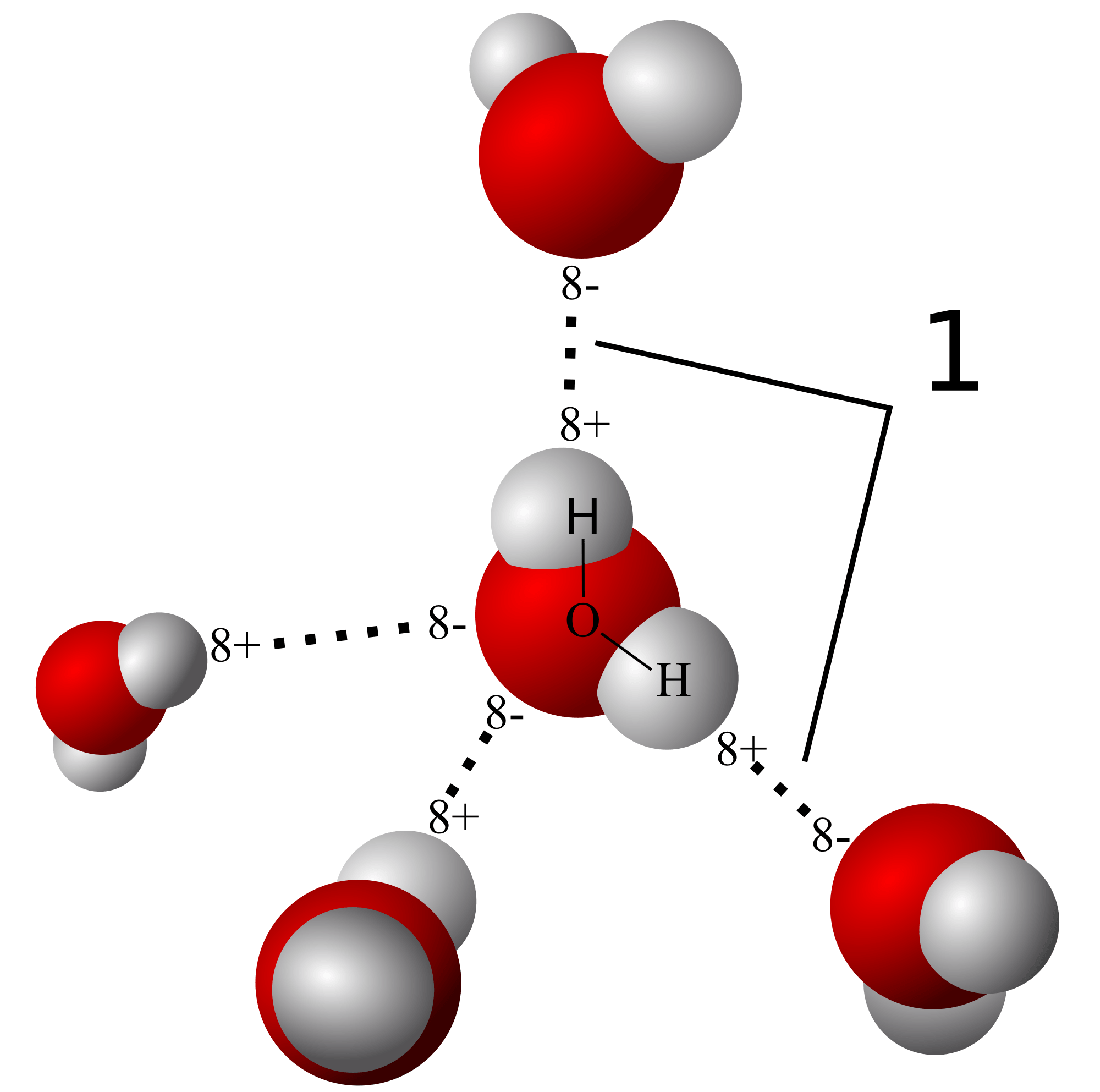
Attractions between different water molecules is called ....
Covalent bonds
Ionic bonds
Polar bonds
Hydrogen bonds
Which option shows the correct dipoles?
O = δ+ / H = δ-
O = δ- / H = δ+
O = δ+ / H = δ+
O = δ- / H = δ-

