wayground logo

Free Printable Worksheets

NEW

Font size

S
M
L
XL
Worksheets

Assessment on Chemical reactions, Equations

Total questions: 50

Worksheet time: 13hrs 30mins

Name
Class
Date
1.
An example of a chemical property is reactivity. This is 
a)
a measure of how easily a substance combines with other substances to produce a new substance 
b)
the danger to your health caused when a poisonous substance combines with chemicals in your body 
c)
an indicator of how easily a substance catches fire. This creates a new substance 
2.
A group of atoms bonded together. 
a)
A Molecule
b)
The Coefficient
c)
The Subscript
d)
An Atom Party
3.
How many hydrogen atoms are in this chemical formula: 
a)
4 hydrogen atoms
b)
1 hydrogen atom
c)
2 hydrogen atoms
d)
3 hydrogen atoms
4.
How many molecules are in this chemical formula?
a)
4 Molecules
b)
6 Molecules
c)
2 Molecules
d)
5 Molecules
5.
How many oxygen atoms are in this chemical formula?
a)
6 oxygen atoms
b)
2 oxygen atoms
c)
3 oxygen atoms
d)
4 oxygen atoms
6.
The one or two letters used to represent elements 
a)
Yield sign
b)
Coefficient
c)
Symbol
d)
Subscript
7.
How many elements are in C6H12O6?
a)
1
b)
2
c)
3
d)
4
8.
A physical change is?
a)
It changes the object into something different
b)
Objects or substances undergo a change that does not change their chemical composition
c)
it is just like a chemical reaction
d)
Paper burning
9.
A chemical change is?
a)
a shoe lace cut in half
b)
doesn't change anything
c)
changes the look of an object
d)
change that results in the formation of new chemical substances
10.
You know you a chemical reaction has occurred if 
a)
there is a precipitate.
b)
there is a color change.
c)
there is a temperature change.
d)
All of these answers are evidence.
11.
What is the left part of a chemical equation called?
H2 + O → H2O
a)
Reactants
b)
Products 
c)
Yields 
d)
Chemical Equation 
12.
What is the right part of a chemical equation called?
H2 + O H2O
a)
Reactants
b)
Products 
c)
Yields 
d)
Chemical Equation 
13.
Is this balanced?
2HgO → 2Hg + O2
a)
Yes
b)
No
14.
When materials combine to form new compounds it is a chemical change. Which example is a chemical change?
a)
baking powder fizzing
b)
water boiling
c)
ice melting
d)
sugar cube dissolving
15.
Which is an example of a chemical reaction?
a)
paper cut into small pieces
b)
chocolate melting in a pan
c)
flour and sugar mixed in a bowl
d)
cookies baking in an oven
16.
Which of the following IS a physical change?
a)
Getting a haircut
b)
Rusty metal
c)
sour milk
d)
A compound
17.
In a ___________change, a substance changes into a different substance.
a)
Physical
b)
Chemical
18.

You try mixing sugar into room temperature water, but it doesn't mix very well. Which is the best way you can increase the solubility of the sugar?

a)

I can heat the water up.

b)

I can mix it longer.

c)

I can add salt to the water.

d)

I can add ice to make the water colder.

19.

Identify the heterogeneous mixture.

a)
b)
c)
d)
20.

Identify the homogeneous mixture.

a)
b)
c)
d)
21.

Which statement about solutions and homogeneous mixtures is correct?

a)

Solutions are liquid, but homogeneous mixtures can be any state of matter.

b)

Solutions are made up of two elements mixed together, but homogeneous mixtures are made from two compounds mixed together.

c)

Solutions can only be separated by chemical reactions, but homogeneous mixtures can be separated by physical changes.

d)

Solutions and homogeneous mixtures are actually the same thing.

22.

Which is the part of a solution that is in the greatest quantity?

a)

solute

b)

solvent

c)

element

d)

compound

23.

Solubility is the ability of a solute to dissolve into a solution. Which of the following statements is true about solubility?

a)

More solute can dissolve in a solution if its solubility is high.

b)

More solute can dissolve in a solution if its solubility is low.

c)

Less solute can dissolve in a solution if its solubility is high.

d)

The amount of solute that can dissolve depends on the solvent, not solubility.

24.

Which factor does not affect solubility?

a)

Temperature

b)

Pressure

c)

Amount of substances

d)

Time

25.
A combination of two or more substances that can be easily separated.
a)
dissolve
b)
mixture
c)
solution
d)
physical property
26.
the substance to be dissolved in a liquid
a)
solute
b)
solvent
c)
dissolve
d)
mixture
27.
the liquid a substance dissolves in
a)
solute
b)
solvent
c)
mixture
d)
solution
28.
If you spilled nails in a sandbox, what separation tool/method could you use to clean out the sandbox so it would be safe for children to play in?
a)
Filter
b)
Screen
c)
Magnet
d)
Evaporation
29.

To separate a mixture of salt and water what separation tool/method is used?

a)

Evaporation

b)

Magnet

c)

Sieve

d)

Filters

30.

Which of the following characteristics is shared by all chemical reactions?

a)

Produce a precipitate

b)

Show a color change

c)

Release heat energy

d)

Form new substances

31.
In chemical reactions, what does the principle of conservation of mass mean?
a)
Matter is not created or destroyed.
b)
The total mass of the reactants is greater than the total mass of the products.
c)
The total mass of the reactants is less than the total mass of the products.
d)
Matter is not changed.
32.
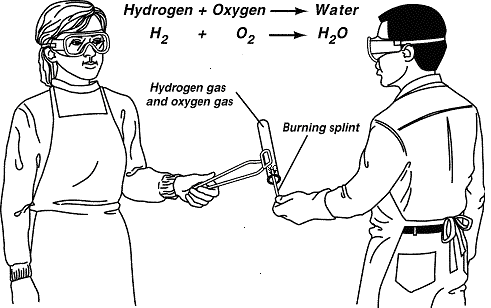
Identify the reactant(s) and product(s) of the reaction.
a)
All three are reactants and none are products.
b)
Hydrogen and water are the reactants, and oxygen is the product.
c)
Water and oxygen are the reactants, and hydrogen is the product.
d)
Hydrogen and oxygen are the reactants, and water is the product.
33.
Which is the Law of Conservation of Matter?
a)
matter cannot be created or destroyed, it only changes form
b)
matter can be created but it cannot be destroyed, it never changes form
c)
matter can be destroyed but it cannot be created, it usually just changes form
d)
matter is an unproven theory created by Hans Geiger
34.

What are the blue numbers called?

a)

oxidation numbers

b)

subscripts

c)

group numbers

d)

product numbers

35.

What does the number 4 represent in 4NH3?

a)

Subscript

b)

Superscript

c)

Coefficient

36.

To balance an equation you should:

a)

ONLY change subscripts.

b)

ONLY change coefficients.

c)

Change BOTH subscripts and coefficients.

37.

Is this equation balanced?

a)

Yes

b)

No

38.

Is this equation balanced?

a)

Yes

b)

No

39.
A common synthetic material that is found almost everywhere is ________.
a)
Coal
b)
Lumber
c)
Plastic
d)
Aerogel
40.
_______ is an example of a synthetic fabric.
a)
Wool
b)
Silk
c)
Cotton
d)
Nylon
41.
Synthetic materials are made by _________.
a)
aliens
b)
humans
c)
farmers
d)
nature
42.

Materials made by humans through chemically changing natural resources are called?

a)

Nonrenewable Resources

b)

Synthetic Materials

c)

Renewable Resources

43.

Natural resources are?

a)

Resources that exist within the environment without humans having to intervene, or put them there.

b)

Resources that exist within the environment through due to human actions.

c)

Organic substrates found deep within the earth's lithosphere

44.

Which of the following is NOT a natural resource?

a)

wood

b)

cotton

c)

oil

d)

plastic

e)

coal

45.

Which of the following is NOT a synthetic material?

a)

Nylon

b)

plastic

c)

paper

d)

polyester

46.

Synthetic materials are made from chemically processing _________________?

a)

plastics

b)

naturals resources

c)

chemicals

47.

Synthetic Materials tend to be ___________________ than Natural materials.

a)

less durable

b)

more durable

c)

just as durable

48.
What is the difference between a natural and synthetic material?
a)
Natural material is made from chemicals and synthetic is made from nature
b)
Natural material is made directly from nature and synthetic material is made from chemicals
c)
Natural material is made from petroleum and synthetic material is made from wool
d)
Natural material is made from trees and synthetic materials are made from plastics
49.

What is a synthetic material?

a)

Any material that is man made

b)

Any material that is only made from natural resources

c)

Any material that is made of recycled materials

d)

Any material that is found in nature.

50.

Define polymer

a)

circular molecule made with many repeating units

b)

short molecule made of a few repeating units

c)

long, chain-like molecule made of repeating units

d)

chain-like molecule that contains hydrogen and oxygen