
Font size
 Worksheets
1/16
Total questions: 30
Worksheet time: 20mins
F
G
H
J
A
B
C
D
F
G
H
J
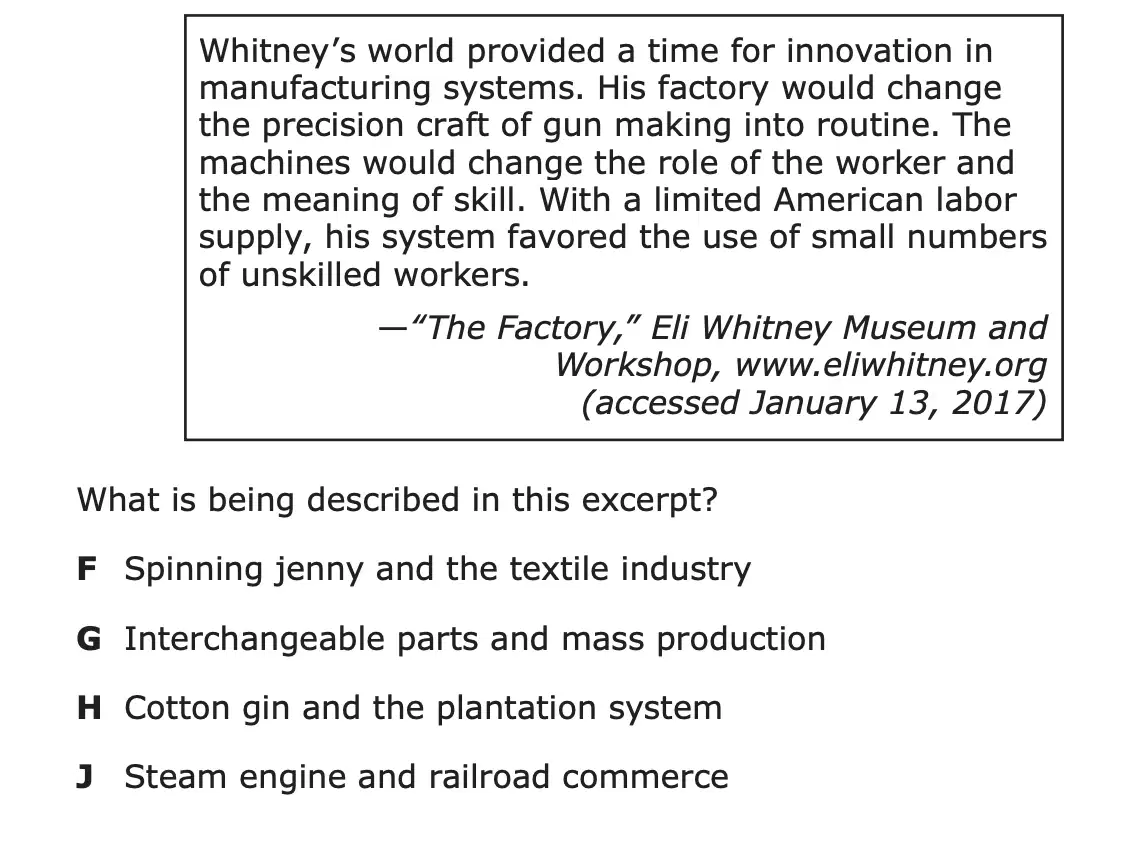
F
G
H
J
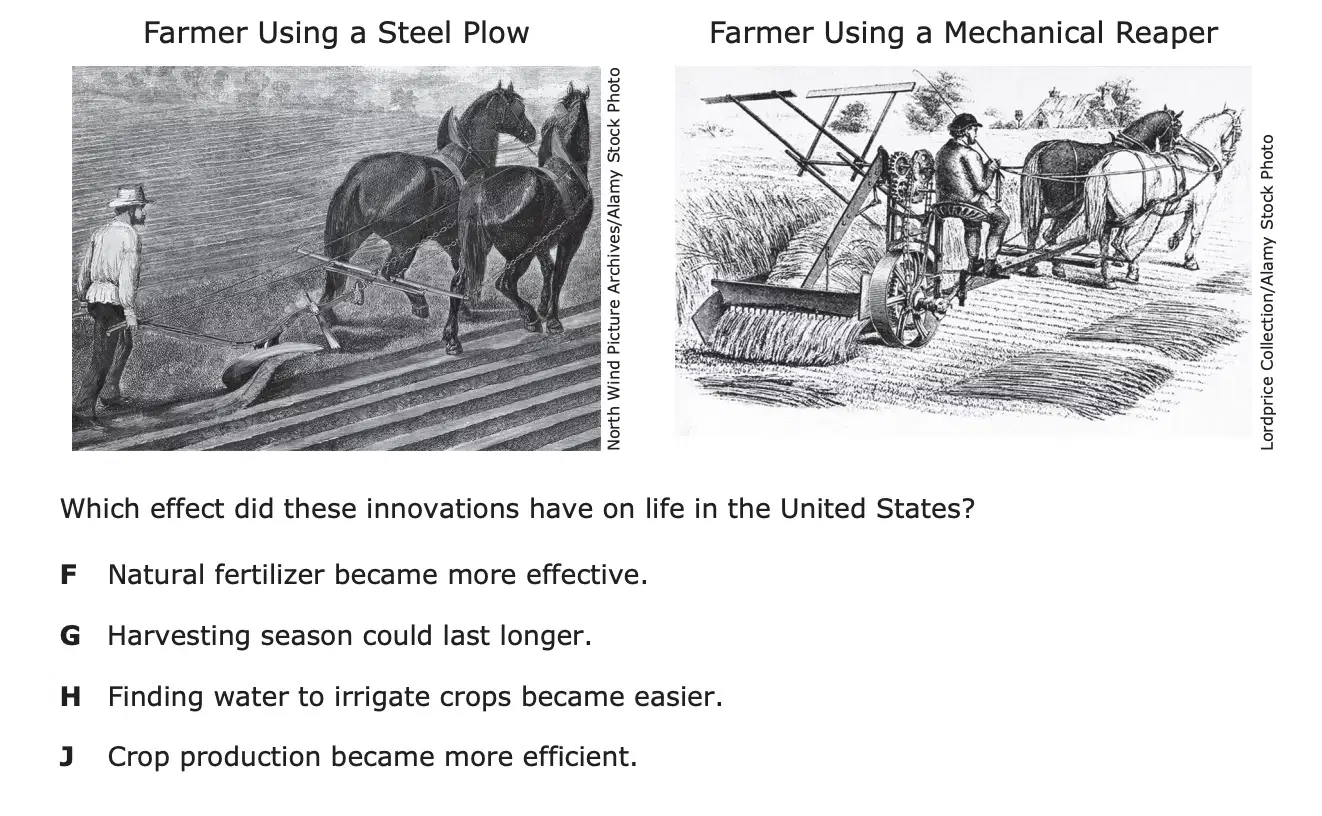
F
G
H
J
Why did early factories need to be located near rivers
Water power was need to run machines
People often traveled to work on steamboats.
Fish from the river were used to feed the workers
The rivers provided a cool breeze
To what does the phrase "facotry system" refer?
Factories set up along rivers to produce a system of goods
Factories located in rural areas to escape urbanization
Workers and machinery producing goods under one roof
Workers forming the first sytem of labor unions
What region of the USA experienced the greatest amount of industrialization in the 1800s?
Midwest
South
Northeast
West
Who memorized the plans to the textile mills and brought them to the US?
Samuel Slater
Eli Whitney
Francis Cabot Lowell
Robert Fulton
What is the movement from rural to urban areas called?
Discrimination
Colonization
Inflation
Urbanization
Which group of immigrants found jobs working on the railroad and in the California gold mine?
Italian Immigrants
Jewish Immigrants
Chinese Immigrants
Mexican Immigrants
Why were the Irish fleeing their home country for the U.S.?
Political Persecution
Religious Persecution
Potato Famine
Economic Poverty
What is the Bessemer Process?
The process of making steel into iron.
The process to complete a skyscraper
Turning lead into steel.
A cheap process to make iron into steel.
_________________-was a time that Europe/America shifted from an agrarian(farming society) to an industrial society where goods were made and produced in factories.
Neolithic Revolution
French Revolution
Industrial Revolution
none of the above

_____________-had the most dangerous jobs during the industrial revolution. Many times they were hired because their tiny hands could fit into places that adults hands could not.
Peasants
Immigrants
children
none of the above
Who were the majority of Lowell Factory Workers?
Young men from the cities.
Boys from nearby farms.
Men who were married and needed extra income.
Young, unmarried farm girls
Who developed the idea of Interchangeable Parts?
Samuel Slater
Eli Whitney
Francis Cabot Lowell
Robert Fulton
What is the Erie Canal?
A natural waterway connecting Lake Erie to the Atlantic Ocean
A man-made waterway connecting Lake Erie to NYC
A railway system connecting major cities in the United States
A highway network across the state of New York
What major project did Chinese immigrants help build after arriving in California?
The Statue of Liberty
The Hoover Dam
The Transcontinental Railroad
The Golden Gate Bridge
A woven cloth that is created with yarn or any other kind of fiber is
Textile
Dress
Rural
Urban
Relating to the countryside is
Urban
Textile
Farm
Rural
Relating to a town or city is
Urban
Textile
Farm
Rural
Which of the following characterizes advancements made as a result of the Industrial Revolution?
Irrigation increased crop production.
World exploration opened up new trade markets.
Machines helped create products rapidly.
Cottage industries (at home businesses) increased.
Which of the following was not a push or pull factor that caused Irish immigrants to come to America?
Overpopulation of Ireland
Lack of employment opportunities in Ireland
Promise of land in America to increase farming
Lack of easy transportation to travel distances

Once mechanized farm equipment (machines) was available, one farm family could grow enough food to feed _____.
many families
a few families
just one family
What did John Deere invent?
Steel Plow
Mechanical Plow
Steam Engine
Steamboat
Which of the following were effects of the Industrial Revolution in the United States?
Urbanization - more people moving into cities
Demand for slavery increased in the South
Demand for slavery increased in the North
People leaving the cities looking for jobs
The National Bank and Protective Tariffs became popular in the West
In the early days of the Industrial Revolution, many factories were built along rivers because
water was a major source of irrigation
water power was used to power factory machines
ships could easily deliver goods to factories
ships could bring in supplies
An overcrowded, dirty area of the city where the housing is usually in very poor condition
Slums
Rural
Suburbs
Urban

