wayground logo

Free Printable Worksheets

NEW

Font size

S
M
L
XL
Worksheets

Levels of Organization - Physiology

Total questions: 23

Worksheet time: 15mins

Name
Class
Date
1.

Which is the correct structural order?

a)

chemical-tissue-cells-organ-organ system

b)

cells-tissue-chemical-organ system-organ

c)

tissue-cells-organ system-chemical-organs

d)

chemical-cells-tissue-organ-organ system

2.

Which of the following is the correct match between a cell, tissue, and organ?

a)

skin cell, skin tissue, heart

b)

muscle cell, muscle tissue, bicep (arm muscle)

c)

fat cell, fat tissue, liver

d)

nerve cell, skin cell, brain

3.

Which of the following examples best represent the levels of organization from the least to most complex?

a)

Lung , Respiratory system , Lung cell , Human , Lung tissue

b)

Lung cell , Respiratory system , Lung , Human , Lung tissue

c)

Human , Lung tissue , Lung , Respiratory system , Lung cell

d)

Lung cell ,Lung tissue , Lung , Respiratory system, Human

4.
In the following analogy, what is a tissue most similar to?
a)
student
b)
class
c)
grade level
d)
school
5.
The brain, spinal cord, and nerves are all organs that work together to send messages throughout the body. This is an example of ____.
a)
 an organ system
b)
an organ
c)
a cell
d)
an organelle
6.
A group of cells works together to connect and support various parts of the body. This group of cells can be called a _____.
a)
an organ
b)
an organism
c)
a system
d)
a tissue
7.

Which of the following examples is correctly matched with its level of organization?

a)

A monarch butterfly is an organ system.

b)

The brain is a type of tissue

c)

A liver is a type of cell.

d)

The skin is an organ.

8.
The respiratory system includes the lungs. What level of body organization are the lungs?
a)
A. tissue
b)
B. organ
c)
C. cell
d)
D. organ system
9.

A microscopic image shows many cube-shaped cells forming a tube or duct. What level of structural organization is this?

a)

chemical level

b)

cellular level

c)

tissue level

d)

organ level

10.

Melanin is a protein pigment that protects us from ultraviolet radiation. What level of structural organization is the classification of melanin?

a)

cellular level

b)

organ level

c)

chemical level

d)

tissue level

11.

True or False: Our organ systems work separately and do not interact with each other at all in our bodies

a)

True

b)

False

12.
Brings oxygen into the body and eliminates carbon dioxide and water
a)
Circulatory system
b)
Digestive system
c)
Excretory system
d)
Respiratory system
13.
Carries needed materials to cells and waste products away from cells
a)
Immune system
b)
Circulatory system
c)
Nervous system
d)
Respiratory system
14.
Protects our bodies from pathogens and fights disease
a)
Immune system
b)
Endocrine system
c)
Nervous system
d)
Circulatory system
15.
Collects and removes wastes produced by the body's cells
a)
Muscular system
b)
Excretory system
c)
Circulatory system
d)
Digestive system
16.
Provide the raw materials for cell respiration
a)
Digestive and respiratory
b)
Immune and endocrine
c)
Respiratory and excretory
d)
Circulatory and Digestive
17.
Eliminate products of cell respiration
a)
Digestive and respiratory
b)
Circulatory and excretory
c)
Respiratory and excretory
d)
Excretory and digestive
18.
Work together to help us move
a)
Endocrine, immune, nervous
b)
Skeletal, muscular, nervous
c)
Digestive, respiratory, circulatory, excretory
d)
Immune, excretory, circulatory
19.
Directs the skeletal muscles to contract
a)
Skeletal system
b)
Muscular system
c)
Endocrine system
d)
Nervous system
20.
Controls long-term changes and daily body activities through the release of chemicals
a)
Immune system
b)
Endocrine system
c)
Digestive system
d)
Nervous system
21.

An example of a negative feedback loop is ...

a)

Blood glucose regulation

b)

Temperature regulation

c)

Heart rate regulation

d)

All of the above

22.

When you get cut, your skin cells release hormones that signal platelets to come and stop the bleeding. Platelets then release more hormones that signal even more platelets to help stop bleeding. The hormone signals continue until the cut is closed. This is an example of what type of feedback?

a)

Negative Feedback

b)

Positive Feedback

23.

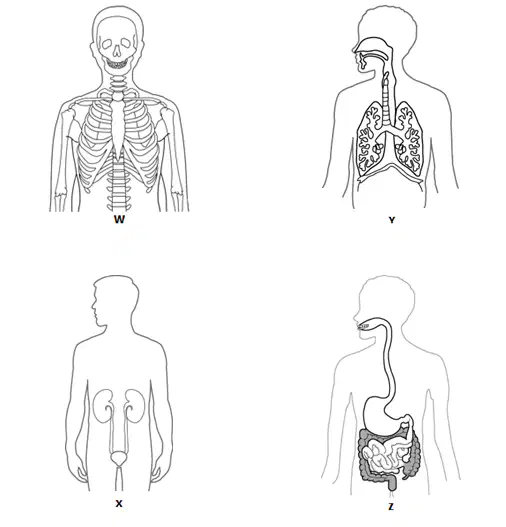
With which systems does the circulatory system interact to help remove wastes from the body?


a)

W and Y

b)

X and Y

c)

Y and Z

d)

Z and X