
 Worksheets
7.3 Cellular Transport
Total questions: 10
Worksheet time: 5mins
What is the process called where molecules move from an area of higher concentration to an area of lower concentration?
Osmosis
Diffusion
Active Transport
Endocytosis
What happens to concentrations when diffusion occurs over a long enough time?
They become uniform and reach dynamic equilibrium.
They remain the same.
They decrease.
They increase.
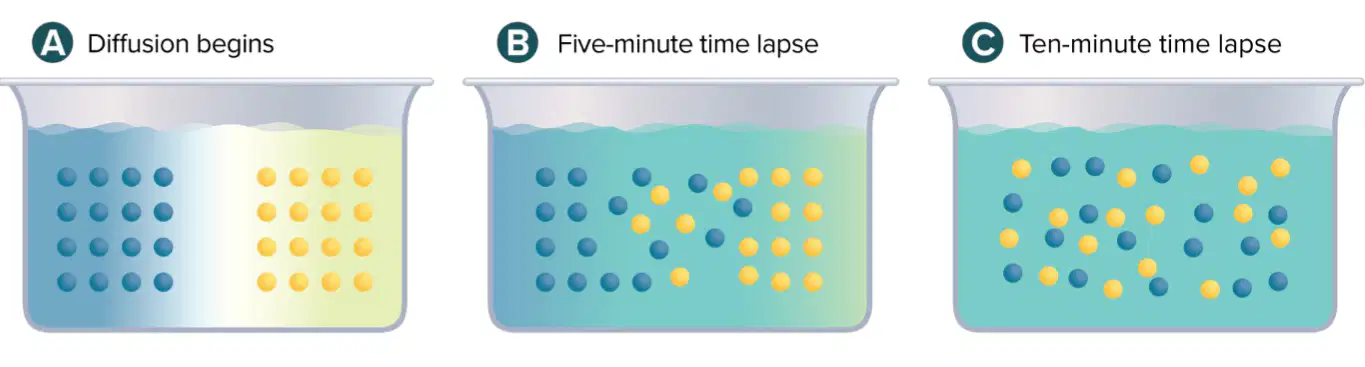
At which stage does the ink become evenly blended in the water?
Diffusion begins
Five-minute time lapse
Ten-minute time lapse
Never
Facilitated diffusion uses ______ to move ions and small molecules across the plasma membrane.
Lipids
Transport proteins
Carbohydrates
Nucleic acids
Which statement is true about osmosis?
It requires energy
It involves the movement of solutes
It is a type of active transport
It is the diffusion of water across a selectively permeable membrane.
What is the result of osmosis in cells?
Increased solute concentration
Balanced water concentration
Decreased water concentration
Increased energy production
In osmosis, water molecules move from an area of ________ concentration to an area of ________ concentration.
High, low
Low, high
Equal, equal
None, none
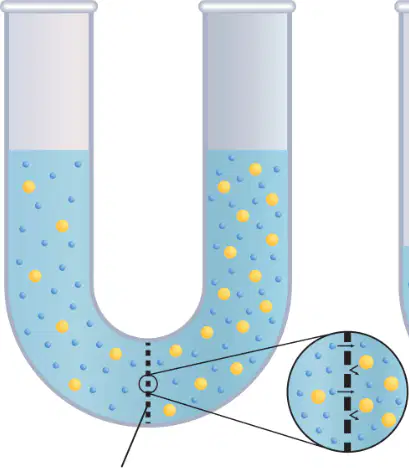
Which side has a greater sugar concentration before osmosis?
Left
Right
Both
Neither
What is a hypertonic solution?
A solution with lower concentration of solutes than the cytoplasm
A solution with higher concentration of solutes than the cytoplasm
A solution with equal concentration of solutes as the cytoplasm
None of the above.
In exocytosis, materials are expelled from the cell. Fill in the blank: The vesicle fuses with the ______ to release its contents outside the cell.
Nucleus
Cell membrane
Mitochondria
Ribosome

