
 Worksheets
Unit 3 test: Waves, Sound, Light
Total questions: 22
Worksheet time: 11mins
Name
Class
Date
1.
Name (first and last)
4 lines
2.
Class Period
a)
1A
b)
1B
c)
2A
d)
2B
e)
3A
3.
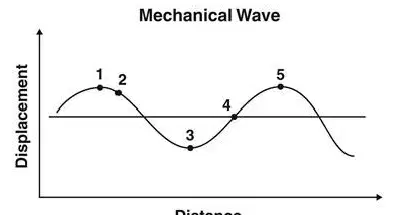
Which point on the wave pictured below represents a trough? (6P 1.1)
a)
point 1
b)
point 2
c)
point 3
d)
point 4
4.
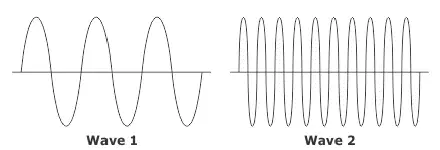
This is a wave pattern diagram for two transverse waves. How do the waves compare? (6P1.1)
a)
Both waves have the same frequency
b)
Both waves have the same wavelength
c)
Wave 1 has a longer wavelength than wave 2
d)
Wave 1 has a higher frequency than wave 2
5.
Which part of the eye is responsible for changing the size of the pupil to allow light to enter the eye? (6P 1.2)
a)
retina
b)
iris
c)
optic nerve
d)
cornea
6.
The function of the retina is to (6P 1.2)
a)
protect the front of the eye
b)
send electrical signals to the brain
c)
allow light to enter the eye
d)
convert light waves to electrical signals
7.
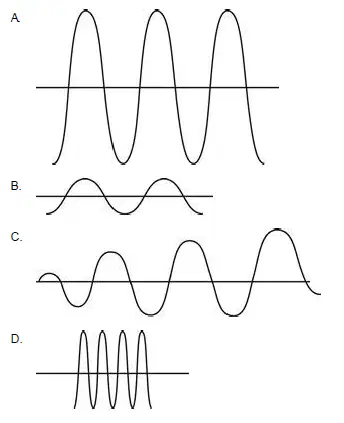
Which wave will have the highest pitch? (6P 1.3)
a)
wave A
b)
wave B
c)
wave C
d)
wave D
8.
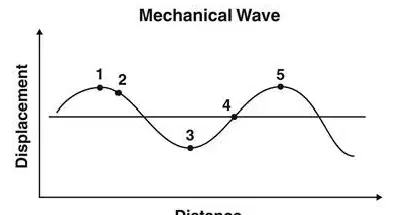
Margarita studied a graph of a mechanical wave. If she wanted to find out the wavelength, from which points should she measure? (6P 1.1)
a)
1 to 3
b)
1 to 5
c)
3 to 4
d)
3 to 5
9.
Which of these factors affects how fast a sound wave moves? (6P 1.3)
a)
The kind of material it is moving through.
b)
The amplitude of the sound wave's vibrations
c)
The wavelength of the disturbance in the medium
d)
The type of motion that caused the sound wave to form.
10.
Which portion of the electromagnetic spectrum are you able to see with your eyes? (6 P 1.2)
a)
Gamma rays
b)
Visible light
c)
Radio waves
d)
microwaves
11.
Light waves are arranged in the electromagnetic spectrum by (6P 1.2)
a)
wavelength and brightness
b)
speed and color
c)
brightness and color
d)
wavelength and frequency
12.
Visible light is which type of wave? (6P 1.2)
a)
seismic
b)
mechanical
c)
longitudinal
d)
electromagnetic
13.
Which statement best describes visible light? (6P 1.2)
a)
Visible light occupies most of the electromagnetic spectrum and requires a medium for travel
b)
Visible light occupies most of the electromagnetic spectrum and can travel in a vacuum
c)
Visible light occupies a small part of the electromagnetic spectrum and requires a medium for travel
d)
Visible light occupies a small part of the electromagnetic spectrum and can travel in a vacuum
14.
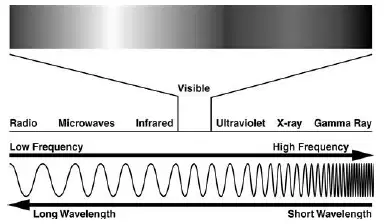
The diagram below shows waves that are (6P 1.2)
a)
seismic
b)
mechanical
c)
longitudinal
d)
electromagnetic
15.
Which part of a wave measures loudness? (6P 1.3)
a)
wavelength
b)
magnitude
c)
amplitude
d)
frequency
16.
If Jamal is playing the drums and hits the drums with a greater force, the sound would be (6P 1.3)
a)
quieter
b)
louder
c)
lower in pitch
d)
higher inpitch
17.
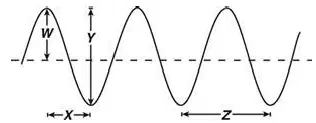
Use the diagram below to answer the question. Which letter represents the amplitude of the wave in the diagram? (6 P1.1)
a)
W
b)
X
c)
Y
d)
Z
18.
Which of these best describes frequency? (6P 1.1)
a)
The loudness of a sound
b)
The energy that bounces off anobject
c)
The number of vibrations per unit of time
d)
The bending of light as it passes through substances
19.
Sound waves can pass through all of these except (6P 1.3)
a)
air
b)
steel
c)
water
d)
the vacuum of space
20.
Through which of these would sound travel the fastest? (6P 1.3)
a)
oil
b)
water
c)
air
d)
metal
21.
The electromagnetic spectrum is best described as a (6P 1.2)
a)
series of colors of the rainbow
b)
list of radioactive elements
c)
band of frequencies and wavelengths of light waves
d)
range of conductivity of metals
22.
Which statement correctly describes how a sound wave travels through air? (6P 1.3)
a)
The wave carries molecules of air away from the source of the sound
b)
The wave carries energy that causes molecules to vibrate back and forth
c)
The wave carries a molecule in one direction until it collides with another molecule
d)
The wave moves through the air and gains energy form the moving molecules that it touches
100 %

