
 Worksheets
Tyre Knowledge Quiz
Total questions: 42
Worksheet time: 21mins
The legal minimum tyre tread depth for passenger cars and trailers up to 3500kg GVW is:
1mm for 75% of the tread width for the complete circumference of the tyre
16mm for 75% of the tread width for the complete circumference of the tyre
0.16mm for 75% of the tread width for the complete circumference of the tyre
1.6mm for 75% of the tread width for the complete circumference of the tyre
Which of the following is an indication that the front wheels may require balancing?
Heavy wear on the outer edges of both front tyres
Sever feathering of both the front tyre treads
Heavy wear around the centre section of the tyre tread
Steering wheel vibration that increases with vehicle speed.
A Tyre has a side wall marking of ‘195/65 R 16’. This means
The tyre has an aspect ratio of 65 mm
The tyre has a section height of 16 inches
The wheel diameter is 195 mm
The tyre has an aspect ratio of 65%
An over inflated tyre will tend to wear:
Overheat with prolong usage
On the centre part of the tread
On the outer edge of the tread
By feathering of the tyre tread
The side wall marking of a tyre is 195/65 R 15. This means that:
The tyre is a cross-ply construction design
The section height of the tyre is 126.75 mm
The tyre is fitted with a 195 mm diameter wheel
The diameter of the tyre is 15 inches.
P195/65 R 15 H 84. State what the number 84 represents:
Speed rating
Load index rating
Aspect ratio
Wheel diameter
P195/45 R 15 H 84. What is represented by the number 45:
Wheel diameter
Speed rating
Aspect ratio
Tyre width
P195/65 R 15 V 84 What is represented by the letter V:
Speed rating
Load index rating
Tyre width
Tyre construction
The legal minimum tyre tread depth for passenger cars is:
1.6mm for 75% of the tyre tread width for the complete circumference of the tyre
0.16mm for 75% of the tyre tread width for the complete circumference of the tyre
16mm for 75% of the tyre tread width for the complete circumference of the tyre
1mm for 75% of the tyre tread width for the complete circumference of the tyre
A tyre is worn below the legal limit down both outer edges, this may indicate that the tyre:
Requires balancing
Pressure is below the recommended setting
Pressure is above the recommended setting
Has the incorrect speed rating for the vehicle
A radial tyre has its plies at an angle of:
45 degrees to its bead.
90 degrees to its bead.
25 degrees to its bead.
75 degrees to its bead.
When fitting radial and cross ply tyres to the same vehicle they must be fitted:
Cross ply to the front, radials to the rear.
Cross ply to the rear, radials to the front.
Radials to the off-side, cross ply to the near-side.
Cross ply to the off-side, radial to the near-side.
Tyre pressures are checked when:
When the tyre is cold
When the tyre is at running temperature
When the tyre has no load on it
When the tyre is very hot

What is indicated by arrow A in Fig 12?
The tyre tread
The tyre bead
The tyre plies
The tread bracing strips

What is indicated by arrow B in Fig 12?
The tyre tread
The tyre bead
The tyre plies
The tread bracing strips
A Tyre fitted to a car is illegal for road use if
It is not properly inflated
It is a cross-ply design
The tread depth is less than 6mm
It has not been balanced
A tyre has one directional arrow shown on its side wall. If the tyre is fitted with the arrow in the wrong direction, the tyre’s
Braking efficiency is increased
Tread could peel off
Could explode
Acceleration capabilities are affected
A Tyre has a side wall marking of 185/65 R 15H
Is of cross ply design
Is for a 0.65m wheel
Has an aspect ratio of 15%
Has an aspect ratio of 65%
Radial and Cross Ply tyre can be fitted on the same axle of a car?
True
False
A wheel is stamped 6J X 15H 26. The number 26 refers to.
The rim profile
The flange height
The rim diameter
The rim offset
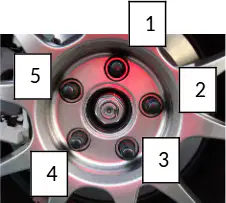
On a five stud wheel fixing the correct tightening sequence is.
No1, No2, No3, No4, and No5
No1, No4, No5, No3 and No2
No1, No5, No3, No4, and No2
No1, No3, No5, No2, and No4
A Tyre has 155/65 R 14H written on the side wall. The letter ‘R’ indicates that the tyre.
Is reinforced for off-road use.
Is of a cross-ply construction
Is only suitable for road use
Is of a radial ply construction
A Tyre with a sidewall marking of 175 R 13 C 6 Ply is in need of replacement. The replacement tyre.
Can be a standard car tyre without the C or reinforced marking.
Must be the same size with the C or reinforced marking and be compatible with the other tyre on the same axle
Must be the same size with the C or reinforced marking, however the other tyre on the same axle can be a different size.
Can be a standard car tyre with the same load index as the other tyre on the same axle.
Tyre repairs can be carried out by anyone provided that they use professional equipment.
True
False
When maintaining semi-automatic wheel changing equipment, it is important to check pneumatic hoses for loose connections.
False
True
A new tubeless tyre will not sit correctly on the rim, the reason for this is due to.
Tyres stacked upright in storage.
Tyres leaning at 10 degrees to one another in storage
Tyres being stacked on top of one another in storage.
Tyres stacked individually in storage.

The type of tyre construction shown in the picture below is.
Cross-ply
Composite
Remould
Radial
According to the British standards for minor tyre repairs (BS AU 159f) the recommended amount of minor repairs that can be performed on a W or Y rated Tyre is.
Unlimited, provided repair patches / plugs do not overlap
A maximum of 2 repairs, provided repair patches / plugs do not overlap
A maximum of 3 repairs, provided repair patches / plugs do not overlap
A maximum of 4 repairs, provided repair patches / plugs do not overlap
A tyre has a sidewall marking of 195/65 R 15T. This indicates the tyre.
Is of cross-ply design
Is for a 195 mm wheel
Is for a 15 inch wheel
Is run at a pressure of 65psi
Bead spreaders are used for.
Tyre fitting
Tyre removal
Tyre repairs
Wheel balancing
It is an offence to use a tyre on a road going vehicle with lumps or bulges in the tread or sidewall caused by separation.
False
True
A Tyre has a sidewall marking of ‘205/55 R 16’. This means the tyre.
Is fitted with a 16” diameter wheel
Has an effective diameter of 55 millimetre
Has an effective diameter of 16 inches
Has an aspect ratio of 205 millimetres
The main purpose of a tyre on a vehicle is to provide cushioned contact and grip with the road surface under a variety of operating conditions.
True
False
The accepted method of measuring the tread depth of a tyre is to use a tread depth calliper.
False
True
What should be done to each wheel nut when re-fitting road wheels?
Tighten using a correctly set torque wrench
Tighten in a clockwise sequence
Tighten using a socket and air wrench
Tighten and cover in grease to prevent rust
The correct method used to repair a puncture in the tread of a tubeless tyre is by using.
An inner tube
You should never repair a tyre
A tubeless repair patch
Superglue
An over inflated tyre will tend to wear.
On the centre part of the tread.
On the outer edge of the tread.
Overheat with prolong usage.
By feathering of the tyre tread.
When checking the tread depth on a tyre it is best to.
Check the centre of the tread in three places around the tyre.
Check the centre three quarters of the width of the tread in three places around the tyre.
Check the outer edges of the tread in three places around the tyre.
Check the outer three quarters of the tread in three places around the tyre.
The main advantage of directional tread pattern tyre is.
To provide a more comfortable ride.
To be more efficient in dispersing water
To give increased road noise.
To provide better handling and cornering.
The nominal section width of a tyre is measured.
Across the tread area of the tyre, inflated to the correct pressure on its correct wheel rim.
From bead to bead with the tyre inflated to its correct pressure on its correct wheel rim
Across the widest part of the tyre, inflated to its correct pressure on its correct wheel rim.
Across the widest part of the tyre, without the tyre being fitted to its wheel rim.
One function of the tread of a tyre is to:
Remove water from the road surface.
Stop the casing from perishing
Help make the steering lighter
Protect the sidewalls from punctures
Passenger car tyres must have a minimum legal tread depth of:
0.16mm
1.6 mm
1mm
16mm

