Wayground logo

Free Printable Worksheets

Font size

S
M
L
XL
Worksheets

Exponential Functions Review

Total questions: 44

Worksheet time: 1hrs 22mins

Name
Class
Date
1.

Which is the BEST estimate of the average rate of change for the function graphed, over the interval 1 ≤ x ≤ 3?


a)

-2

b)

-3

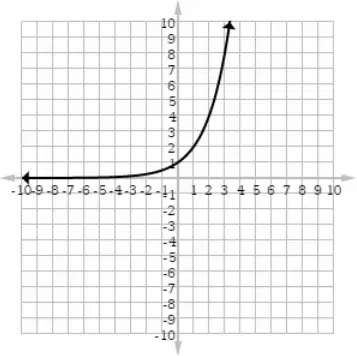
c)

-4

d)

-6

2.
Is the equation linear, exponential or neither?
a)
Linear
b)
Exponential
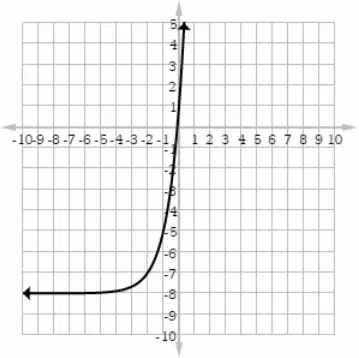
c)
Neither
3.
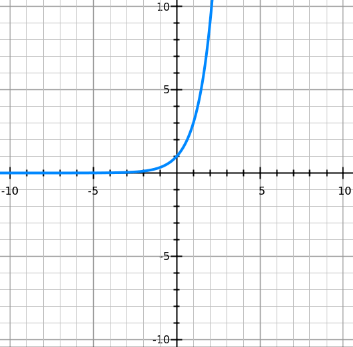
What is the x-intercept of the exponential function? 
a)
(0,1)
b)
(0,0)
c)
There is not one
4.

Is the pictured graph increasing, decreasing, or neither?

a)

Increasing

b)

Decreasing

c)

Neither

5.
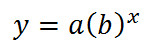
In an exponential function, what does the 'a' represent? 
a)
SLOPE
b)
RATE OF CHANGE
c)
Y-INTERCEPT
d)
COMMON RATIO
6.
Identify the y-intercept (initial value) of the function f(x)=2(4)x.
a)
2
b)
4
c)
(2)x
d)
8
7.
Identify the common ratio (multiplier) of the function f(x)=2(4)x.
a)
2
b)
4
c)
(2)x
d)
8
8.

What is the initial value of the situation represented by f(x)=0.05(2)x?

a)

0.05

b)

2

c)

0.1

d)

1

9.

Is the following function an example of decay or growth?

f(x) = 2(1.25)x

a)

Exponential Growth

b)

Exponential Decay

10.
Which function is exponential and decreasing?
a)
A
b)
B
c)
C
d)
D
11.
Which of the following functions shows an initial amount of $15 and an increase of 35% each year?
a)
y = 15(35)x
b)
y = 15(1.35)x
c)
y = 15(0.35)x
d)
y = 35(1.15)x
12.
You invest $400 for 5 years and the interest rate is 4.29% each year. 
a)
y=400(1 - 0.0429)5
b)
y=400(1+.0429)5
c)
y=400(1+ 4.29)5
d)
y=400e0.049*5
13.
The value of a car is $15,000 and depreciates at a rate of 8% per year. What is the exponential equation?
a)
y=8(15,000)x
b)
y=15,000(1 + .08)x
c)
y=15,000(1 - .08)x
d)
y=15,000(0.08)x
14.

Identify the asymptote of the function −3(3)x+4-3\left(3\right)^x+4  

a)

y = -3

b)

y = 1

c)

y = 4

15.

What is the asymptote of this function?

a)

y = 0

b)

y = 5

c)

y = 2

d)

y = 1

16.
Pick the equation that is exponential growth
a)
y=2(0.5)x
b)
y = 0.5(2)x
17.
Pick the equation that is exponential decay
a)
y=2000(0.88)
b)
y=0.5(1.88)
18.

What is the y-intercept of the exponential function in the graph?

a)

(0,3)

b)

(3,0)

c)

(0,1)

d)

(-1,1)

19.

What is the x-intercept?

a)

x = 0

b)

x= 3

c)

none

20.
What is the domain of the function shown below?
a)
-2 < x < 5
b)
0 < x < 12
c)
y > 0
d)
All Real Numbers
21.

What is the range of the function?

a)

y>0

b)

y<0

c)

y=0

22.

When is the exponential function in the graph decreasing?

a)

Always

b)

Never

c)

After 0

d)

Before 0

23.

On what intervals is the function decreasing?

a)

(0, ∞)\left(0,\ \infty\right)

b)

(− ∞, ∞)\left(-\ \infty,\ \infty\right)

c)

(−∞, 0)\left(-\infty,\ 0\right)

d)

This function foes not decrease

24.
What is the End behavior on the right side
a)
 x→∞, y→∞
b)
 x→⁻∞, y→∞
c)
 x→⁻∞, y→0
d)
 x→∞, y→⁻∞
25.
What is the End behavior on the left side
a)
 x→∞, y→∞
b)
 x→⁻∞, y→∞
c)
 x→⁻∞, y→0
d)
 x→∞, y→⁻∞
26.

What is the Domain and Range of the function?

a)

D: all real numbers

R: y < 0

b)

D: all real numbers

R: y > 0

c)

D: all real numbers

R: all real numbers

d)

D: x > 0

R: y > 0

27.
Whats the horizontal asymptote?
a)
y=1
b)
y=0
c)
(0,-1)
d)
y=-1
28.
Whats the horizontal asymptote?
a)
y=5
b)
y=0
c)
(0,5)
d)
(0,6)
29.

Is this exponential growth or decay?

a)

Growth

b)

Decay

30.

What is the asymptote?

a)

x = 2

b)

x = 1

c)

y = 2

d)

y = 0

31.

What is the range?

a)

(∞, -8) or y < -8

b)

[-8, ∞) or all real numbers greater than -8

c)

(-∞, ∞) or all real numbers

d)

(-8, ∞) or y > -8

32.

What is the domain?

a)

(-∞, ∞) or all real numbers

b)

(∞, -∞) or y > 0

c)

[0, ∞) or y > 0

d)

(1, ∞) or all real numbers greater than 1
33.

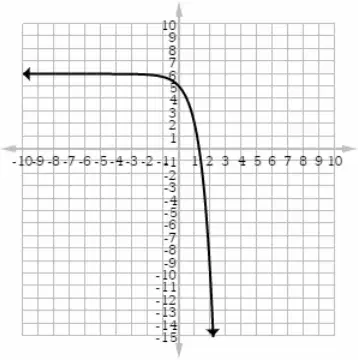
What is the y-intercept?

What is the x-intercept?

a)

y-intercept: (0, 5)

x-intercept: (1.2, 0)

b)

y-intercept: (1.2, 0)

x-intercept: (0, 5)

c)

y-intercept: (5, 0)

x-intercept: (0, 1.2)

d)

y-intercept: (0, 5)

x-intercept: (-1.2, 0)
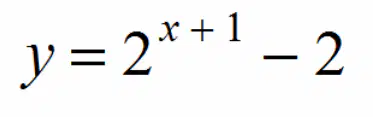
34.

What is the horizontal asymptote?

a)

y = -2

b)

y = 0

c)

y = 1

d)

x = -2

35.

What is the average rate of change for the function f(x) = 2(2)xf\left(x\right)\ =\ 2\left(2\right)^x  over the interval [1,2]?

a)

1/2

b)

4

c)

-4

d)

1/4

36.

Cells in a research facility double every minute. The researchers started with 20 cells. Write an equation to represent this situation.

a)

y = 20(2)xy\ =\ 20\left(2\right)^x

b)

y = 2(20)xy\ =\ 2\left(20\right)^x

c)

y = 220y\ =\ 2^{20}

d)

y = 202y\ =\ 20^2

37.

Scrooge invests in a bank account that pays him 4% interest annually. This can be modeled by y = 500(1.04)ty\ =\ 500\left(1.04\right)^t . How much money did he initially place in the bank?

a)

4

b)

608

c)

500

d)

1.04

38.

Rapunzel's hair grew 16% each week she was in the tower. If her hair was 20 inches long when she was placed in the tower, what is a model for the growth of Rapunzel's hair?

a)

y = 16(1.20)ty\ =\ 16\left(1.20\right)^t

b)

y = 20(1.16)ty\ =\ 20\left(1.16\right)^t

c)

y = 16(1.020)ty\ =\ 16\left(1.020\right)^t

d)

y = 20(1.016)ty\ =\ 20\left(1.016\right)^t

39.

An investment has an initial amount of $15 and increases 35% every year. What is the value of the investment after 5 years?

a)

$ 64.72

b)

$ 0.079

c)

$ 67.26

d)

$ 17.82

40.

Given y=3x determine the y-intercept

a)

1

b)

3

c)

0

d)

y

41.
What is a, the starting term, for the function: f(x) = 300(1.16)x?
a)
300
b)
1.16
c)
.16
d)
x
42.
Suppose you deposit $3000 in a savings account that pays interest at an annual rate of 4%. If no other money is added or withdrawn from the account, how much will be in the account after 10 years?
a)
$3122.18
b)
$4994.50
c)
$4440.73
d)
$86,776.40
43.
A population of fish starts at 8,000 and decreases by 6% per year. What is the population of fish after 10 years?
a)
14327
b)
4309
c)
839
d)
7680
44.
Suppose a culture of bacteria begins with 5000 cells and dies by 30% each year. Write an equation that represents this situation.
a)
y=5000(0.7)x
b)
y=30(5000)x
c)
y=5000(1.3)x
d)
y=5000xx