
Font size
 Worksheets
CardioVascular Recap Test
Total questions: 15
Worksheet time: 29mins
Match the value with the correct label
Typical Resting Stroke Volume in a trained adult
70ml
Typical cardiac output at rest in a trained adult
100ml
Typical cardiac output during maximal exercise in an untrained adult
20 l/min
Typical resting stroke volume in an untrained adult
5000 ml/min
Typical resting heart rate in an untrained adult
70 bpm
Label the parts of the heart
Septum
Pulmonary Veins
Superior Vena Cava
Pulmonary artery
Inferior vena cava
Left Ventricle
Aorta
Right Ventricle
Reorder the following
Impulse to SAN
Atrial Systole
Atrial Diastole
Ventricular Systole
Ventricular Diastole
Match the following
Impulse travels down Bundle of His, Bundle Branches to Purkinje fibres
SA Node sends an impulse through atria
Atrial Diastole
AV node collects and delays impullse
No impulse
Ventricular Systole
Atrial Systole
Ventricular Diastole
The hormone responsible for increasing heart rate is
(a)
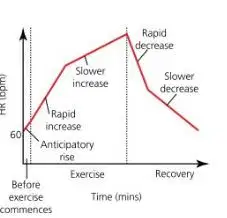
What type of exercise is being carried out in the graph?
Sub-maximal exercise
Maximal (anaerobic) exercise
Intermittent exercise
Match the following mechanisms of venous return to their picture

Muscle Pump

Respiratory Pump

Gravity
Describe the mechanisms of Starling's law of the heart (Frank-Starling mechanism).
Organize these options into the right categories for heart rate response to exercise
Chemoreceptors
Baroreceptors
Prioprioceptors
Adrenaline
Noradrenaline
Increased venous return
Increased temperature
Describe how blood flow to active muscles is maximised during exercise
Label the diagram to show resting and exercise conditions.
What is the most difficult element to learn for the carvdiovascular system?

