
Font size
 Worksheets
Topic 4: Solid Phase Peptide Synthesis
Total questions: 11
Worksheet time: 9mins
What is the primary purpose of Merrifield solid phase synthesis in peptide chemistry?
To increase the solubility of peptides
To facilitate the sequential addition of amino acids
To ensure amino acids do not epimerize
To avoid the need for hazardous reagents
Which reagent(s) is(are) commonly used for the activation of carboxylic acids in peptide synthesis?
Uronium compounds (HBTU)
Carbodiimide (DIC)
Thionyl chloride
ATP
What is the role of uronium reagents in peptide synthesis?
To protect amino acid side chains
To deprotect the Fmoc group
To activate carboxylic acids
To neutralise acids
Which of the following is a common method for Fmoc deprotection in peptide synthesis?
Treatment with trifluoroacetic acid
Treatment with piperidine
Treatment with hydrochloric acid
Treatment with sodium hydroxide
What is the main advantage of using protecting groups for amino acid side chains in peptide synthesis?
To increase the molecular weight of peptides
To prevent unwanted side reactions
To increase their solubility in organic solvents
To decrease the solubility of peptides
Which of the following is a commonly used protecting group for the amino group in peptide synthesis?
Boc (tert-butyloxycarbonyl)
Acetyl
Benzyl
Methyl
In Merrifield solid phase synthesis, what is the solid support typically made of?
Glass beads
Polystyrene resin
Silica gel
Cellulose
Which of the following is a disadvantage of using carbodiimide for carboxylic acid activation?
It is too expensive
It can lead to racemisation
It is not reactive enough
It is too volatile
Which of the following is a common side chain protecting group for serine in peptide synthesis?
Benzyl
t-Butyl
Acetyl
Methyl
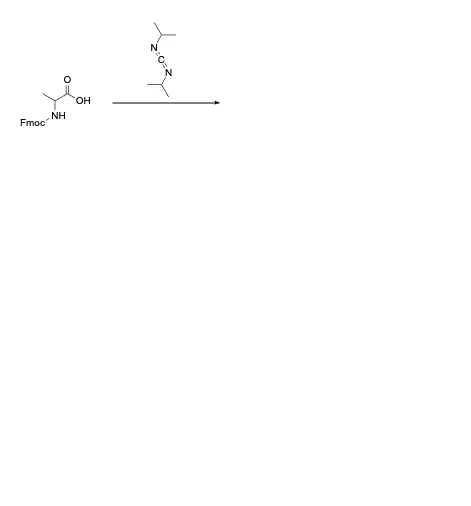
Draw the mechanism for the activation of Fmoc-Alanine with Diisopropyl carbodiimide:
What parts of this peptide would have protecting groups following Fmoc deprotection in solid phase peptide synthesis. Click on the atom(s) linked to a protecting group.

