
 Worksheets
AP Physics 2: Magnetism Full Unit
Total questions: 56
Worksheet time: 9hrs 11mins
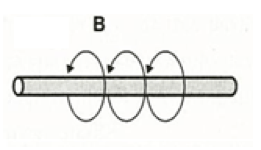
1) A wire carries a current, creating a magnetic field around itself as shown. The current in the wire is:
A. Directed to the right
A. Directed to the left
A. Equal to the magnetic field
In the same direction as the magnetic field
1) Two long parallel wires 40 cm apart are carrying currents of 10 A and 20 A in the opposite direction. What is the magnitude of the magnetic field halfway between the wires?
1.0 x 10^-5 T
2.0 x 10^-5 T
3.0 x 10^-5 T
4.0 x 10^-5 T

1) A straight wire carries a current inside the paper. What is the direction of the magnetic field at point P?
Points to the right
Points to the left
Points to the top of the page
Points to the bottom of the page

Two parallel wires of length 2 m are separated by 40 cm. If the magnetic force between the two wires is 2 ×10^-6 N and the current in the second wire is twice the current in the first one.
1) Which of the following is true concerning the force between the two wires:
The magnetic force is a repulsion between wires
The magnetic force is an attraction between the wires

Two parallel wires of length 2 m are separated by 40 cm. If the magnetic force between the two wires is 2 ×10^-6 N and the current in the second wire is twice the current in the first one.
How much is the current I in the first wire?
1A
2A
3A
4A
1) Which of the following actions would double the magnitude of the magnetic force per unit length between two parallel current-carrying wires? Choose all correct answers.
Double one of the currents.
Double the distance between them.
Double both currents.
None of the above

Two long, straight, parallel wires are held fixed, as shown below. A voltage is applied to wire 𝑋, creating a current 𝐼x to the right, and the wire experiences a magnetic force of magnitude 𝐹B toward wire 𝑌 .
which of the following statements is true.
1. It carries a current in the same direction as the current in wire 𝑋
2. It experiences a force directed away from wire 𝑋
3. It experiences a force of different magnitude than the force on wire 𝑋
1 only
2 only
1 and 2
2 and 3
Which of the following is true about field lines? (Select all that apply)
They go from a north magnetic pole to a south magnetic pole
They go from a south magnetic pole to a north magnetic pole
Their spacing shows the strength of the field
They cannot cross
How does a magnetic field affect a moving electric charge?
It doesn't
It exerts a force parallel to the velocity of the charge and parallel to the direction of the field
It exerts a force perpendicular to the velocity of the charge and parallel to the direction of the field
It exerts a force perpendicular to the velocity and perpendicular to the direction of the field
How does a magnetic field affect a stationary electric charge?
It doesn't
It exerts a force parallel to the velocity of the charge and parallel to the direction of the field
It exerts a force perpendicular to the velocity of the charge and parallel to the direction of the field
It exerts a force perpendicular to the velocity and perpendicular to the direction of the field
Which fields can be monopole fields?
Electric
Magnetic
Gravitational
What does a magnetic field around a current-carrying straight wire look like?
Field lines come out of the wire in every direction
Field lines circle around the wire
Field lines bend from one side of the wire to the other
The wire would have no field lines because it doesn't have a magnetic field
If I put a magnet that can freely move into a magnetic field, what will happen?
Nothing
It will turn to be perpendicular to the field lines
It will turn to be parallel to the field lines, with the magnet's north pole pointed towards the field's south pole
It will turn to be parallel to the field lines, with the magnet's north pole pointed towards the field's north pole

What is a ferromagnetic material?
A material which is exhibits very strong magnetic effects.
A material which is exhibits very weak magnetic effects.
A material which is exhibits no magnetic effects.
An electron, moving south, enters a magnetic field of certain strength. Because of this field the electron curves upward. What is the direction of the magnetic field?
downward
towards the east
upward
towards the west
Two long, parallel wires carry currents of different magnitudes. If the current in one of the wires is doubled and the current in the other wire is halved, what happens to the magnitude of the force between these two wires?
It is doubled.
It stays the same.
It is tripled.
It is quadrupled
Two long parallel wires carry currents of 5.0 A and 8.0 A in the opposite direction. The wires are separated by 0.30 m. Find the magnetic force per unit length between the two wires.
2.7 × 10⁻⁵ N repulsive
7.2 × 10⁻⁵ N repulsive
3.4 × 10⁻⁵ N attractive
2.7 × 10⁻⁵ N attractive
3. It is characterized by non-attraction, or even a slight repulsion, of an element to a magnet
Diamagnetism
Paramagnetism
Tetramagnetism
Pentamagnetism

For a full minute, two sample materials are immersed in a very large external magnetic field that is directed downwards. Then the samples are removed. In the image, which sample is ferromagnetic?
Sample A only
Sample B only
Samples A and B
Neither Sample A nor B
What does the following represent?
⊗⊗⊗⊗⊗⊗⊗⊗⊗⊗⊗⊗⊗⊗⊗⊗
⊗⊗⊗⊗⊗⊗⊗⊗⊗⊗⊗⊗⊗⊗⊗⊗
⊗⊗⊗⊗⊗⊗⊗⊗⊗⊗⊗⊗⊗⊗⊗⊗
Multiplied by a billion
A piece of modern art
Uniform magnetic field directed into the screen away from you
Uniform magnetic field directed out of your screen at you
What does the following represent?
⊙⊙⊙⊙⊙⊙⊙⊙⊙⊙⊙⊙⊙⊙⊙
⊙⊙⊙⊙⊙⊙⊙⊙⊙⊙⊙⊙⊙⊙⊙
⊙⊙⊙⊙⊙⊙⊙⊙⊙⊙⊙⊙⊙⊙⊙
A crowd with binoculars
A bunch of coaxial cables
Uniform magnetic field directed into the screen away from you
Uniform magnetic field directed out of your screen at you

Current is carried by a long straight wire designated by the black x. What direction is magnetic field directed?
out of the page
into the page
clockwise
counterclockwise

A magnetic field is shown directed counterclockwise around a long, straight current-carrying wire. The wire carries current in the ________ direction.
up (y)
down (-y)
into the page (-z)
out of the page (z)

A wire carries current into the page. At point A, the magnetic field points
left (-x)
right (x)
up (y)
down (-y)
A wire carries current into the page. At point B, the magnetic field points
left (-x)
right (x)
up (y)
down (-y)

Point P has a magnetic field B. If P were moved twice as a far away while the current is halved, the resulting magnetic field would be
1/4 the strength in the same direction
1/2 the strength in the same direction
twice the strength in the same direction
four times the strength in the same direction

A long straight current-carrying wire carries current to the right. At point A, the magnetic field is directed
up (y)
down (-y)
into the page (-z)
out of the page (z)

Wire R and Wire S are located as shown with current as shown. Assume both are long compared to their distance to the x-axis. What is the magnitude of the magnetic field at the origin due to the two wires?
2πμ0I
πμ0I
4πμ0I
π2μ0I
Which object(s) have magnetic fields?
Electric Charges
Magnets
Both Electric Charges & Magnets
Magnetic fields do not exist
Electric charges must ___ in order to create an observable magnetic field.
exist
be moving
be stationary
disappear
Electromagnetic induction is...
The process in which a current produces a magnetic field
The process in which a changing magnetic field generates electricity
The process in which electricity is produced by connecting wires to a battery
The process in which lightning strikes a building
Which of the following will generate a current in a loop?
A magnet
A gravitational force
A moving magnet
Friction

Two identical loops of conducting wire are in a uniform magnetic field, as shown in the diagram. How does the magnetic flux through both loops compare?
The magnetic flux through both loops is equal as they are placed in the same field.
Loop B has greater flux due to its orientation relative to the field lines and loop A has no net flux.
Loop B has a greater magnetic flux through it.
The magnetic flux through both loops is the same as they have the same area.
Loop A has a greater magnetic flux through it.
A rectangular coil of wire has sides of lengths 25 cm and 45 cm.The coil is placed into a magnetic field of 0.35 T.All the sides of the turns of the coil are perpendicular to the direction of the field. The flux linkage of the coil is 1.55 Wb. How many turns are in the coil? Round your answer to the nearest whole number.
(a)
A circular loop of wire is perpendicular to a 0.16 T uniform magnetic field. The magnetic flux through the loop is 24 mWb. What is the radius of the loop in cm?
(a)

All the sides of a rectangular loop of conducting wire are perpendicular to a uniform magnetic field, as shown in the diagram. The magnetic field strength is 0.050T .What is the magnetic flux through the loop in mWb?
(a)
Faraday’s Law states that the magnitude of the induced e.m.f. is _________________ to the rate of change of magnetic flux linkage with the solenoid.
equal
inversely proportional
directly proportional
No EMF is induced when?
When the wire is not moving
When the wire is parallel to magnetic field direction
When no lines are cut by the wire
all of the above
According to Lenz’s law the direction of an induced current in a conductor will be that which tends to produce which of the following effects?
enhance the effect which produces it
produce a greater heating effect
produce the greatest voltage
oppose the effect which produces it
A coil spins in a magnetic field. Of the following
which causes an increase in the induced EMF in
the coil?
Spinning the coil faster
Removing the coil from the magnetic field
Keeping the flux at a constant rate
Decreasing the number of turns of wire in
the coil


The bar magnetic is at rest next to the loop. What direction is the induced current in the wire?
Clockwise
Counter Clockwise
I = 0

The loop is being pulled to the right out of the magnetic field. What direction is the induced current in the wire?
Clockwise
Counter Clockwise
I = 0

The loop shrinks in a constant magnetic field. What direction is the induced current in the wire?
Clockwise
Counter Clockwise
I = 0

The loop is expanding in a constant B-field. What direction is the induced current in the wire?
Clockwise
Counter Clockwise
I = 0

A ring is originally oriented 30-deg from the magnetic field. Which of the following would increase the flux?
increasing the field
reversing the direction of the field
increasing 30-deg to 90-deg
decreasing 30-deg to 0-deg

Which coil will have the largest flux?
A
B
C
D

A moveable rod makes contact along two rails with a lightbulb attached. As the rod is moved to the right, a magnetic field is induced _________.
counterclockwise
clockwise
into the page
out of the page
A moveable rod makes contact along two rails with a lightbulb attached. As the rod is moved to the right, a current is induced _________.
counterclockwise
clockwise
into the page
out of the page

In this picture, a bar slides to the right. The flux is _______ and field is induced ________.
increasing, out of the page
increasing, into the page
decreasing, out of the page
decreasing, into the page

Which coil has the maximum flux in it?
A
B
C
All are equal

A conducting bar moves along frictionless conducting rails connected to a 4.00-Ω resistor as shown in Figure 23-11. The length of the bar is 1.60 m and a uniform magnetic field of 2.20 T is applied perpendicular to the paper. What is the applied force required to move the bar to the right with a constant speed of 6.00 m/s?
18.6 N
12.6 N
10.6 N
9.30 N

