
 Worksheets
Circuits review
Total questions: 57
Worksheet time: 57mins


If the battery produced 12.6 Volts what would be the current flow for a 6 Ohm resistor?
2.1 Amps
2.4 Amps
1.71 Amps
15 Amps
A lamp plugged into a standard american outlet (120 V) uses 0.8 A of current. What is the power in the circuit?
0.007 W
96 W
120 W
150 W

What is the power of the circuit?
0.33 W
3 W
8 W
12 W
What is the energy of the circuit if it is running for 40 seconds?
0.3 J
3.3 J
120 J
480 J


If all of these items use 120 V, which has the most current?
Lamp
Radio
Toaster
Oven

What is the equivalent or total resistance (Re) across this circuit?
3 kΩ
10 kΩ
13 kΩ
18 kΩ

A voltmeter has a high resistance so that it can accurately measure the change in voltage across a resistor. In order to do this, the voltmeter must be wired in ____________ with the resistor it's measuring
Series
Parallel
Complex
None of the above

An ammeter has a low resistance which allows it to measure the current in a particular circuit branch without changing the current. In order to measure this current, the ammeter must be wired in __________ along the branch of the circuit whose current it is measuring.
Series
Parallel
Complex
None of the above
What are the correct units to measure resistance?
Amps, A
Volts, V
Ohms, Ω
Coulombs, C
Watts, W
What are the correct units to measure charge?
Amps, A
Volts, V
Ohms, Ω
Coulombs, C
Watts, W
What are the correct units to measure current?
Amps, A
Volts, V
Ohms, Ω
Coulombs, C
Watts, W

For the circuit shown, what is the voltage drop across R1 if R1=R2?
1 V
2 V
3 V
4 V
6 V

For the circuit shown, the total current is 12 mA (milliamps), and R1 is twice as big as R2. What would be the current through R1?
4 mA
8 mA
12 mA
6 mA
10 mA

The total resistance in this circuit is
100 ohms
450 ohms
400 ohms
30 ohms

How does the current in each resistor compare? (subscripts correlate to resistor subscripts)
I1 > I2 > I3
I3 = I2 = I1
I3 > I2 > I1
none of these

How does the voltage across each resistor compare? (subscripts correlate to resistor subscripts)
V1 > V2 > V3
V3 = V2 = V1
V1 < V2 < V3
none of these

If a bulb is added between the battery and the switch, ____
The bulbs get brighter
The bulbs get dimmer
The bulb brightness stays the same
All the bulbs go out

If you add another bulb in parallel,_____
The bulbs get brighter
The bulbs get dimmer
The bulb brightness stays the same
All the bulbs will go out
A battery (of voltage V or 2V) and resistors (of resistance R or 2R) are connected in various combinations as shown. Which circuit has the least amount of current flowing from the battery?


The current running through the 3 ohm resistor is
1 A
2 A
3 A
1.4 A
Which of the following circuits has an equivalent resistance of 12 ohms?


A battery (of voltage V or 2V) and resistors (of resistance R or 2R) are connected in various combinations as shown. Which circuit uses the most power?
Which of the following changes would cause a wire's resistance to increase?
Lengthening the wire
Making the wire thicker
Making the wire's resistivity less
Wrapping the wire with plastic
A 120 v appliance draws 30 A of current. If electricity costs $0.065 /kW*h, how much does it cost to operate the appliance for 3.5 hours?
$0.82
$8.20
$82.00
$820.00
The amount of "push" available to move electrons is _____
Current
Resistance
Voltage
Static Electricity
The opposition to electron movement
Voltage
Static electricity
current
Resistance

What is constant in a series circuit?
resistance (measured in ohms)
current (measured in amps)
voltage (measured in volts)
power (measured in watts)

What is constant in a parallel circuit?
resistance (measured in ohms)
current (measured in amps)
voltage (measured in volts)
power (measured in watts)

What type of current supplies electricity in homes and businesses?
conventional current
direct current
potential current
alternating current

In a series circuit, the equivalent resistance of the circuit will always be
larger than any individual resistance.
smaller than any individual resistance.
equal to the largest individual resistance.
equal to the smallest individual resistance.

What type of current does a calculator battery (size AAA) supply?
direct current
alternating current
conventional current
potential current

What electrical safety features is found in some portable equipment, and is designed to break if too much current is flowing?
circuit breaker
fuse
GFCI
switch
The wire in a fuse will melt when the
current is larger than the fuse rating
current is smaller than the fuse rating
voltage is too large
voltage is too small
What is a suitable fuse rating for a washing machine using 6 A of current?
1 A
5 A
6 A
10 A

How does a circuit breaker works?
Circuit breaker will cause the current to flow from live wire to earth.
Circuit breaker will melt when the current is too large.
Circuit breaker will 'trip' and cut off electricity supply when the current is too small.
Circuit breaker will 'trip' and cut off electricity supply when the current is too large.

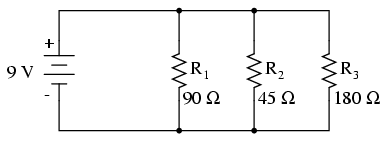
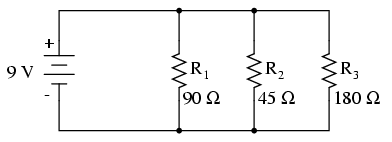
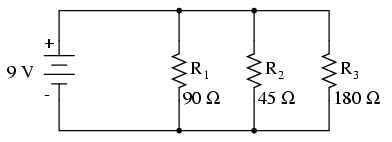
The current going through the 90 ohm resistor is
10 amps
0.1 amps
0.2 amps
The total resistance of this circuit is
25.7 ohms
315 ohms
324 ohms
90 ohms


Solve for total Current in the circuit shown
25 Amps
35 amps
25 milliamps
35 milliamps

Solve for the voltage drop at resistor 1
38 volts
60 Kvolts
50 volts
25 volts
Voltage drop stands for what?
the voltage applied to a circuit
the voltage flowing through a resistor
the voltage used by a load

Using the circuit shown solve for total power dissipated in this circuit.
20 watts
30 watts
1.8 Kilowatts
180 watts

The wattage being dissipated at R3 is ______________________________ W.
18
54
36

