wayground logo

Free Printable Worksheets

NEW

Font size

S
M
L
XL
Worksheets

Unit 1: Intro to Anatomy & Physiology Exam

Total questions: 60

Worksheet time: 15hrs 0mins

Name
Class
Date
1.
Compared to the heart, the skin is a _____ organ
a)
Deep
b)
Superficial
c)
Proximal
d)
Dorsal
2.
Which is the correct structural order?
a)
tissue-cells-organ-organ system
b)
cells-tissue-organ system-organ
c)
tissue-cells-organ system-organs
d)
cells-tissue-organ-organ system
3.
The knee is _______________ to the ankle as it is closer than the hips.
a)
Superficial
b)
Superior
c)
Proximal
d)
Inferior
4.
The hand is ____________ to the biceps.
a)
Superior
b)
Distal
c)
Proximal
d)
Medial
5.
The eyes are ____ to the nose. 
a)
medial
b)
lateral
c)
inferior
d)
posterior
6.
The surface of the back of the neck.  
a)
superior
b)
inferior
c)
proximal
d)
posterior
7.
Divides body into top and bottom portions (superior-head; inferior-feat)
a)
Medial Plane
b)
Sagittal
c)
Proximal 
d)
Transverse Plane
8.
Body is standing straight, facing forward, upper limbs at side and palms facing forward. 
*right and left refer to "right" and "left" of the body in position.
a)
Sagittal
b)
Anatomical Position
c)
Anterior Position
d)
Anatomical Plane
9.
Which plane divides the body into left and right sides
a)
Frontal
b)
Coronal
c)
Sagittal 
d)
Transverse
10.
What does the coronal plane divide the body into?
a)
Front to back
b)
Side to side 
c)
Left to right
d)
Top to bottom
11.
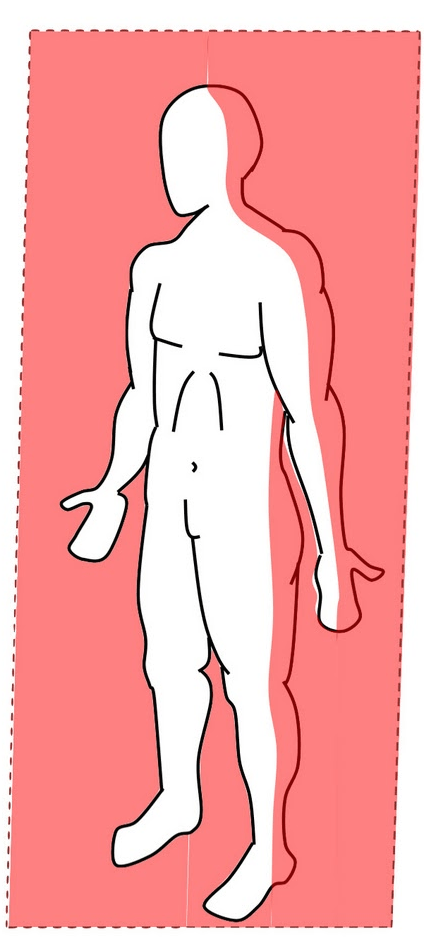
Which body plane is pictured?
a)
sagittal
b)
frontal (coronal)
c)
transverse
12.
Away from midline
a)
Lateral
b)
Distal
c)
Superior
d)
Transverse
13.
What's the other way to say "anterior"?
a)
ventral
b)
Dorsal
c)
superior
d)
inferior
14.
The elbow is  ____ to the shoulder.
a)
Proximal
b)
Distal
c)
Anterior
d)
Lateral
15.
a plane that divides the body into equal left and right halves. 
a)
sagittal
b)
midsagittal
c)
transverse
d)
frontal
16.
a plane that divides the body into top and bottom halves. 
a)
sagittal
b)
midsagittal
c)
transverse
d)
frontal
17.
a plane that divides the body into front and back. 
a)
sagittal
b)
midsagittal
c)
transverse
d)
frontal
18.
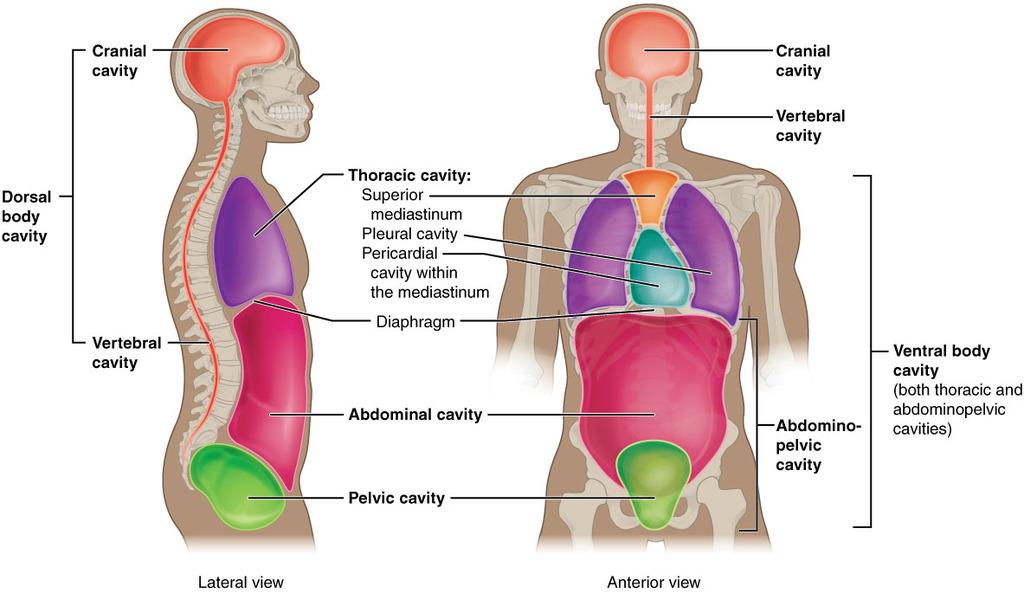
#1
a)
crainial
b)
spinal
c)
pelvic
d)
abdominal
19.

#3

a)

vertebral

b)

cranial

c)

thoracic

d)

pelvic

20.
#4
a)
spinal
b)
cranial
c)
thoracic
d)
pelvic
21.

Which organ belongs with this system: Nervous

a)

kidneys

b)

glands

c)

brain

d)

bones

22.

Which organ belongs with this system: endocrine

a)

kidneys

b)

glands

c)

brain

d)

bones

23.

Which organ belongs with this system: urinary

a)

kidneys

b)

glands

c)

brain

d)

bones

24.

Which organ belongs with this system: circulatory/cardiovascular

a)

heart

b)

stomach

c)

lungs

d)

muscles

25.
The nose is ____ to the chin. 
a)
superior
b)
inferior
c)
proximal
d)
posterior
26.

What is a tissue ?

a)

a group of different cells that work together to perform a specific function

b)

a group of similar cells that work together to perform a specific function

27.
What is a group of similar tissues?
a)
Tissue 
b)
Organ
c)
Cell group
d)
Organ system
28.
The bone is _____ to the skin.
a)
inferior
b)
superficial
c)
deep
d)
posterior
29.

The chin is _____ to the eye.

a)

superior

b)

deep

c)

inferior

d)

lateral

30.

The right shoulder is ______ to the breastbone.

a)

medial

b)

proximal

c)

distal

d)

lateral

31.

The right shoulder is ______ to the breastbone.

a)

medial

b)

proximal

c)

distal

d)

lateral

32.
The rib cage is _____ to the heart.
a)
proximal
b)
medial
c)
superficial
d)
distal
33.
Which body cavity contains organs including the stomach, spleen, liver, gallbladder, and pancreas?
a)
abdominal
b)
pelvic
c)
thoracic
34.
Which body cavity is located above the diaphragm and is surrounded by the rib cage?
a)
abdominal
b)
pelvic
c)
thoracic
35.

What is section 1?

a)

Epigastric

b)

Left Hypochondriac

c)

Right Hypochondriac

d)

Right iliac

36.

What is section 7?

a)

Epigastric

b)

Left Hypochondriac

c)

Right Hypochondriac

d)

Right iliac

37.

What is section 5?

a)

Umbilical

b)

Left lumbar

c)

Right lumbar

d)

Right iliac

38.

What is section 6?

a)

Umbilical

b)

Left lumbar

c)

Right lumbar

d)

Right iliac

39.

What is section 8?

a)

Hypogastric

b)

Left iliac

c)

Right iliac

d)

Right lumbar

40.

What is section 2?

a)

Epigastric

b)

Left Hypochondriac

c)

Right Hypochondriac

d)

Right iliac

41.

Which of these is NOT a abdominal region?

a)

Vertebral

b)

Right Illiac

c)

Epigastric

d)

Left Lumbar

42.
Homeostasis
a)
allows for a wildly fluctuating internal environment
b)
is impossible in vertebrates
c)
is the maintenance of a relatively stable internal environment and often incorporates a form of feedback regulation
d)
is the maintenance of a relatively stable external environment and often incorporates a form of feedback regulation
43.
When you get cut, your skin cells release hormones that signal platelets to come and stop the bleeding. Platelets then release more hormones that signal even more platelets to help stop bleeding. The hormone signals continue until the cut is closed.
a)
Positive Feedback Response
b)
Negative Feedback Loop 
44.

Which body system controls the body to maintain homeostasis?

a)

excretory

b)

nervous

c)

circulatory

d)

skeletal

45.
The maintenance of an organism’s internal environment is called:
a)
compensating
b)
homeostasis
c)
balancing
d)
routine
46.

The group of organisms that use the process of homeostasis includes

a)

mammals, only

b)

animals, only

c)

plants and animals

d)

all living things

47.
organ of the endocrine system that secretes hormones.
a)
heart
b)
gland
c)
brain
d)
skin
48.
Rapid growth during puberty causes your body to release more and more growth hormones. As you grow, more and more growth hormones are released until puberty is reached, and then the hormones stop.
a)
Positive Feedback Response
b)
Negative Feedback Loop 
49.
Negative Feedback Loops:
a)
amplify processes
b)
prevent small changes from getting larger
c)
are initiated during childbirth
d)
are found only in plants
50.

The ultimate cause of death

a)

Over Heating

b)

Diabetes

c)

Bad Hair

d)

Loss of Homeostasis

51.

This happens due to involuntary contractions of voluntary muscles to warm up

a)

Shivering

b)

Sweating

c)

Vasodilation

d)

Vasoconstriction

52.
If the environment gets cold, we will often shiver in order to:
a)
keep body temperature the same as the external temperature
b)
decrease body temperature
c)
increase body temperature
d)
regulate blood pressure
53.
What is another word that can be used to describe "homeostasis"?
a)
STABLE
b)
EQUAL
c)
COMPLETE
d)
CORRECT
54.

What part of a feedback mechanism is what happens inside of the organism, as the result of the effector?

a)

Stimulus

b)

Response

c)

Receptor

d)

Effector

55.

Which part of the feedback loop is a body part that makes a change to bring the system back to homeostasis?

a)

Effector

b)

control center

c)

response

d)

receptor

56.

The body part that senses the change inside the organism ...

a)

receptor

b)

control center

c)

effector

d)

response

57.
What is the evaporation of a liquid to cool the body?
a)
Shivering
b)
Sweating
c)
Vasodilation
d)
Vasoconstriction
58.

When the body temperature drop below normal ranges, arterioles in the skin will

a)

dilate to allow less blood to flow to skin surface

b)

constrict to allow less blood to flow to skin surface

c)

dilate to allow more blood to flow to skin surface

d)

constrict to allow more blood to flow to skin surface

59.

When you are cold, you shiver and your blood vessels contract, which warms you up. When you are hot, you sweat and your blood vessels expand, which cools you down.

a)

False

b)

True

60.
Homeostasis in the human body is often maintained by a: 
a)
neutral feedback loop 
b)
solar feedback loop
c)
positive feedback loop
d)
negative feedback loop