
 Worksheets
Density Practice
Total questions: 20
Worksheet time: 10mins
Name
Class
Date
1.
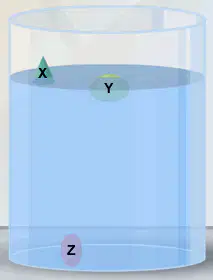
Based on the diagram below, rank the three objects from least dense to most dense.
a)
Object X, object Z, object Y.
b)
Object Z, object Y, object X.
c)
Object X, object Y, object Z.
d)
Object Y, object Z, object X.
2.
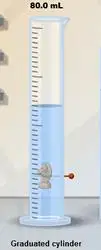
What property is being measured in the image below?
a)
mass
b)
density
c)
volume
d)
height
3.
A ball has a mass of 23.6 grams and a volume of 14.0 cubic centimeters (cc). What is its density?
a)
0.42 g/cc
b)
1.69 g/cc
c)
19.6 g/cc
d)
470.4 g/cc
4.
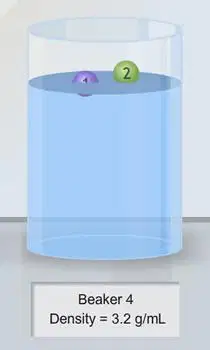
Objects 1 and 2 float as shown in the beaker below. The density of the liquid in the beaker is 3.2 g/mL. Which of the densities given below are possible values for the densities of the two objects?
a)
Density of object 1 = 4.4 g/cm3; Density of object 2 = 4.0 g/cm3
b)
Density of object 1 = 3.0 g/cm3; Density of object 2 = 1.8 g/cm3
c)
Density of object 1 = 1.6 g/cm3; Density of object 2 = 2.9 g/cm3
d)
Density of object 1 = 2.5 g/cm3; Density of object 2 = 3.8 g/cm3
5.

Identical objects are placed in Beaker A and in Beaker B. The objects float as shown in the diagrams below. What can you conclude about the liquid in each of the beakers?
a)
Both liquids are less dense than the objects.
b)
The liquid in Beaker A has a greater density than the objects. The liquid in Beaker B is less dense than the objects.
c)
The liquid in Beaker A has a greater density than the liquid in Beaker B.
d)
The liquid in Beaker B has a greater density than the liquid in Beaker A.
6.
Fill in the blank: An object is most likely to sink in water if _________________.
a)
it has a large mass
b)
it has a large volume
c)
it has a high density
d)
it has a low density
7.

Three balls were measured and placed in a liquid. Based on the following data, what could be the density of the liquid?
a)
1.1 g/mL
b)
1.0 g/mL
c)
0.9 g/mL
d)
0.8 g/mL
8.
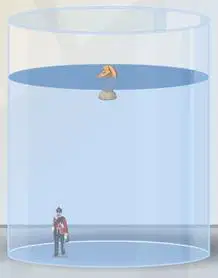
According to the picture, which is the least dense?
a)
the chess piece
b)
the toy soldier
c)
the liquid in the container
d)
There is no way to tell.
9.
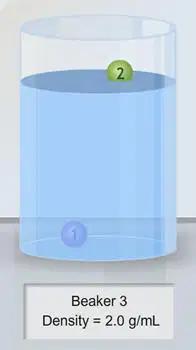
Objects 1 and 2 are placed in the beaker below. The density of the liquid in the beaker is 2.0 g/mL. Which of the densities given below are possible values for the densities of the two objects?
a)
Density of object 1 = 0.8 g/cm3; Density of object 2 = 3.0 g/cm3
b)
Density of object 1 = 3.0 g/cm3; Density of object 2 = 0.8 g/cm3
c)
Density of object 1 = 3.8 g/cm3; Density of object 2 = 3.0 g/cm3
d)
Density of object 1 = 1.5 g/cm3; Density of object 2 = 0.8 g/cm3
10.

An object with unknown density is tested in two beakers. Beaker 1 contains liquid with a density of 1.5 g/mL, and Beaker 2 contains liquid with a density of 2.0 g/mL. The object sinks in both beakers. Which of the following statements about the object's density is true?
a)
The object's density is less than 1.5 g/cm3.
b)
The object's density is exactly 1.5 g/cm3.
c)
The object's density is greater than 1.5 g/cm3 and less than 2.0 g/cm3.
d)
The object's density is greater than 2.0 g/cm3.
11.

"That's just the tip of the iceberg" is a popular expression you may have heard. It means that what you can see is only a small part of the overall problem. As the diagram shows, most of an iceberg is actually out of sight, below the water level. Based on this diagram, what is the most likely density of the iceberg? (Assume a density of 1.03 g/mL for seawater.)
a)
0.88 g/cc
b)
1.23 g/cc
c)
0.23 g/cc
d)
4.14 g/cc
12.
Fill in the blank: The greater the amount of matter that is packed into a given space, the greater the _______________________.
a)
mass
b)
density
c)
volume
d)
temperature
13.
What is the density of a block with a mass of 46 g and a volume of 9 cm3?
a)
45 g/cm3
b)
27 g/cm3
c)
5.11 g/cm3
d)
0.25 g/cm3
14.
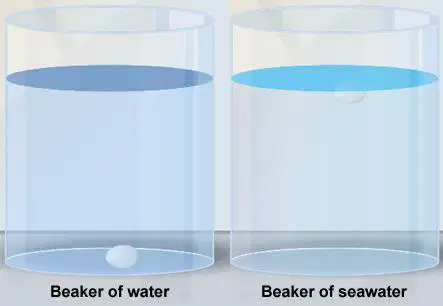
The image below shows the same egg in water (on the left) and in seawater (on the right). What must be true about these liquids?
a)
The seawater is less dense than the plain water.
b)
The seawater is denser than the plain water.
c)
The plain water and the seawater have equal densities.
d)
It is impossible to tell which liquid is denser.
15.

An object with a density of 0.85 g/cm3 is dropped into each of the two beakers shown below. What will happen to the object in each case?
a)
It will sink in both beakers.
b)
It will float in Beaker 1 and sink in Beaker 2.
c)
It will sink in Beaker 1 and float in Beaker 2.
d)
It will float in both beakers.
16.
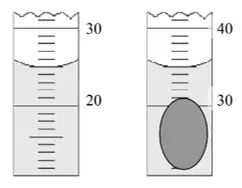
Examine the pairs of graduated cylinders. Calculate the volume of the rock in the second graduated cylinder.
a)
5 ml
b)
10 ml
c)
15 ml
d)
20 ml
17.
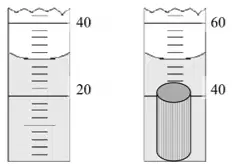
Examine the pairs of graduated cylinders. Calculate the volume of the rock in the second graduated cylinder.
a)
10 mL
b)
15 mL
c)
20 mL
d)
25 mL
18.
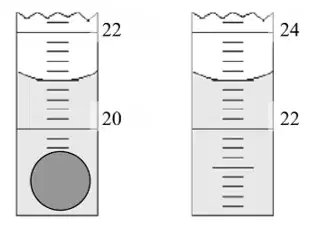
Examine the pairs of graduated cylinders. Calculate the volume of the rock in the second graduated cylinder.
a)
1 mL
b)
2 mL
c)
3 mL
d)
4 mL
19.
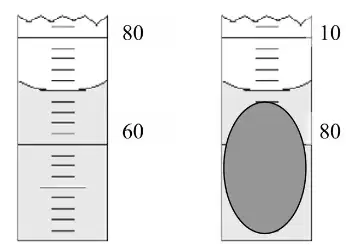
Examine the pairs of graduated cylinders. Calculate the volume of the rock in the second graduated cylinder.
a)
5 mL
b)
10 mL
c)
15 mL
d)
20 mL
20.
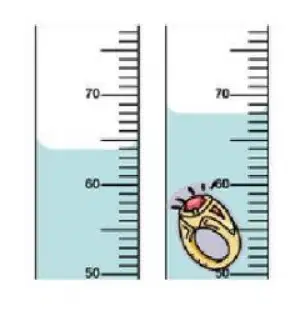
Examine the pairs of graduated cylinders. Calculate the volume of the rock in the second graduated cylinder.
a)
1 mL
b)
2 mL
c)
3 mL
d)
4 mL
100 %

