
 Worksheets
Coasts as natural systems
Total questions: 19
Worksheet time: 10mins
What is meant by 'input' in a system?
Energy and/or matter leaving a system.
Energy and/or matter entering a system.
The edge of a particular system.
Movement between stores/components in a system.
What does 'output' refer to in a system?
Energy and/or matter entering a system.
Energy and/or matter leaving a system.
A section of a system where matter can remain.
The edge of a particular system.
What is the 'boundary' in a system?
Energy and/or matter entering a system.
The edge of a particular system.
Movement between stores/components in a system.
A section of a system where matter can remain.
Which of the following best describes an open system?
Energy and matter are constant.
Only energy is transferred.
Energy and matter can be transferred in, through, and out.
Only matter is transferred.
What happens to stores in a system at equilibrium?
They increase.
They decrease.
They stay the same.
They disappear.
What is dynamic equilibrium?
A state where components remain unchanged
A state where components change to reach balance
A state of constant imbalance
A state where no feedback occurs
What is negative feedback?
Enhancing the original change
Ignoring the original change
Lessening and reversing the original change
Amplifying the system's response
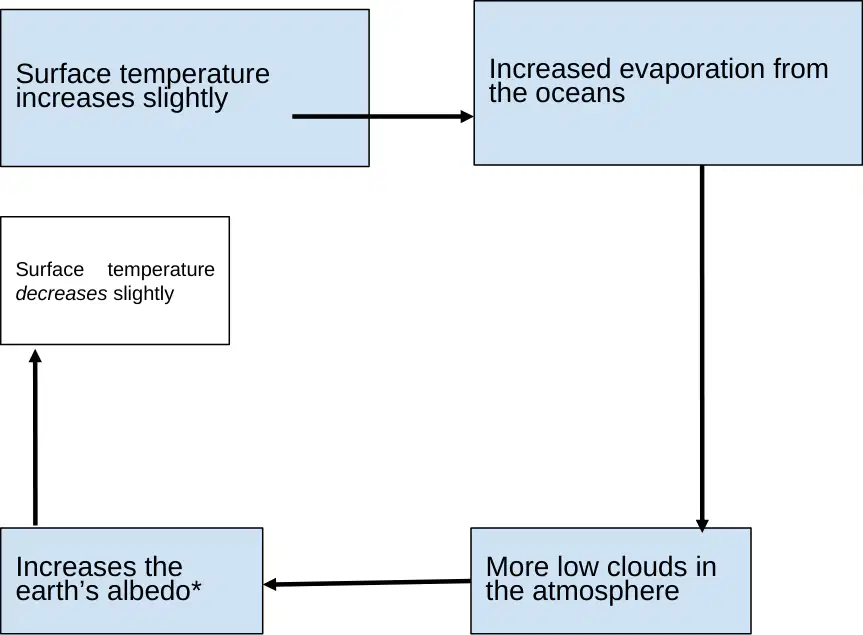
What is the first step in the example of negative feedback provided?
Increased evaporation from the oceans
Surface temperature decreases slightly
More low clouds in the atmosphere
Surface temperature increases slightly
What effect do more low clouds in the atmosphere have in the feedback loop?
Increase surface temperature
Decrease evaporation
Increase the earth’s albedo
Decrease the earth’s albedo
What is albedo?
The absorption of UV rays by the Earth's surface
The reflection of the sun's UV rays back into the atmosphere
The emission of infrared radiation from the Earth
The scattering of sunlight by clouds
What does positive feedback in a system cause?
A return to equilibrium
A decrease in the original change
A further or snowball effect, amplifying the original change
A stabilization of the system
What is the result of ocean waters absorbing more solar radiation?
Sea ice cover increases
Temperatures decrease
Sea ice cover melts and shrinks
The system stabilizes
What is the result of a system moving further away from equilibrium due to positive feedback?
The system becomes more stable.
The system returns to its original state.
The system experiences a snowball effect.
The system stops changing.
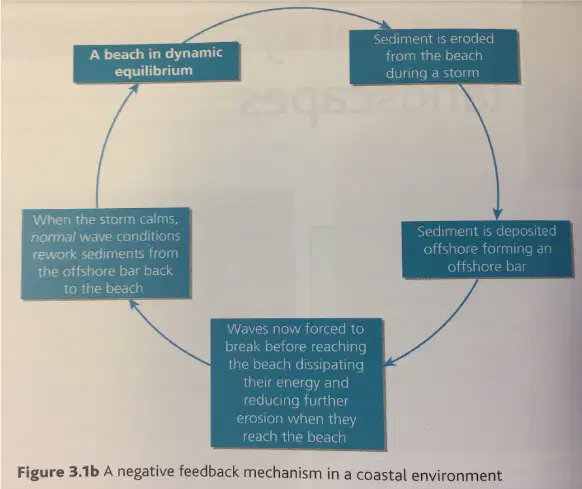
What happens when storm conditions calm according to the flow diagram?
Sediments are reworked back to the beach.
Sediments are permanently lost.
New dunes are formed.
Erosion increases.
Which of the following is a process/flow in the coastal system?
Transport
Beaches
Spits
Offshore bars
Which of the following is a store/component of a coastal system?
currents
sand dunes
weathering
sediment being taken out to sea
Which of the following is an input into a coastal system?
current
sand dunes
weathering
sediment being taken out to sea
Which of the following is an output of a coastal system?
current
sand dunes
weathering
sediment being taken out to sea
Which of the following is a process/transfer in a coastal system? (tick all that apply)
current
sand dunes
weathering
deposition

