
Font size
 Worksheets
Chapter 7 Test: The Reach of Imperialism
Total questions: 24
Worksheet time: 24mins
In 1903 Theodore Roosevelt supported a rebellion that allowed (a) to become a new nation.
Under the (a) to the Monroe Doctrine, the United States intervened in Latin America to collect debts and sent military forces to protect American investments.
The United States backed the 1913 military coup of (a) in Mexico.
The (a) caused economic hardship but resulted in a constitution that granted Mexican citizens many rights and protections.
Imperialism made Latin American economies largely dependent on the (a) of raw materials to European countries.
As a result of the Spanish-American War, the United States annexed ________.
Cuba
Haiti
Mexico
Puerto Rico
Which segment of Latin American society grew as a result of the new prosperity in the late 1800s?
indigenous people
lower classes
Mexican elite
middle sectors
The 1917 Mexican Constitution pushed back against imperialism by ________.
restricting foreign business practices.
establishing a federal government.
decreasing the power of the Mexican president.
securing the Mexican elite's property rights.
The United States used dollar diplomacy to ________.
increase the value of its currency.
expand its economic influence in Latin America.
improve diplomatic relations with Mexico.
help pay for the Panama Canal.
Who benefited from Díaz’s dictatorial reign in Mexico?
A) foreign capitalists
B) peasant farmers
C) small landowners
D) urban workers
What did Western nations hope to gain by establishing new colonies after 1880?
A) languages and cultures to add to their own
B) additional ideas for their own industries
C) more people to add to their population figures
D) raw materials for their industries and markets to sell their products
France was motivated to take over Vietnam by its economic ambitions as well as by
A) a sincere desire to help Vietnam.
B) rivalry with Britain.
C) desire for Laos.
D) a fear of Siam.
Why did the United States fight so hard to defeat the Philippine guerrilla forces?
A) to gain a connection to the markets of China
B) to show Spain that the United States was in control
C) to defeat the Japanese
D) to protect Americans in the Philippines
Citizens of the colonies probably preferred indirect rule over direct rule because
A) their taxes would be lower.
B) the government would be more efficient.
C) there would be fewer changes to their way of life.
D) foreigners would not be living in their country.
Why did peasants in many Southeast Asian colonies revolt against imperial rule?
A) Colonial governments imposed Western systems of education.
B) Local rulers gained more military power and economic prestige.
C) Nationalist leaders failed to protect indigenous religious customs.
D) Plantation agriculture drove them off their land.
Inequality and segregation contributed to the rise of African nationalist movements.
True
False
King Leopold II of Belgium refused Henry Stanley’s urging to help settle the Congo River Basin in Central Africa, ending decades of competition among imperial powers in the region.
True
False
Europeans were interested in West Africa especially for its
size.
independence.
raw materials.
rivers.
How did the explorations of Livingstone and Stanley lead to colonization of Central Africa?
They expelled Boer farmers and indigenous groups from the region.
They found a navigable river to the African interior.
They resolved territorial disputes among competing ethnic groups.
They succeeded in locating the source of the Nile River.
What is one important reason that European nations met at the Berlin Conference?
Otto von Bismarck wanted to end European colonization of Africa.
Britain and Germany wanted to coordinate their conquest of East Africa.
European countries wanted to settle conflicting claims in East Africa.
Indigenous groups in South Africa launched a fierce resistance to colonization.
New imperialism in much of Africa led to (a) .
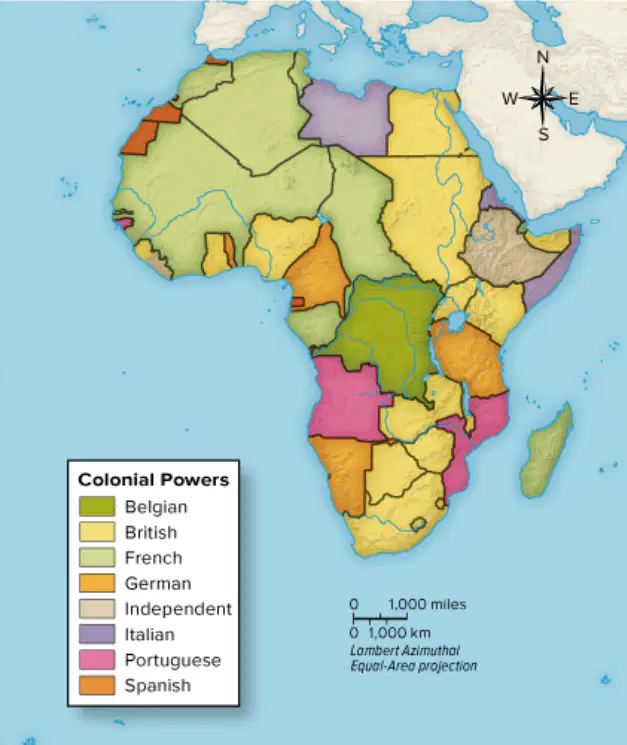
Which African states retained their independence during the era of European imperialism? Select all that apply.
Algeria
Egypt
Ethiopia
Liberia
Libya
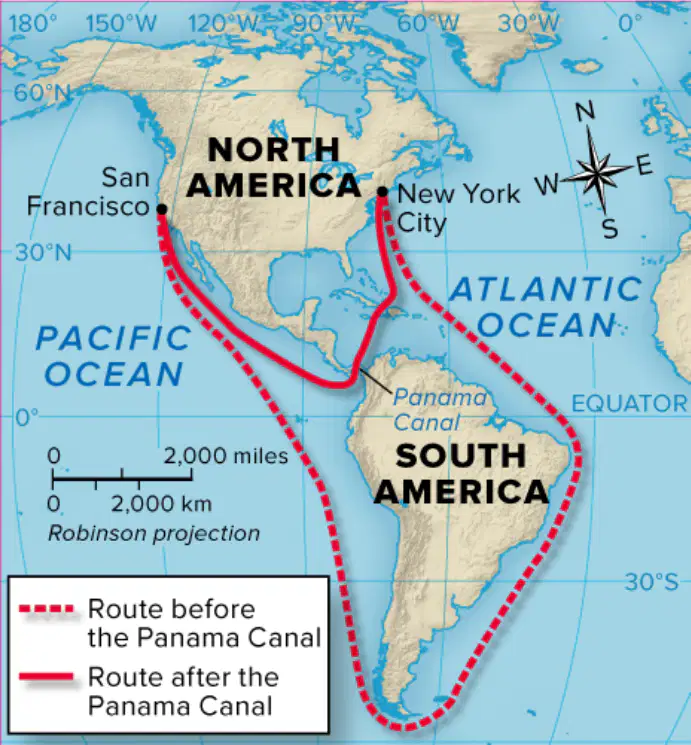
Based on the map of sea routes before and after the Panama Canal, what can you determine about how the canal affected sea travel from New York to San Francisco? Select all that apply.
It made the trip shorter.
It made the trip less expensive.
It made the trip more dangerous.
It made more frequent trips possible.
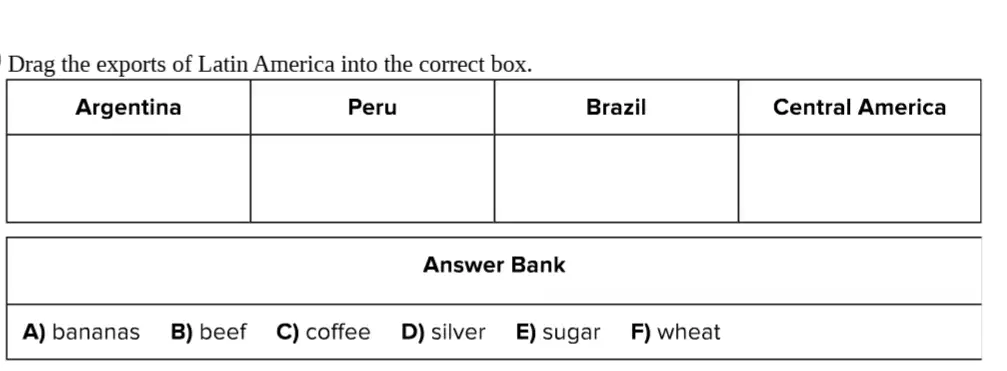
Match the exports with corresponding Latin American country or region.

