
 Worksheets
Mr. J's really big science Quiz
Total questions: 195
Worksheet time: 4hrs 45mins
What is a physical property?
What is matter?
What are some physical properties of matter?
How can you identify the physical properties of matter?
How can we use physical properties to classify objects?

The chart below was constructed to compare some properties of water in different states. Which property should be put into the second column?
A tastes stale
B feels smooth
C has a strong odor
D takes the shape of its container
Why is it important that we create and keep up with our science journals?
We also classify an object based off if it is a solid, liquid or gas. What are some examples?
How do you find an object's volume?
use a thermometer
use a triple beam balance
use a graduated cylinder
Which of these is NOT an example of a physical property of a car?
The car is red.
The car is magnetic.
The car costs $10,000.
What is volume?
how much something weighs
hot hot something is
how much space something takes up
Matter is anything that...
has mass
takes up space
both a and b
Which of these is found using a thermometer?
temperature
color
mass
Which of these will probably float in water?
rock
cell phone
empty water bottle
Which of these are an example of a physical property?
magnetism
color
mass
all of the above
What is States of Matter?
Whether something floats or sinks
how hot or cold something is
Whether something is a solid, liquid, or gas
Which of these is measured in grams?
mass
volume
magnetism
Which is a picture of a liquid?


What is a physical state?
The force caused by magnets attracting certain metals
Amount of matter in an object
Matter exists in 3 states – solid, liquid, gas
Anything that has mass and takes up space
Which of the following is a physical property of matter?
Emotion
Magnetism
Thought
Imagination
Which physical property refers to the amount of matter in an object?
Solubility
Conductivity
Mass
Insulation
Which of the following is NOT a physical property?
Mass
Emotion
Solubility
Conductivity
Which property would you test to determine if a material is magnetic?
Solubility
Conductivity
Magnetism
Insulation
What is the physical property that describes how well a material can prevent heat transfer?
Conductivity
Insulation
Solubility
Magnetism
Which property would you examine to determine if a substance can conduct electricity?
Solubility
Conductivity
Insulation
Magnetism
Which of the following is NOT a tool used to measure mass?
Triple beam balance
Digital scale
Thermometer
Balance scale
Which of the following statements is true about mass?
Mass changes with location
Mass is the same as weight
Mass is the amount of matter in an object
Mass is measured in liters
What is a physical state?
The force caused by magnets attracting certain metals
Amount of matter in an object
Matter exists in 3 states – solid, liquid, gas
Anything that has mass and takes up space
Which of the following is a physical property of matter?
Emotion
Magnetism
Thought
Imagination
Which physical property refers to the amount of matter in an object?
Solubility
Conductivity
Mass
Insulation
Which of the following is NOT a physical property?
Mass
Emotion
Solubility
Conductivity
Which property would you test to determine if a material is magnetic?
Solubility
Conductivity
Magnetism
Insulation
What is the physical property that describes how well a material can prevent heat transfer?
Conductivity
Insulation
Solubility
Magnetism
Which property would you examine to determine if a substance can conduct electricity?
Solubility
Conductivity
Insulation
Magnetism
Which of the following is NOT a tool used to measure mass?
Triple beam balance
Digital scale
Thermometer
Balance scale
Which of the following statements is true about mass?
Mass changes with location
Mass is the same as weight
Mass is the amount of matter in an object
Mass is measured in liters
What is the approximate mass of a standard paper clip?
5 grams
1 gram
10 grams
0.1 gram
What is the function of a triple beam balance?
To measure temperature
To measure mass
To measure length
To measure time
Which unit is commonly used to record mass?
Liters
Meters
Grams
Seconds
What is magnetism?
The force caused by magnets attracting certain metals
Amount of matter in an object
Matter exists in 3 states – solid, liquid, gas
Anything that has mass and takes up space
What happens when a metal sticks to a magnet?
It is magnetic
It is non-magnetic
It is melting
It is rusting
Which of the following is an example of a metal that is a good conductor?
Wood
Plastic
Copper
Rubber

In the illustration, which is an example of a liquid?
the bubbles
the straw
the water
the ice

In which state of matter will there be the LARGEST space between molecules?
Solid
Liquid
Gas

What state of matter is represented in this picture?
solid
liquid
gas
When you boil water, you are changing water from a liquid to a ___.
Liquid
Solid
Gas
What is the term used to describe a gas turning into a liquid?
Freezing
Melting
Evaporation
Condensation
What happens during the freeze process?
Water vapor changes to liquid water
Liquid changes to water vapor
Ice changes to liquid
Liquid changes to ice
What is the process called when ice changes to liquid?
Evaporation
Condensation
Freeze
Melt
What does relative density determine?
A) Whether matter is a solid, liquid, or gas
B) The amount of matter an object can hold
C) Whether an object sinks or floats
D) The amount of matter in something
Which of the following is a physical state of matter?
A) Soluble
B) Mixture
C) Gas
D) Filter
What is volume in the context of physical properties?
A) The amount of matter an object can hold
B) A characteristic of matter
C) Anything that takes up space
D) A method of separating mixtures
What does solubility refer to?
The process of liquid changing to water vapor
The process of water vapor changing to liquid water
Whether or not matter dissolves in water
The process of ice changing to liquid
What happens during the freeze process?
Water vapor changes to liquid water
Liquid changes to water vapor
Ice changes to liquid
Liquid changes to ice
What is evaporation?
The process of ice changing to liquid
The process of liquid changing to ice
The process of water vapor changing to liquid water
The process of liquid changing to water vapor
Do environments change over time?
What are fossils?
How do scientists use fossils?
Scientists use fossils to study and understand how environments have changed over time.

Destin was completing his homework at his desk at night. To help him see his paper better, he plugged in the lamp shown below. After 30 minutes, he noticed that his paper felt hot.
What statement about energy does this observation provide evidence for?
Motion energy can be turned into heat energy.
Light energy also transfers heat energy.
Heat energy transfers light energy.
Electrical energy is produced by light energy.

Wind turbines are used to harness energy from the wind as the wind spins the blades. Others can then use this energy to power their homes.
When the wind spins the blades, what transfer of energy occurs?
energy of motion is transferred into electrical energy
electrical energy is transferred into heat and light energy
solar energy is transferred into electrical energy
electrical energy is transferred into energy of motion

Scientists found the fossil below with webbed feet. The animal most likely lived in what type of habitat?
in the mountains
in the desert
in the tropical rainforest
in a pond, lake, or ocean
What does a thermometer measure?
Pressure
Visibility
Temperature
Humidity
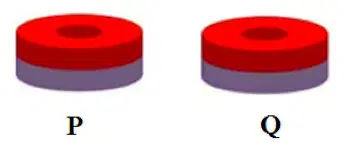
Austin has two magnets. The shaded parts of the magnets represent the poles. What will happen if she brings the dark side of magnet P closer to the dark side of magnet Q?
They will repel each other.
Both the magnets will break.
They will attract each other.
Poles of the magnets will change.

What are the two poles of a magnet?
North Pole
North neutra pole
South neutra pole
South pole
Which magnets will move towards each other?
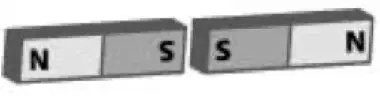
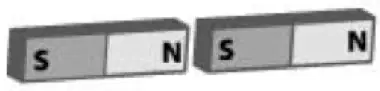
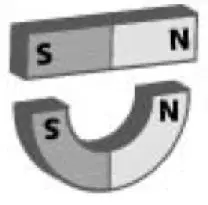
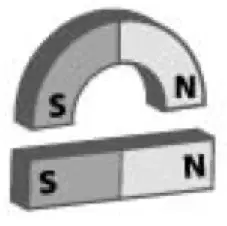
Magnets always have two poles, North and South.
True
False

Nathan holds two magnets near each other. He finds that the magnets stick to each other as shown in this illustration. Magnet A has the poles labelled in the picture. How would you label the poles on Magnet B?
Both Point 1 and Point 2 are north poles
Both Point 1 and Point 2 are south poles
Point 1 is the north Pole and Point 2 is the south Pole.
Point 1 is the south Pole and Point 2 is the north Pole.
Which of the following is NOT a property of magnetic poles?
Like poles repel each other
Opposite poles attract each other
Magnetic poles can exist in isolation
Magnetic poles always come in pairs
What picture shows two magnets that will repel each other?

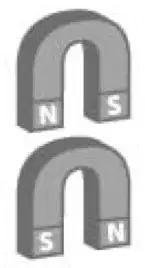




Here is a picture showing how two magnets will stick to one another when opposite poles align. When these magnets are pulled slightly apart, does the attractive force between them still exist?
Yes, but the new attractive force is due to gravity.
No, since they are not touching, no force is at work.
Yes, even though they are not touching, they are pulling on one another.
No, when the magnets are apart, they exert a repulsive force on one another.
What is the main source of energy for plants?
Rain
The Sun
The Grass
Soil
What tool do you use to find the mass of an object?
Graduated Cylinder
Balance
Hand Lens
Bowl
What is a nonliving thing that humans made?
bird
rocks
house
trees
Which state of matter has a definite volume, but does not have a definite shape?
gas
liquid
solid
matter

Mr. Lopez spilled his favorite snack. Is it a mixture or a solution? Why?
Its a mixture, because it is made up of 2 or more substances that can be easily separated.
Its a mixture, because it can only be separated with a sieve.
Its a solution, because it can only be separated by dissolving it in water.
Its a solution because it can not be separated easily.
What happens when water mixes with sugar?
the appearance of sugar changes
the shape of water changes
the taste of sugar changes
the state of water changes
I have a mixture of Wood chips, sand, iron filings, and gravel. Here is a way to separate them:
Use a screen to separate the the sand and iron filings from the gravel and wood chips.
What would be step 2?
Use the screen again to separate the iron filings and the sand
Use a magnet to separate the iron filings from the sand
Use a tweezers to pick out the iron filings
use a filter and water to separate the sand from the iron filings
Which of these mixtures is not a solution?
lemonade
sand and water
Kool-aid
ocean water

As a whole, this bowl of chicken noodle soup would generally be considered a
mixture
solution
Which of the following is NOT a mixture?
oxygen
coins in a piggy bank
a bowl of lucky charms cereal
Chex mix

All of the buttons in this pile
make the pile a mixture.
can be separated with a magnet.
have all the same properties.
are likely to dissolve in water.

This is an example of a
Solution
Mixture

This is an example of a
Solution
Mixture
This is a type of mixture where one substance dissolves into another
Solution
Miscibility
Compound
Solubility
The substance that does the dissolving
Solute
Solvent
Solution
Miscibility
The substance getting dissolved
Solvent
Solute
Solution
Mixture
Identify the solute Lemonade - it contains Water, lemon juice, and sugar
water
lemon juice
sugar and lemon juice
the ability to solve problems
What is a mixture?
A mixture is a pure substance with a fixed composition.
A mixture is a type of chemical reaction.
A mixture is a single substance composed of two or more elements.
A mixture is a combination of two or more substances that are not chemically bonded together.
What are the two main components of a solution?
solute and solvent
acid and base
reactant and product
mixture and compound
What is the process of separating mixtures called?
Sedimentation, centrifugation, or extraction.
Decantation, precipitation, or crystallization.
Filtration, distillation, or chromatography
Evaporation, condensation, or sublimation.
What is a solute?
A solute is a substance that is mixed with a solvent to form a solution.
A solute is a substance that is evaporated from a solution.
A solute is a substance that is filtered out of a solution.
A solute is a substance that is dissolved in a solvent to form a solution.
What is a solvent?
A solvent is a substance that solidifies other substances.
A solvent is a substance that dissolves other substances to form a solution.
A solvent is a substance that evaporates quickly.
A solvent is a substance that conducts electricity.
Which of the following is an example of a mixture: a) Saltwater b) Pure water c) Sugar d) Oil
a) Saltwater
d) Oil
c) Sugar
b) Pure water
Which of the following is a solute: a) Water b) Salt c) Air d) Oil
Water
Air
Oil
Salt
Which of the following is a solvent: a) Salt b) Sugar c) Water d) Air
a) Salt
b) Sugar
c) Water
d) Air
What is the process of separating a solid from a liquid mixture called?
evaporation
distillation
sublimation
filtration
What is the process of separating a liquid from a liquid mixture called?
distillation
condensation
evaporation
filtration
What does dissolve mean?
It dissapears
the substance breaks down into tiny little pieces
It goes away
What is an example of a solute?
Water
Brick
Coffee
Salt
What is an example of a Solvent?
Salt
Sugar
Lemon juice
Water
How could you separate a trail mix mixture?
Use a magnet
Use a strainer
Use a coffee filter
Pick each substance out and sort them
How can you separate Sandy Water mixture?
Use a strainer
Use a coffee filter
Use tweezers
Use a magnet
How can you separate saltwater?
Heat the water and let it evaporate
Use a coffee filter
Use a strainer

Conductor
Insulator

Conductor
Insulator

Conductor
Insulator

Conductor
Insulator

Conductor
Insulator

Conductor
Insulator

Will this circuit work?
Yes
No
Will this circuit work?
Yes
No

Will this circuit work?
Yes
No
A material that allows energy to flow through easily
Conductor
Insulator
A material that does not allow energy to flow through easily
Conductor
Insulator
Which of the following is an insulator?
Glass
Copper
Human body
Water is an insulator.
True
False
The human body is a conductor.
True
False
Rubber
Conductor
Insulator
Metal pan
Conductor
Insulator
The transfer of heat always goes from hot to cold.
True
False
Your coat is an insulator.
True
False
Thermal energy comes from ________________.
how hot something is
the movement of molecules
the flow of electrons
If the molecules in an object move faster, the object becomes _______.
bigger
colder
hotter
Which one of the following is not a source of thermal energy?
sound energy
chemical energy
electrical energy
geothermal energy

Look at the picture. What is the source of the thermal energy?
light energy
mechanical energy
chemical energy
Karen is at the beach with her family. After playing in the sand for an hour, she notices her skin getting warmer. Why is this happening?
Thermal energy from the sun is traveling by conduction.
Thermal energy from the sun is traveling by convection.
Thermal energy from the sun is traveling by radiation.
Sam is cooking soup for dinner. He stirs the soup on the oven and leaves the spoon in the pot. When he returns to check on the soup, the spoon is too hot to touch. What happened?
The thermal energy from the hot soup travelled to the spoon by conduction.
The thermal energy from the hot soup travelled to the spoon by convection.
The thermal energy from the hot soup travelled to the spoon by radiation.
Olivia makes some hot cocoa for her little sister. When she sets the cup down on the table, she notices steam rising from the top. What caused the steam to rise from the cocoa?
The heat from the cocoa is traveling by conduction to the cooler air that surrounds it.
The heat from the cocoa is traveling by convection to the cooler air that surrounds it.
The heat from the cocoa is traveling by radiation to the cooler air that surrounds it.
The different temperatures of objects cause heat to travel from _____________________.
a hotter object to a cooler object.
a cooler object to a hotter object.
A hot air balloon uses ________________ to rise and descend.
friction
radiation
convection
The sun gives off heat. How does the heat travel?
by radiation
by conduction
by convention
Which of the following are forms of geothermal energy? (select two)
volcanoes
camp fires
hot springs
ovens
A campfire transfers heat to objects by radiation.
True
False
Heat always travels from colder objects to warmer objects.
True
False
Which of these best demonstrates the reflection of light?
Looking through the glass of a large window
Looking at an image formed on a silver spoon
Looking at a light bulb that is glowing
Looking at a star on a clear night

When light travels through air into a prism, it bends and separates into many colors.
In which other situation does light bend?
When light moves through air into water
When light hits a wall
When light passes through outer space
When light hits a mirror

Scientists use telescopes to make distant objects appear closer. Some parts of a telescope are shown below. Which of the following best describes how the object lens of this telescope helps scientists observe the moon?
The object lens produces light.
The objective lens blocks light.
The objective lens reflects light.
The objective lens refracts light.

All of these are examples of refraction except...
rainbow
glass of water
prism
bird in mirror

Light traveling through a pair of eyeglasses is —
refracted
transmitted
absorbed
reflected

A student holds a notecard behind a jar of water. Which of the following best explains why part of the note card appears different from the rest of the note card?
The jar reflects light hitting the surface.
The water absorbs light hitting the surface.
The jar scatters light passing through it.
The water bends light passing through it.
Light strikes an object and bounces back toward its source. What is this change in direction called?
Refraction
Reflection
Conduction
Transparent
When light passes through water, it changes direction. This is called—
insulation
reflection
refraction
transpiration

The picture shows a clear marble on top of some words. Some letters look different because
light bounces as it reaches the marble.
light changes colors.
the light shines less brightly behind the marble.
light bends as it passes through the marble.
When light hits an object, the rays can pass through it, bounce off it, or be absorbed by it. Light rays that bounce back are –
radiant
reflected
refracted
rubber
The most light would be reflected when it—
strikes a smooth, shiny surface
strikes a dark, rough surface
passes through a piece of clear glass
passes into a new material
The most light would be reflected when it—
strikes a smooth, shiny surface
strikes a dark, rough surface
passes through a piece of clear glass
passes into a new material

Which picture best illustrates how light travels from a car's headlights?
Car A
Car B
Car C
Car D

Two flashlights are turned on and produce the light shown in the diagram. This illustrates that
both rays are reflected by water.
both rays are refracted by water.
ray 1 is reflected and ray 2 is refracted by water.
ray 1 is refracted and ray 2 is reflected by water.

Which type of lens would make a good hand lens?
concave lens
convex lens
plane lens
prism

A shiny aluminum screen can be placed on the windshield of a parked car. This screen helps to keep the car cool because it—
reflects the sunlight
absorbs heat
causes evaporation
conducts electricity



