
NEW
Font size
 Worksheets
History of the Earth U6 Review
Total questions: 15
Worksheet time: 9mins
_________________ is the best way to measure the age of the Earth.
Fossil analysis
Geological stratification
Decay rate testing in rocks (radiometric dating)
Magnetic field measurements
Just north of Orlando, there are many farmlands. There are also fossil excavation sites. At these sites, fossils of ancient horses and pigs can be found. Shark teeth and other marine fossils can also be found. Which of the following options best explains how that is possible?
Marine animals learned to walk on land.
People left them there when they no longer wanted them.
The area used to be underwater.
Birds dropped the bones there after finishing eating the animal.
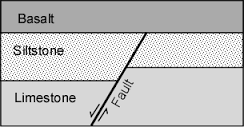
Look at the image. Which of the following statements is true?
Limestone is younger than siltstone but older than basalt.
Basalt is older than siltstone but younger than the fault.
Limestone is the youngest layer.
The fault is younger than siltstone but older than basalt.

The image on the left follows the Law of Superposition. The image on the right shows tilting that occurred after the layers were deposited. Which is the oldest layer in the image on the right (the tilted layers)?
Layer A
Layer B
Layer C
Alfred Wegener found fossils of now-extinct tropical plants that require a lot of moisture in Antarctica. How did the plants become extinct?
The plant has always been in the south pole region, but temperatures dropped dramatically and the plant could not adapt.
Tectonic plates shifted from warmer climates near the equator to the much colder area of the Earth over a long period of time.
Animals in Antarctica ate the plant to extinction.
The climate changed.
The Law of Superposition states _______________________________.
In all rock layers, the oldest layer is at the bottom and each upper layer is younger.
Old rocks are at the bottom.
In undisturbed horizontal rock layers, the oldest layer is at the bottom and each upper layer is younger.
Index fossils help us understand the relative age of rocks.
The Law of Superposition ____________________.
is an observable fact about undisturbed rock layers.
explains the sequence of disturbed rock layers.
is a study of past events about disturbed rock layers.
is a theory that will likely change if new discoveries are made.
How could you find out what kind of environment a place had by looking at the layers of rock?
Measuring the thickness of the layer
Looking for fossils in the layer
Observing the pigment (color) of that specific rock layer
Smelling the rock layer
What are the three methods that best help determine the age of rock layers?
Radiometric dating, index fossils, seismic waves
Radiometric dating, relative dating, seismic waves
Radiometric dating, relative dating, index fossils
Index fossils, relative dating, seismic waves

What is the absolute age of a rock?
The age determined by the things around it.
The age of an igneous rock.
The age determined by radioactive dating.
The time it takes for half of the radioactive atoms in an element to decay.
What is the relative age of a rock?
The age determined by the things surrounding it.
The age of an igneous rock.
The age determined by radioactive dating.
The time it takes for half of the radioactive atoms in an element to decay.
Which of the following is LEAST likely to help you determine the age of sedimentary rocks?
Analyze seismic data to determine when radioactive isotopes decay into stable isotopes.
Look for index fossils in the rock layers.
Apply absolute dating methods to determine the amount of radioactive isotope decay that can be found within sedimentary rocks.
Which of the following is an example of absolute dating?
A rock layer is 23,000 years old because the Law of Superposition says so.
The top rock layer is the youngest layer.
A rock layer is between 23,000 and 30,000 years old.
A rock layer has fossils, but the layers above and below do not have fossils.
Review of the previous unit: How are mountains formed?
Subduction
Convergent boundaries
Divergent boundaries
Transform boundaries

Which of the following statements is true?
The bottom image shows that Layer E remains the oldest layer.
The bottom image shows that Layer X is the youngest layer.
The bottom image shows that Layers A to E are in the same order as in the first image, but some folds and erosions (unconformities) have occurred.
The bottom image shows that Layer E is the youngest layer.

