Wayground logo

Free Printable Worksheets

Font size

S
M
L
XL
Worksheets

Earth Moon and Sun REVIEW

Total questions: 40

Worksheet time: 48mins

Name
Class
Date
1.

The Earth is tilted a_______________ degrees on it's axis.

a)

22.5

b)

23.5

c)

21.5

d)

23

2.

How long does it take the Earth to rotate on it's axis once?

a)

One week

b)

24 hours

c)

One year

d)

365 days

3.

Light is responsible for our seasons. Which option best explains why light gives us seasons.

a)

When we are close to the sun we have summer.

b)

When we are far from the sun we have winter.

c)

Light rays bounce off the Earth and get trapped in the atmosphere making it summer.

d)

The angle of the sun produces more or less intense light which give us seasons.

4.

How long does it take the Earth to orbit the Sun once?

a)

One month

b)

One week

c)

One year

d)

One day

5.

This model shows the arrangement of the Earth and Sun producing which season in North America?

a)

Fall

b)

Winter

c)

Summer

d)

Mud

6.

Which image of light rays (a or b) would produce more heat resulting in summer?

a)

Neither

b)

b

c)

a

d)

both a and b

7.

When does the degree tilt of the Earth change?

a)

Once a month.

b)

Once each year.

c)

Once every full moon.

d)

Never

8.

If our distance from the Sun was the true reason for the seasons, which of the following would also be true (but is not!).

a)

The entire Earth would experience the same season at the same time.

b)

We would never have night.

c)

There would be no moon phases.

d)

Our moon would not orbit us.

9.
Which season is taking place in the Southern Hemisphere in Position 1?
a)
Winter
b)
Spring
c)
Summer
d)
Fall
10.
Which season is taking place in the Northern Hemisphere in Position 2?
a)
Winter
b)
Spring
c)
Summer
d)
Fall
11.
In winter, the axis of the earth is pointed away or toward the sun?
a)
towards
b)
up
c)
down
d)
away
12.
In summer, the axis of the earth is pointed away or toward the sun?
a)
towards
b)
up
c)
down
d)
away
13.
What type of tides would this arrangement of earth-moon-sun create?
a)
neap tide
b)
spring tide
c)
new moon tide
d)
full moon tide
14.
Wha type of tide would this arrangement of earth-moon-sun create?
a)
full moon tide
b)
new moon tide
c)
neap tide
d)
spring tide
15.
Which phase of the moon is represented in this diagram?
a)
new moon
b)
first quarter
c)
full moon
d)
last quarter/third quarter
16.
What causes tides?
a)
gravity
b)
wind
c)
spring
d)
neap
17.
What type of tide will occur at 9:30 a.m.?
a)
low 
b)
high 
c)
none
d)
high and low
18.
Why does the moon's gravitational pull have more of effect on tides than the sun's gravitational pull?
a)
they are the same
b)
the moon is larger than the sun
c)
tides are not caused by the moon
d)
the moon is closer to the Earth than the sun
19.
The bulge of water on the side of the Earth closest to the moon produces ___________.
a)
high tide
b)
low tide
c)
neap tide
d)
spring tide
20.

A neap tide occurs during which two lunar phases?

a)

Full Mooon and New Moon

b)

Waxing Crescent and Waning Crescent

c)

Waxing Gibbous and Waning Gibbous

d)

1st Quarter and 3rd Quarter

21.

A spring tide occurs during which two lunar phases?

a)

New Moon and Full Moon

b)

Waxing Crescent and Waning Crescent

c)

Waxing Gibbous and Waning Gibbous

d)

1st Quarter and 3rd Quarter

22.

Which moon phase is this?

a)

Waning Crescent

b)

Waxing Crescent

c)

Waning Gibbous

d)

Waxing Gibbous

23.

Which moon phase is this?

a)

3rd Quarter

b)

1st Quarter

c)

Waning Gibbous

d)

Waxing Gibbous

24.

Which moon phase is this?

a)

3rd Quarter

b)

1st Quarter

c)

Waning Gibbous

d)

Waxing Gibbous

25.

Which moon phase is this?

a)

3rd Quarter

b)

1st Quarter

c)

Waning Gibbous

d)

Full Moon

26.

Which moon phase is this?

a)

3rd Quarter

b)

1st Quarter

c)

Waning Gibbous

d)

Full Moon

27.

Which moon Phase is #1?

a)

Full moon

b)

New Moon

c)

Waning Gibbous

d)

Waxing Gibbous

28.

Which moon Phase is #6

a)

Full moon

b)

New Moon

c)

Waning Gibbous

d)

Waxing Gibbous

29.

Which moon Phase is #8?

a)

Waxing Crescent

b)

Waning Crescent

c)

New Moon

d)

3rd Quarter

30.

Which moon Phase is #4?

a)

Waxing Crescent

b)

Waning Crescent

c)

Waxing Gibbous

d)

Waning Gibbous

31.

If today is the 20th of December, and the moon phase is a 1st Quarter moon, what would be the moon phase on the 24th of December?

a)

b)

c)

d)

32.
A solar eclipse only occurs during which moon phase?
a)
1st Quarter
b)
New Moon
c)
Full Moon
d)
3rd Quarter
33.
Which is NOT a reason why lunar eclipses are more commonly seen than solar eclipses.
a)
The Earth's shadow is larger on the moon that the moon is on Earth.
Lunar eclipses last for a longer period of time.
b)
The Earth's shadow is larger on the moon that the moon is on Earth.
c)
Solar eclipses are only visible in a small strip of degrees latitude.
d)
The Earth's orbit and the moon's orbit is the same.
34.
Why does a lunar eclipse have to occur in this moon phase?
a)
This phase shows how the Earth can block the sunlight to the moon.
b)
This phase allows Earth to block the moon from the sun.
c)
This phase allows for the moon to block the sun’s light to the Earth.
d)
This phase shows how the sun can block the moon from Earth.
35.
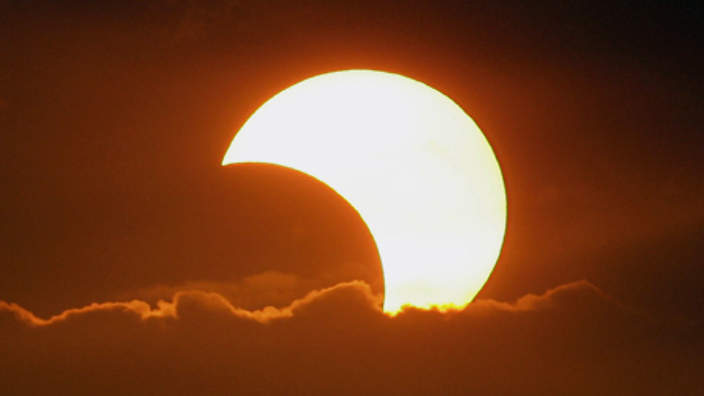
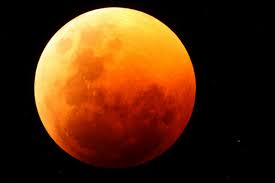
This image is an example of
a)
Lunar Eclipse
b)
Full Moon
c)
New Moon
d)
Solar Eclipse
36.
This image is an example of 
a)
Lunar Eclipse
b)
New Moon
c)
Solar Eclipse
d)
Full Moon
37.
Why isn't there an eclipse every month?
a)
Because the moon orbits the sun differently than Earth does.
b)
Because the Earth's orbit and the moon's orbit are at the same angle, flat plane.
c)
Because the moon's orbit is offset from Earth's orbit by 1.5°, not in a flat plane.
d)
Because the lunar cycle is longer than a month.
38.

This model is showing us a...

a)

lunar eclipse

b)

solar eclipse

c)

phases of the moon

d)

earth eclipse

39.

This image is showing us a.....

a)

solar eclipse

b)

lunar eclipse

c)

phases of the moon

d)

earth eclipse

40.
What type of eclipse is this?
a)
Total lunar eclipse
b)
Total solar eclipse
c)
Partial lunar eclipse
d)
Partial solar eclipse