
 Worksheets
Prove Triangle Congruent
Total questions: 40
Worksheet time: 1hrs 4mins
Name
Class
Date
1.
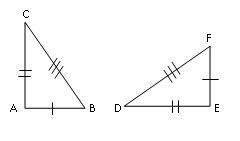
Name the postulate, if possible, that makes the triangles congruent.
a)
SSS
b)
SAS
c)
ASA
d)
Not Possible
2.
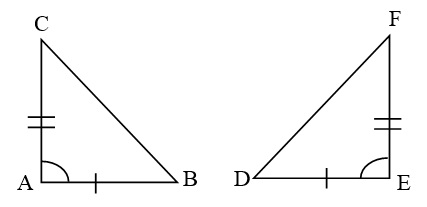
Name the postulate, if possible, that makes the triangles congruent.
a)
SSS
b)
SAS
c)
ASA
d)
AAS
3.
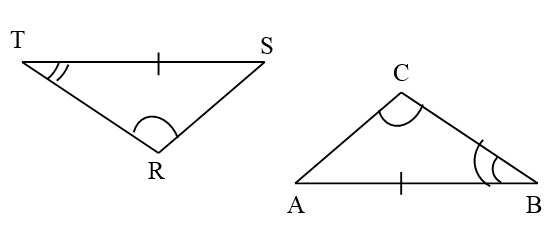
Name the postulate, if possible, that makes the triangles congruent.
a)
SAS
b)
ASA
c)
AAS
d)
Not Possible
4.

Name the postulate, if possible, that makes the triangles congruent.
a)
SAS
b)
ASA
c)
AAS
d)
Not Possible
5.
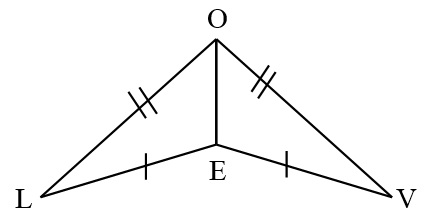
Name the postulate, if possible, that makes the triangles congruent.
a)
SSS
b)
SAS
c)
ASA
d)
Not Possible
6.
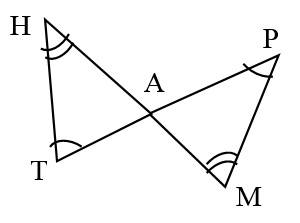
Name the postulate, if possible, that makes the triangles congruent.
a)
SSS
b)
ASA
c)
AAS
d)
Not Possible
7.

Name the postulate, if possible, that makes the triangles congruent.
a)
SAS
b)
ASA
c)
AAS
d)
Not Possible
8.

Name the postulate, if possible, that makes the triangles congruent.
a)
SSS
b)
SAS
c)
ASA
d)
AAS
9.

Name the postulate, if possible, that makes the triangles congruent.
a)
SAS
b)
ASA
c)
AAS
d)
Not Possible
10.

Name the postulate, if possible, that makes the triangles congruent.
a)
SSS
b)
SAS
c)
ASA
d)
Not Possible
11.

Name the postulate, if possible, that makes the triangles congruent.
a)
SSS
b)
SAS
c)
ASA
d)
AAS
12.

What is the correct congruence statement? ΔDEC ≅________
a)
ΔAEB
b)
ΔEAB
c)
ΔBEA
d)
Not Congruent
13.
Which of the following is not a valid reason to prove congruent triangles?
a)
SSA
b)
ASA
c)
SAS
d)
SSS
14.

a)
A
b)
B
c)
C
d)
D
15.
∆ABC≅∆XYZ
which is true?
which is true?
a)
AB≅XY
b)
AB≅YX
c)
AB≅XZ
d)
BC≅CB
16.

∆PRQ≅∆SRT
a)
TRUE
b)
FALSE
17.
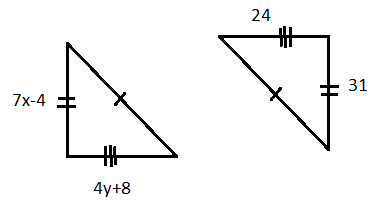
Solve for x
a)
5
b)
4
c)
3
d)
2
18.
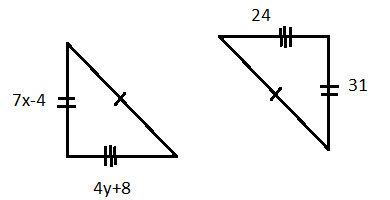
Solve for y
a)
2
b)
3
c)
4
d)
5
19.
Figures that have the same _____ and size are congruent triangles.
a)
corresponding
b)
corners
c)
angles
d)
shape
20.

Solve for x
a)
30
b)
40
c)
50
d)
60
21.
All of the following prove triangles congruent except
a)
ASA
b)
SSS
c)
AAA
d)
SAS
22.
When does one use CPCTC?
a)
Before triangles are congruent
b)
After triangles are congruent
c)
Whenever one wants, there are no restrictions
d)
There is no such thing as CPCTC
23.

a)
A
b)
B
c)
C
d)
D
24.

a)
A
b)
B
c)
C
d)
D
25.

a)
A
b)
B
c)
C
d)
D
26.

a)
A
b)
B
c)
C
d)
D
27.

What is the "statement" for step 2 of the proof?
a)
AD=AD
b)
AD=DA
c)
HD=DN
d)
HD=ND
28.

What is the "statement" for step 3 of the proof?
a)
AH=AN
b)
AD=AD
c)
HD=ND
d)
HD=DN
29.

What is the "statement" for step 3 of the proof?
a)
HA=HA
b)
Tacos
c)
MA=AM
d)
MA=MA
30.

What is the "reason" for step 2 of the proof?
a)
reflexive property
b)
proof
c)
SAS
≅ thrm
≅ thrm
d)
given
31.

What is the "reason" for step 2 of the proof?
a)
reflexive property
b)
proof
c)
SAS
≅ thrm
≅ thrm
d)
given
32.

What is the "reason" for step 4 of the proof?
a)
AAS
b)
ASA
c)
SAS
d)
SSS
33.

What is the "reason" for step 3 of the proof?
a)
Vertical Angle Theorem
b)
given
c)
reflexive property
d)
proof
34.

If the "statement" for step 3 is ∡HJI≅∡KJL of the proof, what is the "reason"?
a)
Vertical Angles
b)
Reflexive Property
c)
Alternate Interior Angles
d)
Given
35.

If the "reason" for step 4?
a)
Vertical Angles
b)
Reflexive Property
c)
Alternate Interior Angles
d)
Given
36.

a)
Transitive Property, SAS(Side-Angle-Side)
b)
Reflexive Property, SAS(Side-Angle-Side)
c)
Transitive Property, SSS(Side-Side-Side)
d)
Reflexive Property, SSS(Side-Side-Side)
37.

What is the "statement" for step 4 of the proof?
a)
∡MAH≅∡THA
b)
∆MHA≅∆THA
c)
HM=AT
d)
∆MAH≅∆THA
38.

Identify the missing statement or reason
a)
Reflexive Property
b)
Definition of Midpoint
c)
Given
d)
Vertical Angles Theorem
39.

What statement follows logically from knowing that "segment JK bisects <NJP"?
a)
Segment NJ congruent to segment PJ
b)
<NKJ congruent to <PKJ
c)
<NJK congruent to <PJK
d)
Segment JK congruent to segment JK
40.

In a proof that these two triangles are congruent, Ryan stated <FAE is congruent to <XUE. What was his reason?
a)
If two parallel lines are crossed by a transversal, then alternate interior angles are congruent.
b)
If two parallel lines are crossed by a transversal, then corresponding angles are congruent.
c)
Vertical angles are congruent.
d)
defintion of bisects
100 %

