
NEW
Font size
 Worksheets
Q3 SW#5 Determining Ages of Rocks 5P
Total questions: 25
Worksheet time: 11mins

What is the Law of Superposition?
The principle that in undisturbed horizontal sedimentary rock layers, the oldest layer is at the bottom and the youngest layer is at the top.
The principle that the youngest rock layers are always on the bottom.
The principle that all rock layers are the same age.

Which type of fossil is used to determine the relative ages of rock layers?
Trace fossils
Index fossils
Petrified fossils

Explain how geologists use the position of rock layers to determine their relative age.
By measuring the thickness of each layer.
By analyzing the color of the rock layers.
By using the law of superposition to determine that the oldest layers are at the bottom and the youngest are at the top.

What is radioactive decay?
The process by which rocks are broken down by weathering.
The process by which unstable atomic nuclei lose energy by emitting radiation and changing into another atom.
The process by which sedimentary rocks are formed.

Describe how geologists use radioactive dating to determine the absolute age of rocks.
By comparing the amount of a radioactive element in a rock sample with the amount of the stable element into which it decays, using the element's half-life.
By measuring the thickness of the rock layers.
By identifying the types of fossils found in the rock.

What is an unconformity in the geologic record?
A continuous sequence of rock layers.
A gap in the geologic record where rock layers have been lost due to erosion.
A fold in the rock layers.

How do geologists use index fossils to match rock layers?
By comparing the color of the rock layers.
By identifying the presence of the same index fossils in different rock layers, indicating they are the same age.
By measuring the thickness of the rock layers.

What is the half-life of a radioactive element?
The time it takes for half of the radioactive atoms to decay.
The time it takes for a rock layer to form.
The time it takes for a fossil to form.

Why can't carbon-14 dating be used to date rocks older than about 50,000 years?
Because carbon-14 is not found in rocks.
Because the amount of carbon-14 left would be too small to measure accurately.
Because carbon-14 decays too quickly.

What is the significance of an igneous intrusion in determining the relative age of rock layers?
It is older than the rock layers it cuts through.
It is younger than the rock layers it cuts through.
It is the same age as the rock layers it cuts through.

How do geologists determine the relative age of a fault?
By measuring the length of the fault.
By finding the relative age of the youngest layer cut by the fault.
By comparing the fault to nearby rock layers.

What is the role of fossils in understanding Earth's history?
They provide evidence of the types of minerals present in ancient rocks.
They provide physical evidence about the history of life on Earth and how Earth has changed over time.
They are used to measure the thickness of rock layers.

What is the difference between relative age and absolute age of rocks?
Relative age is its age compared to other rocks, while absolute age is the exact number of years since the rock formed.
Relative age is determined by radioactive dating, while absolute age is determined by the position of rock layers.
Relative age is determined by the color of the rock, while absolute age is determined by fossils.

How can folding affect the position of rock layers?
Folding can cause the youngest rock layers to be on the bottom.
Folding has no effect on the position of rock layers.
Folding can cause the rock layers to become thicker.

near the bottom of the rock layers.
in the middle of the rock layers.
somewhat near the surface.

If you found an index fossil in a layer of rock in Montana and a similar fossil in a layer of rock in Texas, you would know
the fossils and rock layers are the same age.
the fossils from Montana are older.
the absolute age of the fossil.

Which of the following offers a possible list of the layers in order from oldest to youngest?
E, C, B, D, A
E, D, C, B, A
C, B, A, D, E

A, B, C, D, E
B, C, D, A, E
B, C, D, E, A

Which is an example of absolute age?
"This trilobite is older than that dinosaur."
"That stromatolite is the absolute oldest fossil I've ever seen."
"Velociraptors lived 71-75 million years ago."
Maria is older than her brother but younger than her sister is an example of ________ age.
relative
absolute
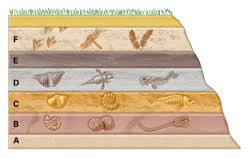
Which rock layer in the diagram seems to be the oldest?

The rock formation labeled "P" is a (an) _______.

Letter "F" is a (an) _______.

Which rock layer or intrusion is the youngest?


