
 Worksheets
Theatre Design Elements Quiz
Total questions: 58
Worksheet time: 29mins
What are the major design elements of theatre that students need to identify?
Music and Dance
Props, Costumes, Lighting, Sound, Scenery, Make-up, Publicity
Script and Dialogue
Audience and Stage
How should students explain the design elements in a production?
By memorizing scripts
By explaining how they work together
By focusing on the audience
By ignoring the technical aspects
What hands-on work should students do in tech theatre?
Directing actors
Designing for different areas like props, costumes, and lighting
Writing scripts
Performing on stage
What should students understand about the production team?
Their favorite movies
The responsibilities and function of the team
The history of theatre
The audience's preferences
What are the major technical components of a production of a play?
Lighting, Sound, Set Design, Costumes
Music, Dance, Script, Audience
Director, Producer, Actor, Script
Camera, Editing, Script, Audience
Why is it important to understand all aspects of technical theatre, regardless of your role in a production?
To ensure a cohesive production
To impress the audience
To reduce production costs
To increase ticket sales
What is the role of a Designer in a production?
A person who manages the budget
A person who creates or plans a specific part of the production, such as costumes, lighting, set, make-up, or sound
A person who directs the actors
A person who writes the script
Who is responsible for creating the scenery and props in a production?
Director
Producer
Crew
Audience
What do Technical Rehearsals emphasize in a production?
The storyline and dialogue
The performance of the production’s technical elements
The marketing and promotion
The casting of actors
What are Props in a stage production?
The script of the play
The costumes worn by actors
Stage properties or items that might be part of the stage decorations
The lighting equipment
Who is the Property Master in a production?
The person in charge of the props for a production
The person who designs the costumes
The person who directs the play
The person who manages the lighting
What is the definition of "Scenery" in a theatrical context?
A) A rough sketch
B) Curtains, backdrops, or structures for a play's background
C) Special sounds from pre-recorded sources
D) The dialogue or signals for actors
What does "Rendering" refer to in the context of stage design?
A) A person who plans lighting
B) A floorplan of the set
C) A rough sketch
D) Special sounds for a play
What are "Sound Effects" in a stage production?
A) Dialogue for actors
B) A rough sketch
C) Special sounds from pre-recorded sources
D) A floorplan of the set
What is a "Cue" in theater terminology?
A) A rough sketch
B) The dialogue, sounds, or signals for actors
C) A person who plans lighting
D) Curtains and backdrops
Who is a "Lighting Designer" in a stage production?
A) A person who plans and implements lighting
B) A rough sketch artist
C) A sound technician
D) A stage manager
What is a "Lighting Plot" in stage design?
A) A rough sketch
B) A list of sound effects
C) A floorplan showing lighting placement
D) A dialogue script
What is the purpose of stage makeup in a production?
To enhance or change an actor's appearance
To list all characters and scenes
To manage the box office
To organize advertising
What does a costume plot include?
A list of all characters and scenes with garments needed
A committee for advertising
A group for managing the audience
A collection of stage makeup
Who is responsible for organizing and implementing advertising for a production?
Publicity Crew
House Crew
Costume Plot
Stage Makeup
What is the role of the house crew in a production?
Managing the box office and audience
Enhancing an actor's appearance
Listing characters and scenes
Organizing advertising
What is one of the tasks that must be done behind the scenes for a show?
Writing the script
Building sets
Casting actors
Designing the poster
Which of the following is NOT mentioned as a task for the support team in staging a show?
Hanging lights
Selecting music
Directing actors
Planning makeup
Why is a support team necessary for staging a show?
To write the script
To perform on stage
To handle various tasks in a short time
To sell tickets
What are props used for in a play?
To enhance characterization and aid the actor in stage business
To distract the audience from the main action
To replace the actors on stage
To serve as the main dialogue in the play
Which of the following best describes props?
Items used by the actors for stage business and characterization
The main script of the play
The lighting equipment used on stage
The costumes worn by the actors
What are hand props?
Large items like chairs and tables
Small items necessary to the play's action that can be carried by the actor
Props that serve to decorate the set
Items like pictures and lamps
Which of the following is an example of a stage prop?
Book
Letter
Bench
Clock
What is the purpose of trim props?
To be carried by the actor
To serve as large props on stage
To decorate the set
To be used as hand props
Which item is NOT typically considered a hand prop?
Book
Letter
Chair
Flower

What are literal props in a script?
Props that are stated in the script, usually in the stage directions.
Props that are not stated in the script, but assumed.
Props that are only used in rehearsals.
Props that are mentioned in the dialogue.

What are implied props in a script?
Props that are stated in the script, usually in the stage directions.
Props that are not stated in the script, but assumed.
Props that are only used in rehearsals.
Props that are mentioned in the dialogue.
What is the title given to the crewhead or designer in a show?
Stage Manager
Properties Master/Mistress
Lighting Director
Costume Designer
What is one of the responsibilities of the Properties Master/Mistress?
Directing the actors
Designing the costumes
Gathering all the props for the show
Managing the lighting
What is the first step the Properties Master/Mistress takes in their role?
Designing the set
Reading the script and highlighting all the props needed
Organizing rehearsals
Creating a lighting plan
After identifying the props needed, what does the Properties Master/Mistress do next?
Makes a prop list
Starts rehearsals
Designs the costumes
Directs the actors
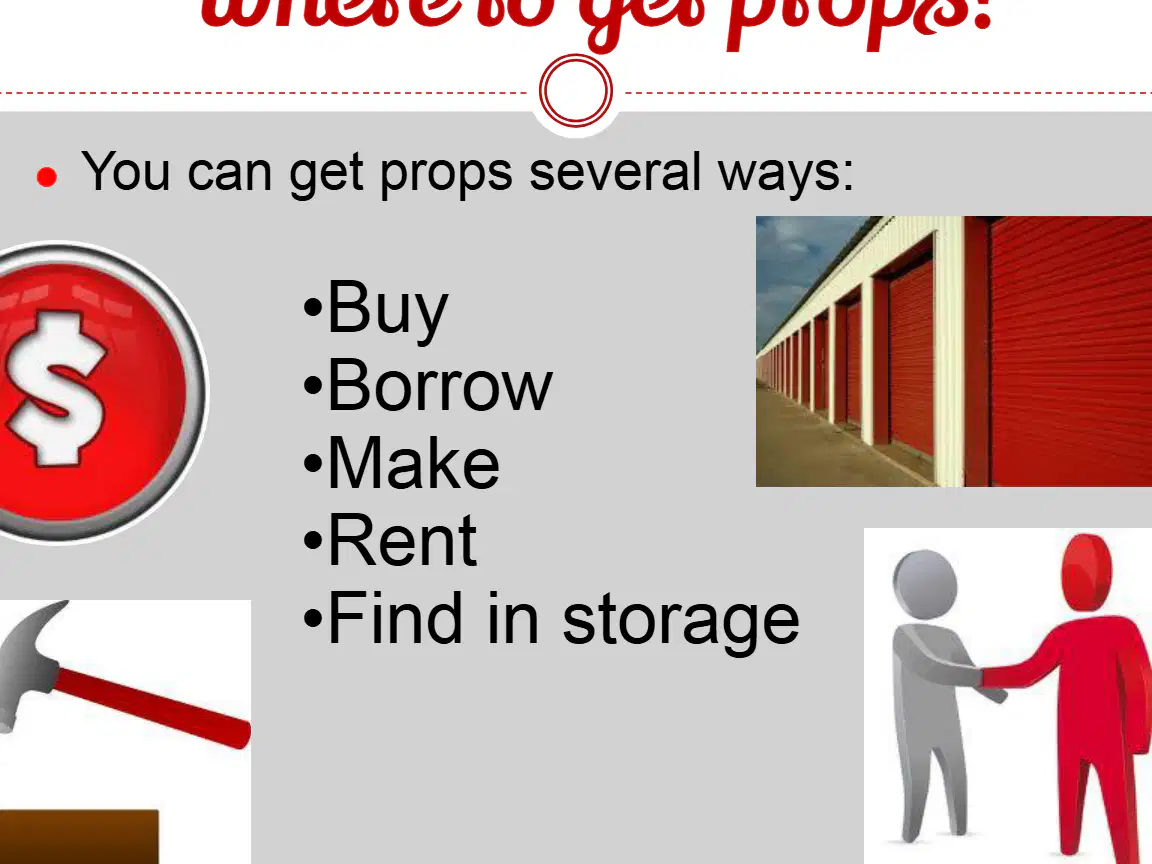
Which of the following is NOT a way to get props according to the image?
Buy
Borrow
Steal
Rent

What is one way to acquire props mentioned in the image?
Make
Ignore
Destroy
Hide
What is the purpose of scenery in a play?
To provide lighting for the actors
To transform an empty stage into a suitable background for the play
To serve as a script for the actors
To entertain the audience with music
What factors influence the design of scenery in a play?
The color of the costumes
The play's requirements, theatre facilities, budget, time, and crew's capabilities
The number of actors
The length of the play
Why is scenery important in a play?
To create a setting and show where and when the play takes place.
To provide costumes for the actors.
To serve as a backdrop for advertisements.
To ensure the play is performed outdoors.
What is one of the purposes of defining the acting area with scenery?
To give actors places for entrances and exits and movement.
To hide the audience from the actors.
To make the stage look larger.
To reduce the number of actors needed.
How does scenery contribute to the mood or atmosphere of a play?
It makes a statement about the theme.
It changes the lighting of the stage.
It controls the volume of the actors' voices.
It determines the length of the play.
Who is responsible for designing a floor plan for each scene?
The director, technical director, or scenic designer
The actors
The costume designer
The lighting technician
What is created from the floor plan?
A scenic design
A costume sketch
A lighting plan
A sound design
What is the purpose of building a model set?
To show a 3-D example of what the set will look like
To test lighting effects
To rehearse actor movements
To design costumes
What happens after plans are developed?
Construction begins
Rehearsals start
Costumes are designed
Lighting is installed
What is a rendering in the context of stage design?
A detailed blueprint
A rough sketch
A 3D model
A color palette
What does a floor plan represent in stage design?
A side view of the set
A front view of the set
A drawing of the stage setting as seen from above
A detailed list of materials
What is an elevation view in stage design?
A top-down view of the set
A side view of the set
A front view of the set
A 3D rendering of the set
What does a section view show in stage design?
A bird's eye view of the set
A side view of the set
A front view of the set
A detailed color scheme
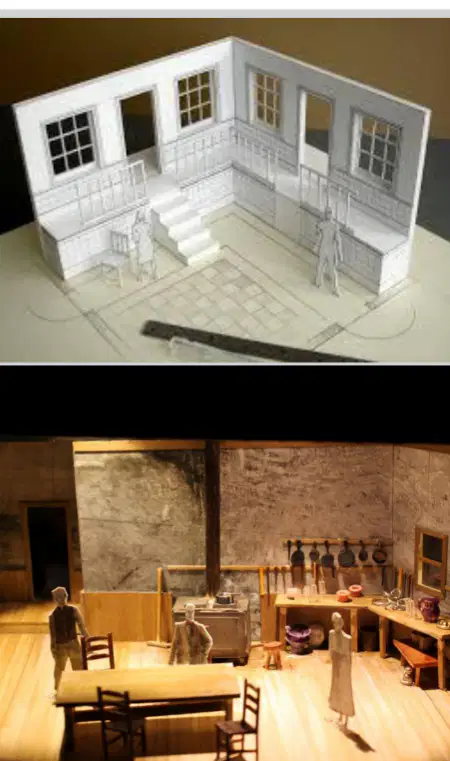
What is a model set typically made of?
Metal
Paper/cardboard or wood
Plastic
Glass
What does it mean when a set is in "SCALE"?
It is made of metal
It is painted
It is proportionate to size
It is colorless
What is a "white model" in the context of model sets?
A painted model of the set
A colorless model of the set
A model made of metal
A miniature model of a plane
What is the final model of a set?
A model made of glass
A colorless model of the set
A painted model of the set
A model made of metal
What is the purpose of large backdrops in scenery?
To provide lighting
To create sound effects
To look like a scene
To serve as costumes
Which of the following is an example of a production that uses large backdrops?
The Lion King
Guys and Dolls
Les Misérables
Phantom of the Opera
Where are set pieces placed in relation to the backdrop?
Behind the backdrop
Above the backdrop
In front of the backdrop
Below the backdrop

