wayground logo

Free Printable Worksheets

NEW

Font size

S
M
L
XL
Worksheets

Nuclear Chemistry Review

Total questions: 40

Worksheet time: 1hrs 27mins

Name
Class
Date
1.

_______is the splitting of atomic nuclei

a)

Fission

b)

nuclear reaction

c)

Fusion

d)

bayler reaction

2.

_____is the joining of atomic nuclei

a)

Fusion

b)

chain reaction

c)

Photosynthesis

d)

Fission

3.
What is a chain reaction?
a)
When electrons are emitted causing electricity
b)
When a nuclear fission reaction occurs, the protons emitted can strike other nuclei in the sample, and cause them to split
c)
When a nuclear fission reaction occurs, the neutrons emitted can strike other nuclei in the sample, and cause them to split
d)
When a nuclear fission reaction occurs, the electrons emitted can strike other nuclei in the sample, and cause them to split
4.

How is the alpha particle written in a nuclear equation?

a)

42He

b)

24He

c)

0-1e

d)

00γ

5.
Which type of nuclear radiation is being emitted here?
a)
Alpha
b)
beta
c)
gamma 
d)
none
6.
Solve this equation for alpha decay.
85209At = ___ + 24He
a)
83205Bi
b)
86209Rn
c)
81207Tl
d)
85208At
7.

Gamma rays have

a)

no mass

b)

a huge mass

c)

a small mass

d)

an average mass

8.
Solve this equation for beta decay.
614C = ___ + -10e
a)
410Be
b)
714N
c)
210He
d)
613C
9.
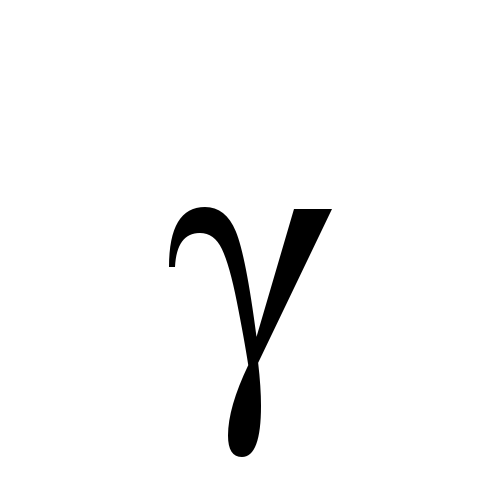
Has the symbol
a)
Alpha
b)
Beta 
c)
Gamma
10.

Has the lowest penetrating power.  Can only penetrate 0.05 mm into the body and can be stopped by the skin.

a)
Alpha
b)
Beta
c)
Gamma
d)

Electron capture

11.
Has the highest penetrating power.  Can penetrate our body.  Even several cm thick of lead or several meters thick of concrete cannot stop all of it.
a)
Alpha
b)
Beta
c)
Gamma
12.
Uranium-238  decays into  Thorium-234  by emitting .........
a)
an alpha particle
b)
a beta particle
c)
gamma rays
d)
visible light
13.
Radioactive materials have unstable...
a)
electrons
b)
protons
c)
nuclei
d)
neutrons
14.
In a correctly written symbol what would be located in the "A" position?
a)
number of neutrons
b)
atomic number
c)
number of electrons 
d)
mass number
15.
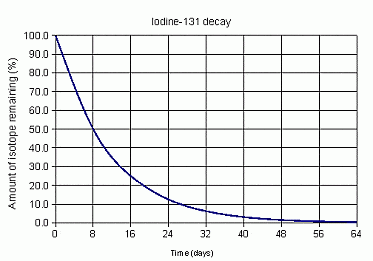
What is the half-life of iodine-131?
a)
32 days
b)
8 days
c)
16 days
d)
24 days
16.

The % of the parent isotope remaining after 2 Half Lives.

a)

50%

b)

25%

c)

12.5%

d)

6.25%

17.
What is Half-life?
a)
The amount of time it takes for some of the nuclei in a sample of the isotope to decay
b)
The amount of time it takes for half the electrons in a sample of the isotope to decay
c)
The amount of time it takes for half the nuclei in a sample of the isotope to decay
d)
the amount of time it takes to double the nuclei in a sample of the isotope to decay
18.

A beta particle is also called _____.

a)

an isotope

b)

a mass number

c)

an electron

d)

a fusion

19.

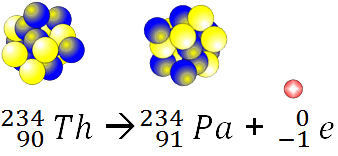
Which nuclear process if shown in the picture?

a)

alpha decay

b)

beta decay

c)

fusion

d)

fission

20.

high-energy photons emitted by a radioisotope

a)

positron

b)

radioactivity

c)

alpha particle

d)

gamma radiation

e)

beta particle

21.

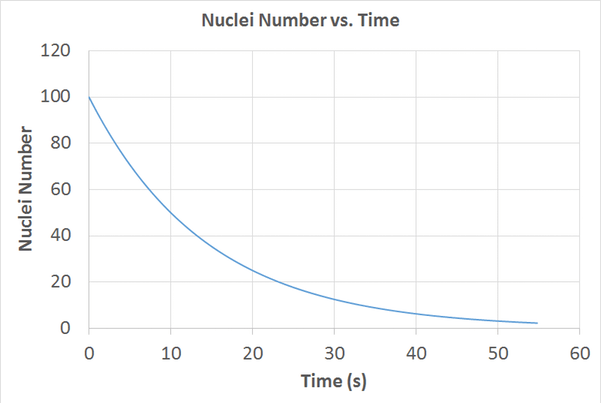
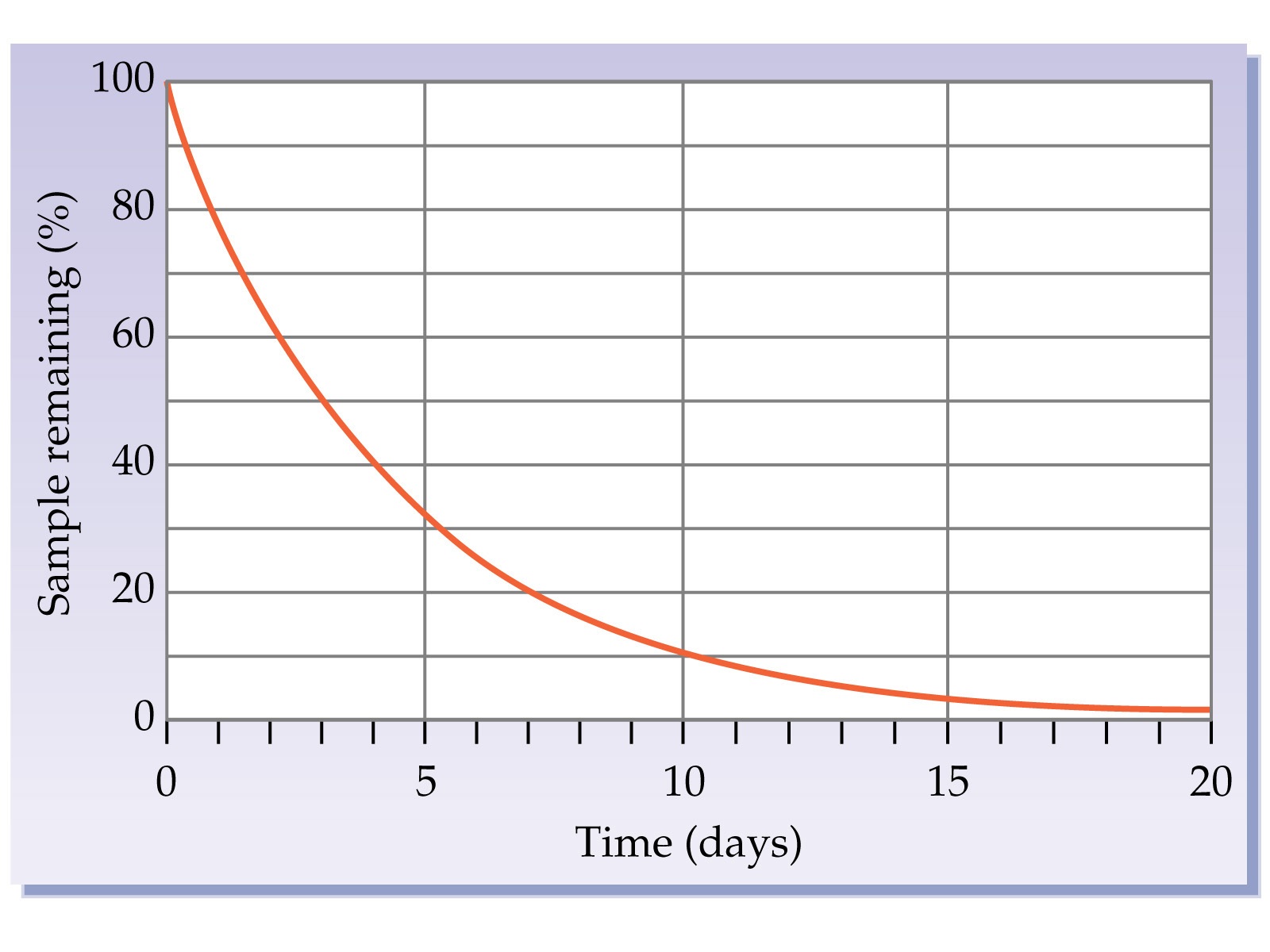
What is the Half life of this isotope?

a)

5 seconds

b)

10 seconds

c)

15 seconds

d)

20 seconds

22.

What is the Half Life of this isotope?

a)

3 days

b)

5 days

c)

8 days

d)

10 days

23.

What mineral is used to create Nuclear Power?

a)

Uranium

b)

Cobalt

c)

Iron

d)

Gold

24.

What do Nuclear Power plants Produce?

a)

Tesla cars

b)

Electricity

c)

Water

d)

Carbon dioxide

25.

What is radioactivity?

a)

An unstable atom releases energy to become stable

b)

A stable atom gains energy and becomes unstable

c)

When a bomb goes off.

d)

Negatively charged particles are emitted from the nucleus
26.

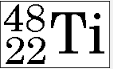
How many neutrons does this isotope of titanium have?

a)

48

b)

22

c)

26

d)

70

27.

What do these symbols represent?

a)

alpha particle

b)

beta particle

c)

gamma ray

d)

neutron

28.

What is the symbol for a gamma ray?

a)
b)
c)
d)
29.

How many protons are in the nucleus of the element shown?

a)

19

b)

9

c)

10

d)

28

30.

A neutral atom of the isotope 2612Mg would consist of

a)

12 protons, 26 neutrons

b)

26 protons, 12 neutrons

c)

26 protons, 14 neutrons

d)

12 protons, 14 neutrons

31.

How many neutrons does an Oxygen-19 isotope have?

a)

19

b)

8

c)

11

d)

10

32.

Three types of nuclear radiation are _______ radiation, _________radiation, and _____________ radiation.

a)

alpha, beta, and gamma

b)

theta, beta, and kappa

c)

alpha, beta, positron

33.
What happens to the atomic number during alpha decay?
a)
The atomic number decreases by 4
b)
The atomic number increases by 1
c)
The atomic number decreases by 2.
d)
The atomic number stays the same.
34.

In the symbol 167N what the 7 stand for?

a)

Mass number

b)

Atomic number

c)

Atomic mass

d)

Number of neutrons

35.
If we start off with element 24X50 after an alpha decay we get another element Y that looks like
a)
22Y50
b)
22Y46
c)
20Y48
d)
26Y54
36.

Solve the nuclear decay reaction:

a)
b)
c)
d)
37.

The % of the parent isotope remaining after 1 Half Life.

a)

50%

b)

25%

c)

12.5%

d)

6.25%

38.

What is the only difference between two different isotopes of the same element?

a)

Number of neutrons

b)

Number of protons

c)

Number of electrons

d)

Size of atom

39.

Isotopes of an element have a different number of...

a)

Protons

b)

Neutrons

c)

Electrons

d)

Mass

40.

Which subatomic particle is used to identify the atom, as it never changes?

a)

protons

b)

neutrons

c)

electrons